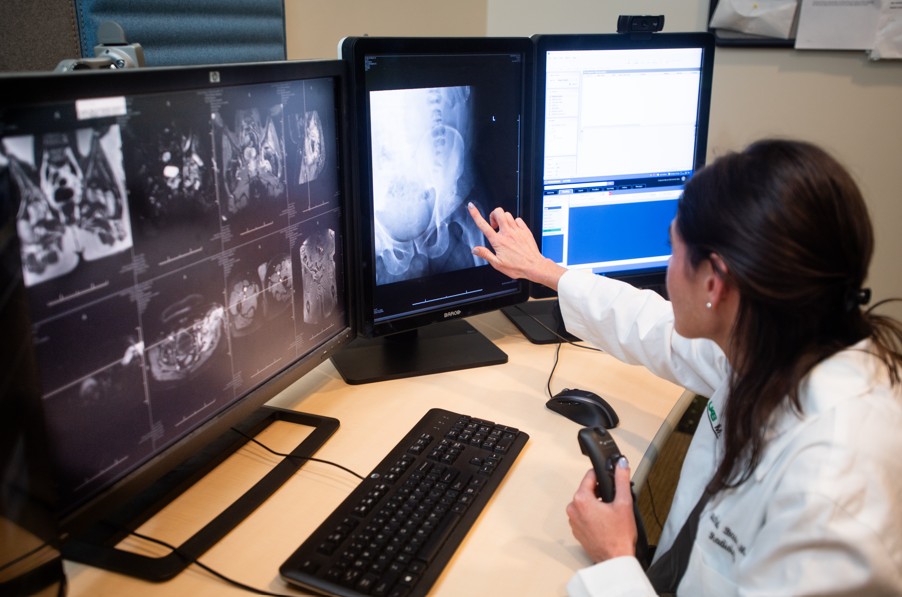
Most patients spend a significant amount of face time talking with their specialist. But in the field of radiology, providers work almost entirely behind the scenes, interpreting medical images to offer diagnoses and recommend treatment plans.
Mahmud Mossa-Basha, M.D., professor and chair, Witten-Stanley Endowed Chair of Radiology, explains the critical role they play in a patient’s diagnosis and treatment.
Behind the scenes
Patients may be familiar with being taken into an imaging room and being positioned by a radiology technologist. But what exactly happens after medical imaging is done?
“The radiologist is responsible for collecting all the information about a patient, including current and prior imaging studies, patient symptoms and presentation, lab results and other diagnostic tests performed,” Mossa-Basha said. “This information is used to guide the team on what is ailing a patient, and what is the next step in diagnosis and/or treatment.”

After images are captured by the technologist, a radiologist then interprets those images to determine a diagnosis and recommend a treatment plan. Specialized image displays and advanced image processing allow radiologists to read and interpret images.
“Radiologists do occasionally interact with patients through communication of important findings on imaging studies, but also through procedures that we do,” Mossa-Basha said. “These include procedures with needles, through arteries and veins, or through injection of radioactive materials under the guidance of imaging.”
Detailed diagnoses and treatment recommendations are sent directly to the specialist who ordered the imaging.
What kind of medical images do radiologists interpret?
Doctors may order imaging for a variety of reasons, from X-rays to detect potential bone fractures to CT scans used in emergencies to quickly detect internal bleeding or other trauma. The most common types of medical imaging include the following:
- Magnetic Resonance Imaging (MRI)
- Computed tomography (CT)
- X-rays
- Ultrasound
- Mammography
- Fluoroscopy
“Radiologists read imaging studies that cover the work of every specialty in medicine and healthcare,” Mossa-Basha said. “Imaging diagnosis has become a central pillar for patient diagnosis and has an expanding role in patient treatment through interventional radiology and nuclear medicine treatment.”
Diagnostic vs. interventional radiology
Diagnostic radiology is used to diagnose the cause of symptoms, monitor how well the body is responding to specific treatments, and screen for potential illnesses, including breast cancer, colon cancer, or heart disease. Contrastingly, interventional radiology uses imaging to guide many types of procedures, including angiography and angioplasty, embolization, port catheter placement, biopsy, draining, and ablation.
In some cases, interventional radiology can be an alternative to larger-scale surgeries that require general anesthesia. Interventional procedures allow for reduced recovery time, many on an outpatient basis, minimal invasion, and reduced potential for complications.
Advancements in imaging technology continue to expand the role of radiology, allowing physicians to diagnose conditions earlier, continuously monitor diseases progression and treatment success, and perform increasingly precise, targeted interventional procedures.
“Interventional radiology procedures and other radiological therapies have continued to increase in scope, application and impact on patient care, proving to be safer and more effective alternatives to treatment of many diseases, including cancers, stroke, trauma, infection, and many other diseases,” Mossa-Basha said. “These applications will continue to grow and the technology will continue to improve, enhancing patient outcomes and recovery.”
Though radiologists work almost entirely behind the scenes, their interpretations guide countless clinical decisions and influence almost every patient’s care journey.