Chandler Annesi, M.D., a research resident in the UAB General Surgery Residency Program working under the supervision of Zain Hashmi, M.D., assistant professor in the Division of Trauma and Acute Care Surgery, has won the American College of Surgeons (ACS) Committee on Trauma Resident Trauma Paper Competition, earning national recognition for her research on pediatric trauma care.
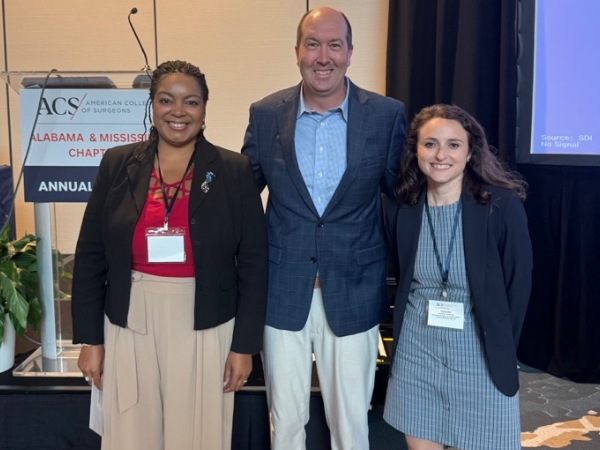 Her study, titled “Reevaluation of Hemodynamic Instability in the Pediatric Trauma Population,” examines how clinicians identify hemorrhagic shock in injured children and challenges traditional physiologic thresholds used in trauma care.
Annesi first presented the research at the Alabama ACS meeting in Gulf Shores in July 2025 and won the ACS Alabama Committee on Trauma Resident and Fellow Trauma Paper Competition. She then advanced to the regional competition in Jefferson, Mississippi, in November, where residents and fellows from across the region presented their work. Among 14 research presentations, the top two were selected to advance, with only the first-place presentation moving on to represent the region at the national competition. Annesi earned first place at the regional meeting, securing a spot at the ACS Committee on Trauma Annual Meeting, held this March in Birmingham, Alabama.
At the national competition, 17 finalists, one from each ACS trauma region across the world presented their research, highlighting some of the most impactful trauma studies conducted by surgical trainees globally. Following the final round of presentations last week, Annesi was named the winner of the ACS Committee on Trauma Resident Trauma Paper Competition for Clinical Sciences.
“Persistence with the data has taught me a lot,” Annesi said. “At the beginning of the project, it wasn’t clear where it was going or whether it would have much of an impact. But as the analysis progressed, I began to understand what the data was trying to teach me and how it could influence care.”
Her research evaluates whether traditional definitions of hemodynamic instability accurately identify pediatric trauma patients at risk for death. Current definitions are based on physiologic norms from healthy pediatric populations rather than children experiencing traumatic injury. Using data from the American College of Surgeons Trauma Quality Improvement Program (TQIP), Annesi and her collaborators analyzed more than 233,000 pediatric trauma cases to determine age-specific physiologic thresholds associated with mortality.
The findings suggest that children who ultimately die after trauma may present with higher systolic blood pressures than the thresholds traditionally taught in clinical practice, meaning some critically injured patients may not initially meet current definitions of instability. The study also found that shock index, the ratio of heart rate to systolic blood pressure performs comparably to traditional measures, suggesting it may serve as a useful tool for identifying high-risk pediatric trauma patients earlier.
“We are extremely proud of Dr. Annesi’s accomplishment for winning this prestigious award,” Hashmi said. “Her work reflects the kind of rigorous, clinically meaningful research we strive for in trauma surgery and challenges long-standing assumptions, with the potential to improve how we identify critically injured pediatric patients.”
A manuscript based on this work is in progress and planned for submission later this month.