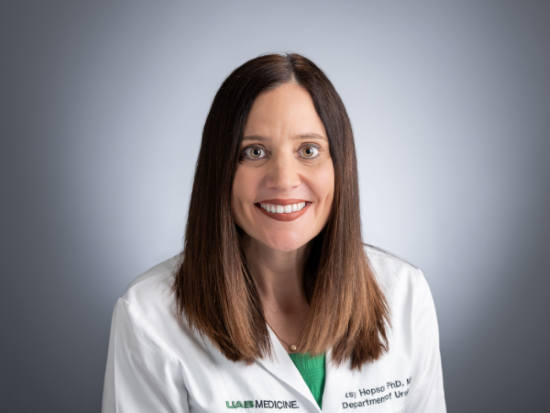
 Betsy Hopson, Ph.D., MSHABetsy Hopson, Ph.D., MSHA, assistant professor in the UAB Department of Urology, director of the Staging Transition for Every Patient (STEP) program at UAB, recently secured two funding sources to address a critical, often-overlooked gap in care for patients with spina bifida involving catheterization education.
Through a national AUA Research Scholar award and a UAB Faculty Development Grant, she is developing a new curriculum called Sexual Abuse Prevention and Family Education for Clean Intermittent Catheterization (SAFE-CIC). The Faculty Development Grant will help fund tools for patients and caregivers, while the AUA award supports complementary work focused on training providers and nurses. Together, the projects are designed to expand catheterization teaching beyond technique to include conversations about safety, boundaries, and body autonomy.
Catheterization is a part of treatment for many patients with spina bifida from a young age, which involves caregivers and others routinely accessing intimate areas of the body. In addition, many patients with spina bifida undergo precocious puberty, which involves early physical development. Those facts lead to a startling and unfortunate reality, Hopson explained.
“If you look in the literature, across all disabilities, they're three times more likely to be sexually abused than their abled-bodied peers, and no one's really studied it to understand causation,” Hopson said.
Hopson said it was patient testimonies that led her to pursue this research herself.
“If I heard a patient or two patients tell me a story, then that kind of led me to think, OK, is there something to that that I should study?” Hopson said. “Every time I would listen and hear a gap, then I would develop a research question around that.”
One of the most concerning gaps became clear as she began working more closely with adults with spina bifida and seeing what life looked like beyond childhood care. What she found was a pattern: that many patients were navigating adulthood without even basic sexual health education. That absence, she said, comes with real risk.
“If they are not getting basic education around this, then they are kind of ripe for vulnerability,” Hopson said, adding that data later confirmed that nearly 40 percent of spina bifida patients had experienced sexual abuse, with women being subjected to abuse at a higher rate than men.
“And then catheter users in women were two times more likely to have been abused than non-catheter users,” Hopson said. “With that combination of data, I felt a real push towards this idea that all catheterization teaching should include teaching around body autonomy and appropriate touch.”
Part of the problem stems from how people with disabilities are often perceived in clinical settings.
“Providers see people with disabilities in general as being asexual,” she said. “During catheterization teaching, we are essentially teaching the individual that it's OK to have their most private regions exposed, but then because they are often seen as asexual, they aren’t receiving any education about appropriate touch.”
When she looked at all these factors together, Hopson said it became clear how they intersect.
“When you combine those two things, I felt like that probably created a perfect storm for abuse,” she said.
Despite how common catheterization is for patients with spina bifida, there is currently no consistent way that best practices for catheterization are taught across the country. Most instruction focuses on the mechanics, including how to perform the procedure and how to become more independent. Conversations about safety and boundaries are largely absent, and that is what Hopson is working to change.
The new SAFE-CIC curriculum weaves sexual abuse prevention and education into catheterization teaching from the start of care. The curriculum will be co-developed with people who have lived experience, including adults with spina bifida and their caregivers.
“It's a plan for me to include both caregivers and adults with spina bifida that can kind of look back on what they wish they had been taught and help develop the curriculum that will be incorporated into catheterization teaching,” Hopson said.
From there, the content will be refined through an iterative process, including feedback from younger patients, before being piloted in clinical settings. The goal is to make sure the material is not only accurate, but useful and relevant at different stages of life.
For patients and families, the curriculum will go beyond step-by-step instruction and include age-appropriate conversations about body autonomy, boundaries, and recognizing appropriate versus inappropriate touch. It will also create space for more open discussions about sexual and reproductive health. At the same time, it is designed to support caregivers, helping them navigate how to talk about these issues in a way that equips patients with confidence.
“I think about this umbrella of sexual and reproductive health in two arms,” Hopson explained. “There’s the awareness and prevention arm where obviously we want to prevent abuse from happening. But almost equally important, the more time I spend with people with spina bifida, I have learned that they want a high quality of life just like the rest of us do. These are individuals that have hopes and dreams and go on to do all sorts of things despite this diagnosis. So, normalizing these conversations and answering their questions and showing them what's possible in life, I think is equally important to preventing the abuse.”
On the provider side, the work focuses on changing how catheterization is taught in practice. Right now, much of that education centers on technique and independence. Hopson’s approach adds another layer, giving nurses and clinicians the tools and language to incorporate safety, consent, and whole-person care into those conversations.
“If we’re going to be the one prescribing this treatment to save their bladder, then we have to look at the whole child and the whole person and everything that that treatment could be bringing into their life,” she said.
The long-term vision is even broader. Because there is currently no standardized way to teach catheterization, this work has the potential to shape a new national model. Once developed and tested, the curriculum could be scaled across different clinics and patient populations, with future studies exploring how it translates across regions and cultures.
At the same time, Hopson is careful about how this work is framed. While the risks she has identified are serious, they don’t define the patients she serves.
“Their condition is hard, but these are the most remarkable people, and everything about the way I live my life has been shaped by their resilience and their joy,” she said.