Two faculty members in the UAB Department of Urology were recently recognized for a patent related to the treatment of primary hyperoxaluria, a rare genetic condition resulting from an excess of oxalate in the urine that can lead to chronic kidney disease.
 John Knight, Ph.D., and Kyle Wood, M.D., MBA, both associate professors in the Department of Urology, along with Ross Holmes, Ph.D., former professor in the Department of Urology, were honored for the patented invention “Treating primary or idiopathic hyperoxaluria with small molecule inhibitors of lactate dehydrogenase” (U.S. Patent No. 11,752,138), a joint filing with the UAB Research Foundation, Vanderbilt University, and the U.S. Department of Health and Human Services.
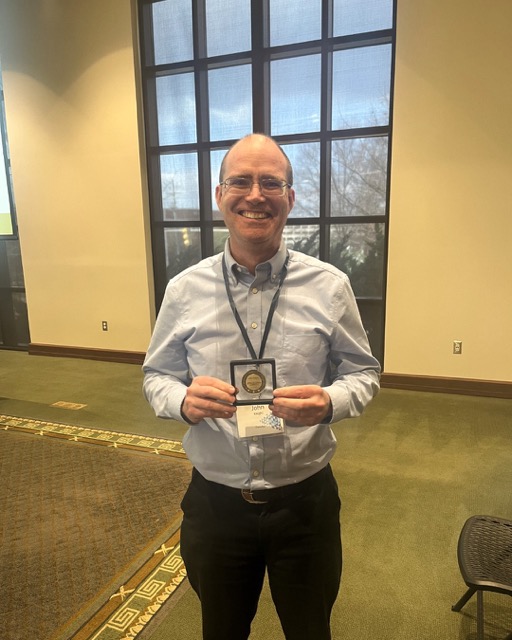
Knight, Wood, and Holmes were presented with a commemorative coin from the UAB Harbert Institute for Innovation and Entrepreneurship during the Department of Urology’s retreat on Feb. 19.
“This patent reflects how a multidisciplinary collaboration among academic researchers can lead to an important discovery,” Knight explained. “Our team’s expertise in experimental models of primary hyperoxaluria helped generate the proof‑of‑concept data that supported the filing.”
Primary hyperoxaluria is characterized by the overproduction of oxalate, raising the risk of calcium oxalate kidney stones and chronic kidney disease.
“The development of a potent small‑molecule oral inhibitor of lactate dehydrogenase could become an effective way to reduce the risk of calcium oxalate kidney stone disease and chronic kidney disease in patients with primary hyperoxaluria,” Knight noted.
 Earlier LDH inhibitors only modestly blocked the enzyme and did not effectively reach the liver, the major site of oxalate production in primary hyperoxaluria. The methods in this patent focus on potent LDH inhibition with liver‑targeted distribution, strong activity in hepatocytes, and little or no cytotoxicity.
Linked preclinical work associated with the patent showed that an LDH inhibitor reduced endogenous oxalate synthesis in a model of primary hyperoxaluria, suggesting a possible path to lower stone burden and protection of kidney function if translated to patients.
The patent coin program highlights how faculty innovation moves ideas from laboratory findings toward potential patient impact and underscores the collaborative strengths both within the Department of Urology and across institutional partners.
The UAB Harbert Institute for Innovation and Entrepreneurship operates the UAB Research Foundation and serves as UAB’s technology‑transfer office, helping protect discoveries, manage patents, and advance university innovations toward real‑world use.
“Recognizing our patented inventors was essential,” said Karthik Gopalakrishnan, Ph.D., senior director for the UAB Harbert Institute for Innovation and Entrepreneurship. “Their creativity and persistence turned breakthrough ideas into real‑world solutions, and it was their vision that drove innovation forward. We were proud to celebrate the individuals whose work strengthened our university’s impact every day.”