Notice - UNSCHEDULED Maintenance
- Details
- 2026-09-23 18:34
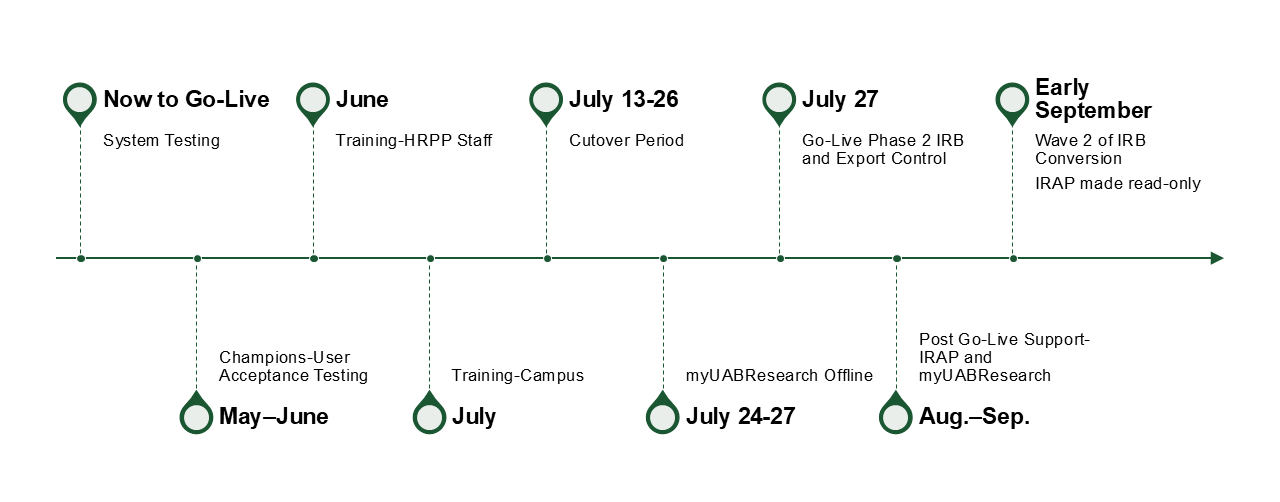
Multiple AI tools are available (or soon to be available) to assist the UAB research community with their work in myUABResearch.
Last Updated: Sep. 23, 2026

Do you have additional questions? Please visit our FAQs page for more information.
| Submission Type | Time-Sensitive Approvals – IRAP Submission Deadlines | Less Urgent – Consider Submitting in myUABResearch | Key Notes |
|---|---|---|---|
| Exempt / NHSR | Submit by late June / early July | Submit directly in myUABResearch on or after August 24 | Faster review (approximately 12–30 days median), but still allow buffer. |
| Expedited Studies | Submit by mid-June | Submit in myUABResearch on or after August 24 | Median review time approximately 40–80 days; build in revision cycles. |
| Full Board / Clinical Trials | Submit by late May to early June | Consider submitting after myUABResearch go-live unless urgent | Longest timelines (approximately 60–100+ days); high risk of missing Wave 1 if delayed. |
| Amendments (Procedural) | Submit by early to mid-July to ensure approval before August 20 | Avoid submitting just before Wave 2; otherwise submit after conversion in myUABResearch | Pending amendments will block conversion. |
| Personnel Amendments | Submit by late July (short review times) | Can wait and submit after August 24 if non-urgent | Typically quick (approximately 2–3 days median). |
| Continuing Reviews | See detailed table below | See detailed table below | Must be approved—not just submitted—to enable conversion. |
| Reportable Events | Submit as needed prior to August 10 | Allowed during freeze if urgent | Exception category. |
| Emergency Use / Just-in-Time (JIT) | Submit in IRAP and notify |
Submit via alternate process during freeze; upload after go-live | Exception category. |
| Protocol Expiration Date | Where to Submit CR | CR Submission Deadline | Rationale |
|---|---|---|---|
| Before October 12, 2026 | Submit in IRAP | Submit 6–8 weeks before expiration (approximately August 1 or earlier for early September expirations) | Must remain active in IRAP through Wave 2; cannot wait for myUABResearch. |
| August 10 – October 12, 2026 (high-risk period) | Submit in IRAP before August 10 | No later than August 8–9 | Avoid expiration during the freeze period and ensure study continuity. |
| After October 12, 2026 | Wait and submit in myUABResearch (if study converts) | Submit 6–8 weeks prior to expiration in the new system | These studies should convert in Wave 1 or Wave 2. |
| Late October–November 2026 Expirations | Prefer submitting after conversion in myUABResearch | Submit in the system where the study resides post-conversion | Avoid duplicate or conflicting submissions. |
| Not Converted by Wave 2 | Submit continuing review in IRAP if expiration is before October 1; otherwise follow new submission rules | Based on expiration timing | After Wave 2, IRAP becomes read-only; unconverted studies must restart. |