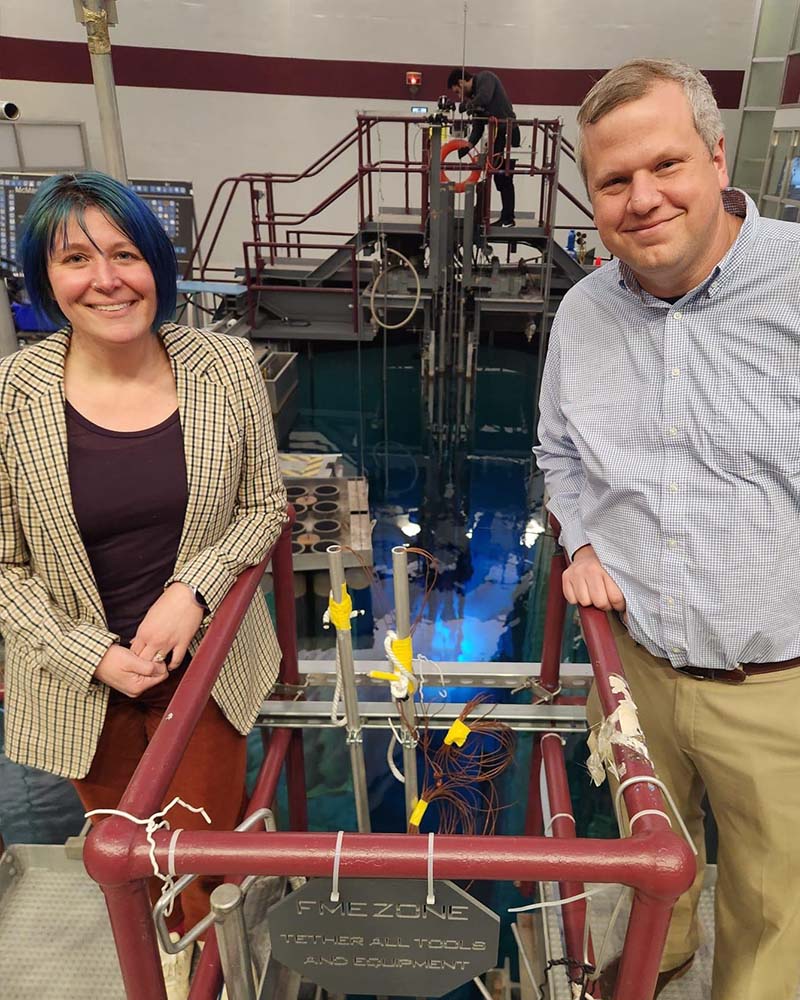
Multimillion-dollar gifts from philanthropists Marnix and Mary Heersink to UAB and McMaster University laid the foundations for a close partnership on biomedical innovation and global health initiatives. Dr. Heersink, who grew up in Burlington, is quoted as saying:
“I cannot think of better schools to partner than McMaster and UAB. They are both located in old steel towns, whose economies are now transformed around medical education and research. The universities are young and that gives them both the hunger and freedom to push boundaries.”
The collaboration includes the Health Physics Programs at both schools, which have signed a Program Agreement that includes:
- Course sharing across institutions
- Development of a joint "International Radiation Regulations" certificate
- Co-mentorship of graduate students
- Collaborative research between faculty, staff, and trainees
- Internship opportunities at McMaster nuclear facilities and the UAB Cyclotron
- Development of experiential learning opportunities (1-2-week programs)
Interested students can learn more about McMaster courses on the McMaster Radiation Sciences Graduate Program websiteOpens an external link.
Radiation Pop Culture Project
UAB Radiation Pop Culture Project
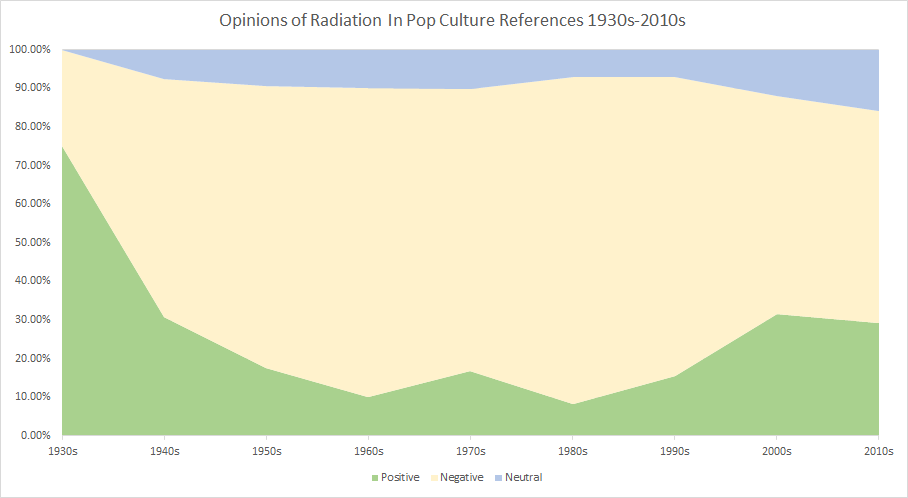
 From the creation of Godzilla that hit the theatres in the 1950's - to the nuclear holocaust of the made-for-television movie "The Day After" in the 1980's - to the shenanigans of Homer Simpson in the 1990's (through today!) - to the song "Radioactive" by Imagine Dragons in the 2010's - the topic of radiation has permeated pop culture. The depiction of radiation - whether realistic, fantastic, or somewhere in between - has captured the fascination of audiences from day one.
We are certainly not an exception to this rule. Come to think of it - we are probably more susceptible to this because of our field. We went so far as to create the UAB Radiation Pop Culture Project. This is a Hulk-sized reference bank dedicated to tracking and monitoring pop culture references to radiation. We have around 1,000 references so far.
Radiation Pop Culture Project Reference Bank Form
UAB Radiation Pop Culture Project
Our interest lies in the science of radiation and how it is depicted - or maybe more importantly - how it is perceived. And while we have a strong start - we need you to help.
We Need You
As you can imagine, it is impossible for a team our size to know or find all pop culture references. We welcome your additions of things we missed to our list of references. And we welcome your updates or additional input to those we have already captured.
To submit your information to our database committee for review, simply fill out the form below. One quick note: TV shows should be entered as seasons to prevent overweight when compared to movies and books.
UAB Radiation Pop Culture Reference Bank Submission Form
Accreditation
 UAB Health Physics Accreditation
The Master of Science (MS) in Health Physics program is seeking accreditation by the Applied & Natural Science Accreditation Commission (ANSAC) of Accreditation Board for Engineering and Technology (ABET), http://www.abet.org.
ACADEMIC YEAR 2022-2023 ACADEMIC YEAR 2023-2024
To be successful in the professional realm, graduates will employ responsible teamwork, clear communication skills, effective project management capabilities, professional
attitudes, and a clear understanding of the ethical issues faced by our profession. Graduates will
engage in life-long learning and professional development, as demonstrated by participation in
technical seminars, professional conferences and symposiums, discipline-specific training, and
advancement in the professional certification process.
In their careers, graduates will integrate their technical knowledge, applied
skills, and professional judgment to design and evaluate radiological systems considering safety,
reliability, security, economics, and societal impact.
Graduates will contribute to the growth of their professional and scientific field, will provide for their own development and will contribute to the expansion and development of their
colleagues. They will do so while engaging the radiation safety and broader community in an
inclusive and equitable manner.
Graduates will employ their broad technical knowledge in their careers. Graduates will
identify, formulate, analyze, and solve radiological problems by applying fundamental and
advanced scientific and technical knowledge coupled with applied skills. Breadth also includes a
continuing awareness of contemporary issues, influences, and trends needed to understand the
impact of radiological issues in global and societal contexts.
Research
UAB Health Physics Research
UABs Health Physics professors are extremely passionate about health physics and the environment. UAB was recently funded for their D2ROPS grant with the NRC to study in detail regulatory inconsistencies between states and federal regulations. Drs Wilson and Caffrey also regularly study dose implications from natural and man-made radiation in the environment. Recent student publications include: Few areas of radiation are as still poorly understood as low-dose and low-dose rate radiation damage in humans. UAB aims to be a center in which experts turn to, in order to solve once and for all, the linear no-threshold model uncertainty. Recent student publications include: With over 40 million nuclear medicine procedures per year and growing, radiation safety is vital to the success of medical treatments. UAB Health Physics researchers work closely with UAB’s hospital and radiation safety program to solve modern problems confronting radiation safety in the hospital. Professor Caudill spent several years working in hospitals across the globe in radiation safety and brings that experience to UAB ready to tackle the next generation of challenges. Recent student publications include: It is vital that the risks of radiation are communicated well to everyone! Recent projects from UAB studied how pop culture retains persistent misconceptions about radiation that likely influence the general public’s fears and radiophobia. UAB also works hard to study how radiation safety training can be optimized in the post-covid world. Recent student works include: Lasers, 5G, and microwaves are all included within an area of radiation called non-ionizing. This radiation does not have sufficient power to ionize atoms however can still be a very real radiation safety hazard.
Environmental Health Physics
Low-Dose Impacts
Health Physics in Medicine

Community Health Physics
Non-Ionizing Health Physics
Health Physics
Please click on a button below to open a PDF version of the program handbook that corresponds with the chosen year.
2024 - 2025
2023 - 2024
2021 - 2022
2020 - 2021
2019 - 2020
2018 - 2019
2017 - 2018
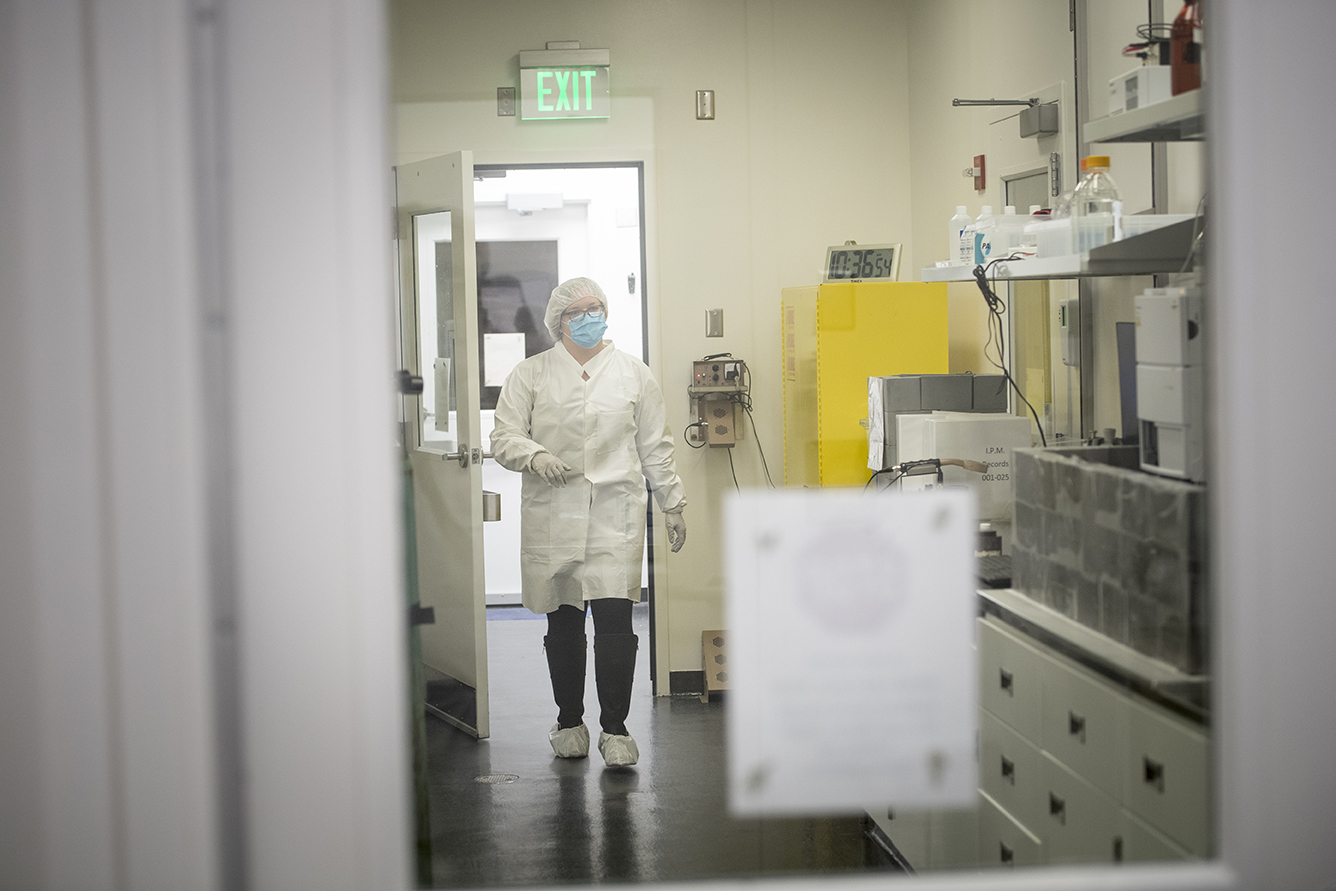 Students in the MS in Health Physics program have an opportunity to gain hands-on experience in the health physics industry through supervised practices. This allows students to work alongside professionals already in the industry and practice what they have learned in the classroom in a supervised setting.
Supervised Practice Locations
In addition to the sites listed below, new sites are added regularly. Student suggestions and ideas for alternative sites for completing the practicum requirement are always considered!
- UAB Advanced Imaging Center - Birmingham, AL
- UAB Office of Radiation Safety - Birmingham, AL
- O'Neal Comprehensive Cancer Center - Birmingham, AL
- Alabama Department of Public Health, Office of Radiation Control - Montgomery, AL
- Huntsville Hospital Radiation Safety - Huntsville, AL
- NASA Marshall and Kennedy Space Flight Centers - Huntsville, AL
- Versant - Various
- West Physics - Various
- National Council on Radiation Protection and Measurements - Virtual/Hybrid
- Centers for Disease Control - Atlanta, GA
- Nuclear Regulatory Commission - Birmingham, AL
- Environmental Protection Agency - Virtual/Hybrid
- Y-12 National Security Complex - Oak Ridge, TN
- Savannah River National Laboratory
- Idaho National Lab- Idaho Falls, ID
- BWXT
- Niowave
- Yale University and New Haven Hospital System - New Haven, CT
- Missouri University Research Reactor - Columbia, MO
- MedStar Georgetown University Hospital - Washington, DC
- Mayo Clinic - Jacksonville, FL
- Wellstar Cobb Hospital Cancer Center
- HCA Florida Capital Hospital - Tallahassee, FL
- Westinghouse - Various
- Pantex Nuclear Weapons Facility - Various
- H3 Environmental, LLC - Albuquerque, NM
Application Deadlines:
March 1 – First Consideration and Funding Deadline
- In recent years we have been full with applications submitted by March 1. We highly encourage you to apply no later than March 1.
April 30 – International Student Admission
August 1 – Final Admission if Space Available
Application Fees:
- Domestic applicants and green card holders: $50
- International applicants: $60
Instructions for Completing the Application
Prospective students may apply at any time during the year; however, students begin program courses in either the fall or spring semester. Applications are submitted online through the UAB Graduate School. All admissions documents (test scores, transcripts, immigration documents, WES, etc.) must be sent to the UAB Graduate School.
Official transcripts from each institution where college credit was received can be mailed to:
UAB Graduate School
LHL G03, 1720 2nd Avenue South
Birmingham, AL 35294-0013
Transcripts can be submitted electronically by choosing University of Alabama at Birmingham - Graduate Admission or using the email
Example for Completing Application:
- For which of the following are you applying? Master’s Degree
- Intended program of study: Health Physics
- Concentration: Not Applicable – Selected program does not offer concentrations
- Term: Fall 201X
Requirements
-
Preferred Prerequisites
- Calculus-based General Physics I - 4 hours
- Calculus-based General Physics II - 4 hours
OR
- Algebra-based General Physics I - 4 hours
- Algebra-based General Physics II - 4 hours
- Calculus - 3 hours
-
Application Requirements
Health Physics students must have a BA or BS degree from a regionally accredited institution and meet all UAB graduate school requirements and be accepted to the graduate program.
-
International Requirements
Please visit the Graduate School's International Admissions page for information about deadlines, requirements, English proficiency exams, and the application process.
Application Review Process
After an application window has been opened, applications are reviewed at program deadlines. An interview with the Program Director will be scheduled for qualified applicants.
Additional Information
Learn more about tuition and fees on the UAB Admissions website.
*If you have a pacemaker, stent and/or other metallic implants you may not be eligible for the MRI practicum in the UAB Advanced Imaging Center PET/MR area - the strong magnetic field may result in harm to you.
*Preferred prerequisite courses include calculus-based general physics I and II or algebra-based general physics I and II and calculus.
The example curriculum below is subject to change. Visit the Graduate Catalog to see the current curriculum and course descriptions.
Please contact our department's admissions team with any questions.
-
First Year - Fall Term
Plans I (Thesis) and II (Non-Thesis)
- MHP 602 - Radiation Physics (3 hours)
- MHP 651 - Advanced Radiation Biology (3 hours)
- MHP 650 - Research Methods (3 hours)
- CDS 505 - Professional Development (1 hour)
Total Credit Hours: 10
-
First Year - Spring Term
Plans I (Thesis) and II (Non-Thesis)
- MHP 610 - Radiation Detection & Measurement with Lab (4 hours)
- MHP 620 - Principles of Dosimetry (3 hours)
- MHP 653 - Research Methodology & Publication Analysis (2 hours)
- MHP 645 - Radiation Shielding & Protection (3 hours)
- MHP 654 - Laser Safety & Protection or Elective (3 hours)
Total Credit Hours: 15
-
First Year - Summer Term
Plan I (Thesis)
- MHP 657 - Monte Carlo Techniques for Health Physicists or Elective (1 hour)
- MHP 699 - Thesis Research (6 hours)
- MHP 691/692 - Supervised Practice (6 hours)
Total Credit Hours: 13
Plan II (Non-Thesis)
- MHP 657 - Monte Carlo Techniques for Health Physicists or Elective (1 hour)
- MHP 698 - Non-Thesis Research (6 hours)
- MHP 691/692 - Supervised Practice (6 hours)
Total Credit Hours: 13
-
Second Year - Fall Term
Plans I (Thesis) and II (Non-Thesis)
- MHP 655 - Contemporary Health Physics (3 hours)
- MHP 611 - Physics of Diagnostic Imaging or Elective (3 hours)
- MHP 691/692 - Supervised Practice (6 hours)
- MHP 671 – Environmental Health Physics or Elective (3 hours)
Total Credit Hours: 15
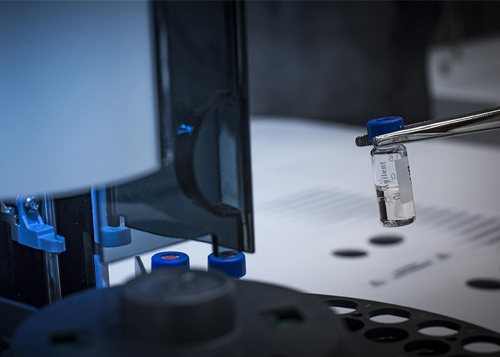 Students of the Health Physics program have access to many facilities through UAB and partnerships with other facilities.
Radiation Lab
UAB has state-of-the-art, recently renovated teaching and research lab space that offers students hands on opportunities to learn how to use common health physics equipment. Key features the labs include:
- Many types of Geiger counters
- SAM 940 Handheld Radiation Isotope Identifier
- 12 NaI gamma spectroscopy systems
- Electrically cooled Ortec HPGe detector system
- Ortec Alpha Duo alpha spectroscopy system
- Hidex 300 SL Liquid Scintillation Counter
- Wet chemistry lab space
Other UAB Facilities
Other UAB facilities include:
- UAB Advanced Imaging Center access – offers students one of a kind practicum training on the medical cyclotron, one of the most powerful cyclotrons in an academic medical center in the United States.
- Learning Resource Center access – here students have common areas, study areas and break out rooms, and food options.
Off-Campus Facilities
Off-campus facilities include a radiopharmaceutical production facility and the Alabama Department of Public Health, Office of Radiation Control.