The Art of Blind Fencing
Blind fencing instruction begins! Seen here from left to right are an assistant coach, Pound, and another BVI fencer.In Austin, Texas, an unusual fencing class echoes with the sound of sword engaging with sword. Pat Pound, who has been blind since age 14, is the first student in this class for blind fencers. Together with UAB Low Vision Rehabilitation Graduate Certificate program alumna Regina Budet, OTR, OTD, SCLV, ECHM, she is a driving force in bringing this sport to their local blind and visually impaired community.
Blind fencing began as a rehabilitation technique used for World War I veterans blinded during combat. The aim was to help them regain the skills they needed to live independently. Pound first heard about the sport from an acquaintance, also blind, who mentioned that he enjoys—and benefits from—fencing.
A former blindness rehabilitation and disability policy professional, Pound was immediately drawn to the excitement and benefits of blind fencing.
“Fencing has a direct connection to how well blind people do at orientation and mobility,” she says. “It requires you to bend your knees, be on the balls of your feet, and practice, practice, practice. The muscle memory this creates transfers automatically as you move about in the world.”
She reached out to Budet, who was unfamiliar with blind fencing but intrigued by its possibilities for the blind and visually impaired population she works with.
“I’ve experienced the benefits of sports firsthand, and I know that this population has difficulties getting physical activity adapted for them. That was very appealing to me,” says Budet, founder and owner of Austin’s Empower Occupational Therapy.
Building the program
Coach Murray explains a detail to Pound while the assistant coach and a BVI fencer look on.As Budet learned more about blind fencing, it became clear that it could improve a range of skills for visually impaired people of all ages, including listening, navigation, balance, and coordination. These skills are integral for mobility with a cane as well as for overall spatial awareness and confidence in daily activities.
A fencing program was feasible, she thought, because it wouldn’t require adaptive equipment or large practice spaces. During blind fencing bouts, both participants—pairs of sighted and visually impaired individuals—are blindfolded underneath their fencing masks.
“Blind participants use the same equipment as sighted fencers, who sometimes practice blindfolded to hone their other senses,” Budet says.
She and Pound partnered with Cindy Bachofer, MEd, a low vision specialist at the Texas School for the Blind and Visually Impaired in Austin. It was Bachofer who located Gary Murray, a local fencing coach who was interested in learning to work with blind participants.
“We taught coach about blindness while he taught us all about fencing,” Budet says. Progress came quickly, and in January of this year, just a few months after Budet first learned about blind fencing, Pound faced off with an instructor in the inaugural class.
This video features Coach Murray and blind fencer Rabih Dow, the person who first told Pound about the sport, introducing it to volunteer fencers from local programs for people who are blind and visually impaired.
Extending reach and impact
The team that made BVI Fencing a reality. Shown from left to right are Budet, Bachofer, Pound, and Murray.The program, now officially called Blind and Visually Impaired (BVI) Fencing, is building momentum through demonstrations at local events and professional conferences. The BVI team is training three sighted teenage volunteers as assistant coaches for students who may never have seen a fencing bout or held a sword.
“Coach Murray is also developing a program to train fencing coaches through Zoom on how to work with blind folks,” Budet says. “We want to spread these programs a lot further.”
Blind fencing will get an international stage at the 2024 Summer Paralympic Games in Paris, France, where Murray has arranged for a group of blind fencers from Italy to demonstrate the sport. Wheelchair fencing has been a Summer Paralympic event since 1960, but this will be the first time at these games that blind fencers touch swords to showcase the sport’s inclusivity and adaptability.
“It’s an exciting time,” Pound says. “We’re at the beginning, but there’s so much potential.”
For Budet, the program is about more than teaching fencing, it’s a chance to open up a dynamic sport with many physical and mental benefits to people who are blind and visually impaired.
“Blind fencing involves many cognitive components—it definitely works your brain,” Budet says, while Pound likens its strategic engagement to a chess game. It also challenges individuals to overcome personal fears and limitations, supporting the ability of blind and visually impaired individuals to live independently.
Budet wants to build a strong evidence base for blind fencing. Right now, she says, there is little research on the range of its potential benefits for blind and individually impaired fencers.
“As we increase awareness, I will be looking for opportunities to partner with other organizations to answer some of these questions,” she says.
For now, the BVI team continues to meet, strategize, and fence to spark the imagination and interest of potential participants and to share this platform for growth, learning, and empowerment with blind and visually impaired communities around the globe.
By definition, action is "the fact or process of doing something, typically to achieve an aim." Occupational therapy is an action industry and OT students are action people.
We are developing students who take action on their bold ideas for meaningful change through community opportunities, volunteer activities, and experiential enterprises.
Click the boxes below to experience occupational therapy in action:
- Learn about the innovative blind fencing program developed by an alumna of our Low Vision Rehabilitation Graduate Certificate program.
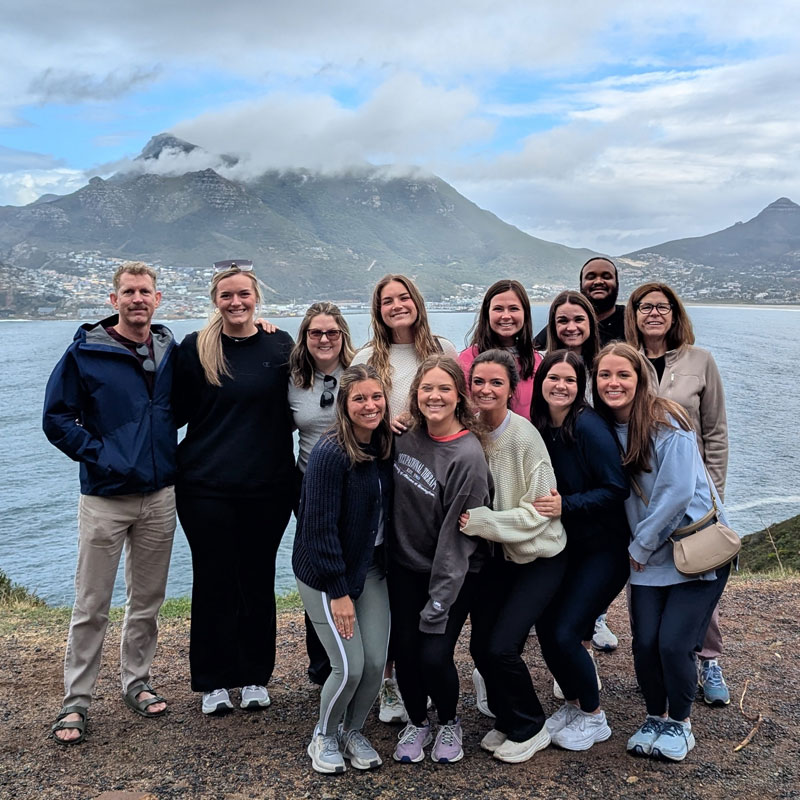
- Visit OT Education Abroad, a blog with stories from the department's May 2023 visit to South Africa.
- Discover Magic Camp, which teaches children aged 9–18 years with disabilities to perform magic tricks, a program our faculty's research has shown can improve social skills and self-esteem.
- Explore OT Life to see how an occupational therapist's day is different for everyone and never the same.
- Dig into Student Profiles and Faculty Profiles for a look at the personal and professional journeys of some of the exceptional individuals who bring our department to life.
A day in the life of an occupational therapist is different for everyone and never the same.
Work with children? Yes. Work in a hospital? Yes. Work with the elderly? Yes. Work in schools? Yes.
You get the picture. With a wide range of possibilities, we teach our students a wide range of solutions. We use creative techniques to bring hands-on learning to the classroom. We use service-learning to bring students to real fieldwork.
While others use books and simulations we use real people with real problems in real life. Often we capture our students in these environments through photographs that reveal the excitement of knowledge and the joy of impacting lives.
Inaugural Course in Blindness Rehabilitation
Applications are now open for the Low Vision Rehabilitation Graduate Certificate program’s first course in blindness rehabilitation. The course will equip occupational therapists (OTs) with the skills they need to help clients who are blind optimize their occupational participation and performance.
Opportunities
Creative Occupations Class
Each Friday afternoon of their first summer semester, UAB’s entry-level OTD students explore the world of artistic expression in creative occupations class.
Many students look forward all week to this course, in which professional artists guide them through first-hand experiences in an array of artistic mediums.
Lab Sessions
Each year we have a group of leaders, our UAB OT Student Ambassadors, who along with the UAB Student Occupational Therapy Assocation host the newest OT students for a pizza lunch.
But of course, this is about much more than just eating lunch. This is a way for the veteran students to provide the incoming students with a glimpse of what their life will be in UAB OT. This past year, more than half of the incoming class attended the session. They learned about classes, faculty, labs, clinics and expectations.
Pi Theta Epsilon Induction
We inducted 16 students into the Alpha Beta Chapter of Pi Theta Epsilon last year. It was the largest inducted by UAB OT and included Anne Abernathy, Olivia Collette, Katie Crumpler, Haley Dean, Renee Harris, Alexandra Hollis, Morgan Hutto, Erin Killen, Dunrey LaRose, Casey Latham, Omar Mohiuddin, Allison Riley, Savannah Shores, Shea Spicher, Tara Weaver and Abbey White.
“Pi Theta Epsilon is known for recognizing students that have demonstrated academic excellence, scholarly contributions, and service so it is an honor to be counted among an exceptional group of students being inducted,” said one OT student.
Experiential Learning
So often each semester, our OT classes receive first-hand learning experiences designed to put them in the place of their potential clients.
In this session, they were asked to navigate the School of Health Professions Building in wheelchairs. For those not familiar with SHPB, it is a six-floor building. Students were required to navigate elevators, ramps, bathrooms and more without leaving their wheelchairs. In a simultaneous session, students were asked to navigate a kitchen and bake cookies while using a walker.
In both cases, students were not allowed to be out of client character during the session.
Joy to Firehouse Shelter
Mention volunteering at a shelter and most people think about serving food. But what about the rest of the day-to-day operations? Or what about the holidays?
After countless hours of volunteering, our students recognize that The Firehouse Shelter, who serves homeless men in the seven county Birmingham, Alabama metro area, is much more than a place for people in need to eat.
So on the student's day off - no classes, no clinics - in Fall 2015, they spent their own time off taking care of little things, like cleaning, and big things, like decorating for the holidays.
Class of 2016 Poster Presentations
Every year, UAB Occupational Therapy students conduct research for their field. The research conducted cover a wide variety of problems affecting many different demographics of people. Recently, some students were even part of a published study of play space inequities between affluent and non-affluent communities.
Every year, during the Spring semester, our OT students complete their research and create posters that they present to OT practitioners, alumni, students and faculty. The 2016 event was held at the new UAB Hill Student Center Ballroom.
Hosting AHEC Students
Students from the UAB School of Health Professions Departments of Occupational Therapy and Physical Therapy spent two days with students from the Alabama Statewide Area Health Education Centers (AHEC) Program. They explained the differences and the highlights of being an OT or a PT, they showed them how OTs and PTs work and much more.
The Alabama Statewide Area Health Education Centers (AHEC) Program's mission is to reduce health disparities by improving the quantity, diversity, distribution and quality of Alabama’s healthcare workforce.
Pediatrics Class
The class is officially called OT 624: Occupations of Infants, Children and Adolescents but everyone calls it "Pediatrics Class." This four-hour credit course official listing says, "Evaluation, intervention planning, implementation, and specific intervention strategies across diagnostic categories for children, birth through adolescents using a holistic approach."
But what separates this class at UAB from this class at many universities is the actual children. Faculty and staff work to bring children - yes, sometimes even their own - into the classroom so students can truly understand the challenges and the benefits of working with children. As we saw on this day, children are not easily distracted when something catches their eye.
UAB OT partners with UAB Theatre
Our students are now getting real-world experience with a new cross-professional program that uses students from the College of Arts and Sciences’ Department of Theatre as patients.
OT students must master many skills in human interaction before moving to the next step of their education, including fieldwork rotations, during which they interact with real patients. So UAB OT students get to work with “real” patients before they begin their field study and UAB Theatre students get to test their chops in acting out a diagnosis before auditioning for a character role with medical issues.

UAB Arts in Medicine and the Department of Occupational Therapy in the UAB School of Health Professions are excited to offer Magic Camp, a fun, interactive program that uses the art of magic to support therapeutic goals for children with disabilities.
Research shows that learning and performing magic tricks can offer meaningful therapeutic benefits for children and adults with disabilities. This engaging approach has been found to enhance motivation and support improvements in physical, psychological, perceptual, and social functioning.
As a therapeutic tool, magic is gaining recognition for its ability to foster confidence, creativity, and connection, while helping participants achieve rehabilitation goals in a fun and empowering way.
Magic Camp is free and open to children ages 9–18 with disabilities. Campers will learn tricks from the HOCUS FOCUS program developed by international illusionist and educator Kevin Spencer, a leading authority on the use of magic in physical and psychosocial rehabilitation.
Camp sessions are led by UAB occupational therapy graduate students who have been specially trained in this evidence-based protocol.
This summer, we are offering three camps:
- Two virtual camps held via Zoom
- One in-person camp on the UAB campus
Each camp concludes with a performance in which campers can showcase their new skills for friends and family.
2025 Camp Schedule
Virtual Camp 1
- Dates: May 26–June 27 (No sessions the week of June 9–13)
- Time: Monday, Wednesday & Friday afternoons
Virtual Camp 2
- Dates: July 7–August 1
- Time: Monday, Wednesday & Friday afternoons
In-Person Camp
- Dates: July 11–August 8
- Time: Fridays, 9 a.m. – 12 p.m.
- Location: UAB Campus
The lessons, the camp, and the final magic show are unforgettable highlights in our occupational therapy students’ educational journey, and we would love to share them with you and your family.
Interested in Joining Us?
Please email us at
More on the UAB OT Magic Camp
Collaboration with UAB Arts in Medicine
The UAB Magic Camp is part of a collaboration between UAB's Department of Occupational Therapy, Children's of Alabama, Hocus Focus™ and UAB Arts in Medicine (AIM). AIM focuses on the needs of the whole person–mind, body and spirit–and it includes both interactive and passive arts experiences, such as bedside and workshop activities and performances and visual art installations in public spaces.
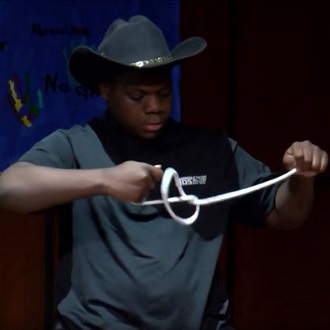
Magic Camp "Tricks" Kids Into Doing Therapy
Illusionist Kevin Spencer will tell you - tricks have more magic than you may think.
Spencer, an award-winning performing artist who toured the world for more than 25 years, created Hocus Focus™ to support the learning of students, with varying degrees of challenges and abilities, through the art of magic. He brings his magic to UAB OT Magic Camp every year through UAB's artist-in-residence fellowship program.
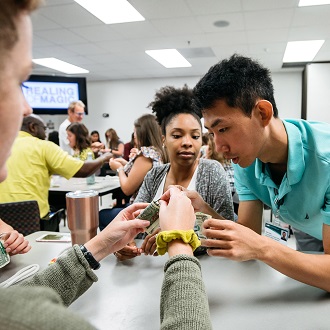
OT Students Gain Direction With Misdirection
Each year during his residency at UAB, illusionist Kevin Spencer works with UAB OT students and gives them their own bag of tricks – complete with magical props like ropes and wands – and then he shows them how to perform some basic magic.
However, the real trick is that the students are learning more than magic. They are learning to direct their clients’ rehabilitation in three key areas: dexterity, motivation and socialization.
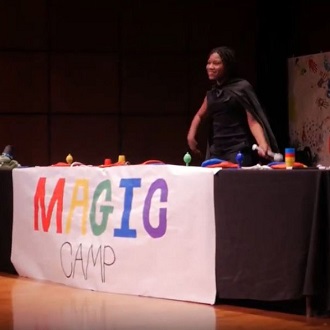
Close Up Profile: Inside Magic Camp
A few years back, Gavin Jenkins, Ph.D., chair of the UAB Department of Occupational Therapy, was asked to consider bringing illusionist Kevin Spencer to UAB to teach therapeutic magic to first-year UAB OT students. He remembers that "at the time I was extremely skeptical - I thought 'this is not occupational therapy'."
But after watching Spencer and his students work together, his attitude toward Spencer's magic act quickly changed. In this video, Jenkins talks about how his mind was changed and why the UAB Magic Camp was developed.
Magic Revealed: The Power of OT
Early in his career, Spencer was nearly killed in a car crash. He says when he woke up he was in neurological intensive care. He had a closed brain injury and a lower spinal cord injury. It took him nearly a year in intensive therapy just to regain the skills he lost as a result of the crash.
In speaking to our first-year UAB OT students, he talks personally and passionately about the power of the OT profession and how grateful he is for their work. From first-hand experience, he tells the students: "You will hold in your hands - the power to change peoples' lives."
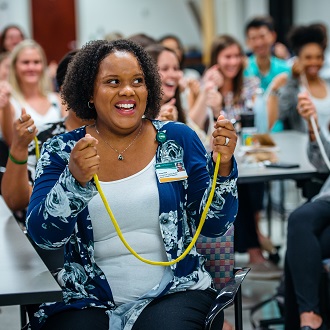
Magic Revealed: Ropes Trick
For the UAB OT students to teach their future clients magic, they must first learn the tricks behind the act.
In this video, Spencer teaches the students a "Ropes Trick" where he takes three ropes of different lengths (short, medium, long) and he magically makes them all the same length. And then magically returns them to their original lengths!
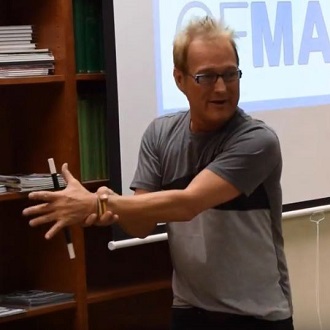
Magic Revealed: Wand Trick
As we've mentioned, Kevin Spencer is an illusionist and artist who has performed magic in front of tens of thousands of people on stages in 34 countries on six continents.
Even so, his excitment in working on a "small stage" with our first-year UAB OT students never wanes. His enjoyment is evident in round two of his magic lessons as he walks students through the floating wand trick.

Behind the Scenes: UAB OT Classroom
Spencer believes that sometimes people in therapeutic health professions forget arts can play a significant role in recovery. His program, Healing of Magic™, is a carefully designed, systematic approach in promoting and protecting human health.
Every year, Spencer, who is considered the leading authority on the therapeutic benefits of magic, entertains and educates first-year students in our Master of Science in Occupational Therapy program. His workshop is part of a four-day teaching residency at UAB.