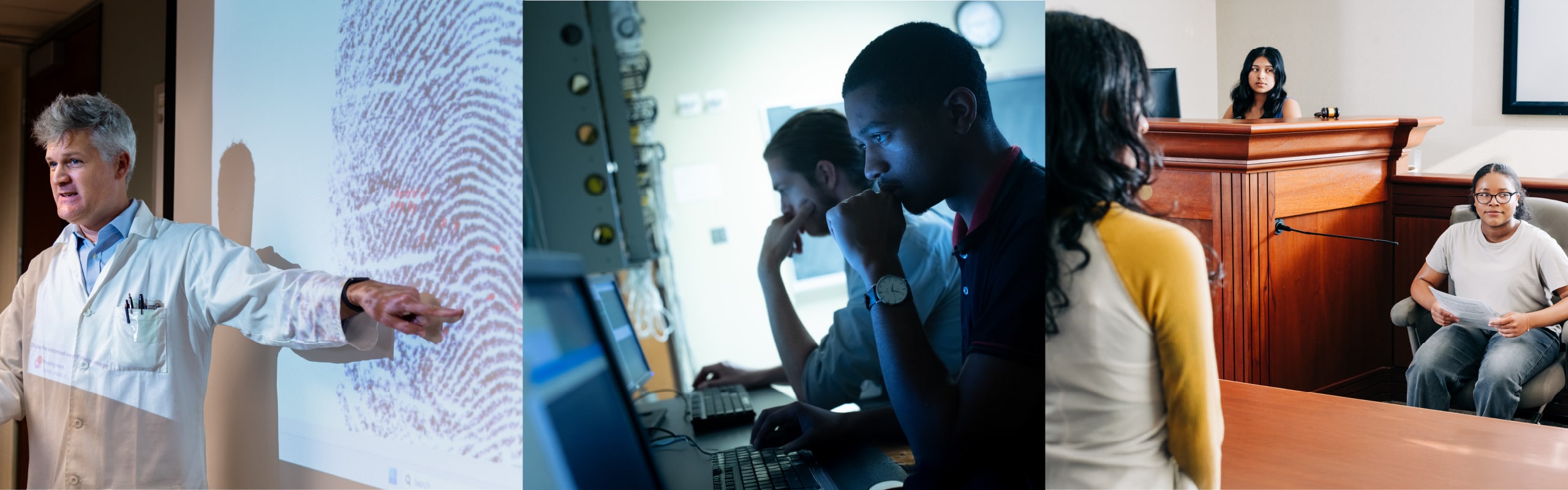
The Pre-Law Program at UAB provides programming to students interested in attending law school and pursuing a career in the legal profession. The program consists of:
- programing focused on pre-professional competencies including reading to comprehend, writing to understand, critical thinking, spontaneity, and speaking to persuade
- pre-law advising
- an academic minor that exposes them to the substantive study of the law
- opportunities to participate in experiential learning through internships with local law firms and the Mock Trial Team
- opportunities to participate in pre-law events
- programming focused on developing professionalism
 Scholarships are available for qualified students.
The Pre-Law Program is overseen by a program director and supported by faculty members in the J. Frank Barefield, Jr. Department of Criminal Justice, the departments of Political Science and Public Administration and Philosophy, as well as the Collat School of Business. It is also supported by members of the Birmingham Bar Association and the Magic City Bar Association, who give of their time and talent by serving as guest lecturers in various law and law-related classes; overseeing programmatic fundraising and scholarship development; and providing students with internship opportunities in various settings.
Learn more about the Pre-Law Path: Public Administration /Juris Doctorate (MPA/JD Coordinated Degree) and the Pre-Law Path: Public Health /Juris Doctorate (MPH/JD Coordinated Degree).
Subscribe to the Pre-Law Journey Newsletter Opens an external link.
The Legal Affairs Minor
A critical component of the Pre-Law Program is its Legal Affairs minor, designed to help students learn to think both critically and creatively about law. Because the curriculum is interdisciplinary and presents law as the subject of liberal inquiry, students in the minor examine law from various perspectives.
The minor also provides students the opportunity to develop a solid foundation of knowledge on topics including:
- the origins and functions of law
- basic rules of law
- comparative legal systems
- law as a social phenomenon
- the influences and effects of the legal profession on
society - the impact of societal trends and changes on law
 The J. Frank Barefield, Jr. Department of Criminal Justice offers undergraduate degrees in:
The department also offers minors in:
Launch Your Career
The criminal justice program at UAB is one of the oldest in the U.S. With a long-standing tradition of excellent faculty and outstanding graduates, students who complete the program have gone on to work in prestigious positions in many different fields within the justice system, social service fields, and in careers not related to justice.
The digital forensics program is tailored to students looking to work in the exciting and lucrative field of computer forensics and security. The program’s hands-on approach helps give students practical experience, giving them the opportunity to make immediate contributions to the field.
Learn in the Classroom and the Field
All students in our Bachelor of Science with a Major in Criminal Justice program are required to do an internship as their capstone experience. This requirement gives our students unprecedented access to a network with those already working in the field, the chance to acquire valuable experience, and the opportunity to gain hands-on learning in both the classroom and in the field. Students in the digital forensics program experience a robust capstone experience that may include an internship.
We invite you to explore our programs and find the right one for you!
 What can you do with a major in criminal justice? You’ll be surprised at the array of options available to you: law enforcement, private security, juvenile justice, probation, parole, corrections, law school, graduate school . . . and that’s just a start. More importantly, the skills that you’ll develop as a result of majoring in criminal justice will serve you regardless of the field you choose.
The program is designed to teach students how to think critically; communicate effectively— either in writing or verbally; understand, manipulate, and interpret quantitative data; be engaged citizens; and work as a member of a team. These skills are highly valued by employers and constitute some of the core necessities for success in the 21st-century workforce.
How do we know this? We asked recruiters at companies with whom we’ve worked, including Facebook, VISA, the National Institute of Standards (NIST), the FBI, and the National Security Agency (NSA).
Study With Us
The criminal justice program will help you develop the basic skills and knowledge necessary to be successful in the field of criminal justice. It will give you:
- familiarity with the major theoretical explanations for crime/delinquency and the logic and procedures associated with the research process, including statistical inference and hypothesis testing
- fluency in the substantive, procedural, and operational aspects of the criminal justice system and its processes
- an appreciation of the ethical foundations of the criminal justice system, its agencies, and personnel
We hope to see you in the classroom next semester!
For more information, please contact Martha Earwood, the Undergraduate Program Coordinator.
Program Requirements
The program leading to the Bachelor of Science with a Major in Criminal Justice offers students broad academic exposure to the fields of criminal justice, criminology, and law while providing opportunities for students to study in areas such as corrections, criminology, forensic science, juvenile justice, law, policing, and computer forensics. The primary mission of the program is to educate students by developing in them the knowledge and basic skills necessary to be successful in the field of criminal justice, including:
- major theoretical explanations of crime/delinquency
- the logic and procedures associated with the research process, including understanding statistical inference and hypothesis testing
- the substantive, procedural, and operational aspects of the criminal justice system and its processes
- the ethical foundations for the system
Course Catalog
A complete list of program requirements, courses, and a proposed four-year program of study for criminal justice majors are available in the UAB Undergraduate Catalog.
Available On-Campus and 100% Online
Students pursuing a major in criminal justice have the opportunity to take courses online, in the classroom, or a blend of each.
If you do not live in the Birmingham area or have a work schedule that does not permit you to take on-campus classes, you can complete your degree completely online. Online courses appear on your transcript the same as campus-based courses and have the same level of excellence as our on-campus courses.
Often, students want to take courses in the classroom but may need the flexibility of an online class. No problem! You can blend online and on-campus classes within a semester or choose one format or the other for a given semester. In our program, you'll have the flexibility you need to complete your degree.
All online course content is accessed through UAB’s learning management system, Canvas, which includes a variety of tools to make the course experience more engaging. Some of the tools used within online courses include virtual classroom lectures, multimedia, chat, and discussion boards. You can learn more about online programs and courses on the UAB Online website. Also, learn more about our Accelerated Learning Opportunities.
Ready to Apply?
All the information you need to apply can be found on UAB's Undergraduate Admissions website.


 Do you want to solve cases by examining digital evidence? Protect computer systems from hackers and malware? Then the Bachelor of Science with a Major in Digital Forensics is for you. Digital forensics is one of the fastest growing career fields. Some estimates say over 100,000 jobs will be available for cybersecurity/digital forensics personnel in the next 10 years. If you want to learn how to conduct cyber security operations and investigations, this program is the perfect fit for you.
The digital forensics major is an interdisciplinary degree program, combining course work in criminal justice and computer science. The focus of the program is an understanding of the procedures and processes necessary to discover, recover, analyze, and present information that has been stored on digital devices.
Students graduating with a digital forensics degree can pursue positions in entry- and advanced-level positions with federal, state, and local law enforcement agencies; with many different companies (finance, computer, retail) that need cybersecurity experts; and public and private sector non-profit companies. Students completing the program may also continue on to a graduate studies program (master’s and doctoral-level) in computer science, criminal justice, information systems, information technology, or law.
For more information, please contact
Program Requirements
The goal of the required courses for a Bachelor of Science with a Major in Digital Forensics is to provide graduates with the tools they need in computer programming and operations to work effectively within a computer environment, and also the skills needed to understand the behavior of those who may be a threat to computer systems and/or engage in cybercrime. Additionally, graduates will have an understanding of the legal systems and processes necessary to gather digital evidence and support a computer investigation in court if necessary.
All students graduating with the digital forenics major have the option to complete an internship. Students can complete internships in a law enforcement or intelligence agency at the federal, state, or local level; or in a cybersecurity-related position within a business industry such as banking (Regions, Wells Fargo), finance (Visa, Deloitte), computers (Facebook, Google), or retail (Walmart, Target). Students can gain practical experience in their future employment and will be able to test the skills they developed in the program.
Course Catalog
A complete list of program requirements and courses are available in the UAB Undergraduate Catalog Catalog.
Ready to Apply?
All the information you need to apply can be found on UAB's Undergraduate Admissions website.
 The J. Frank Barefield, Jr. Department of Criminal Justice offers five minors to students who are interested in the field but who are majoring in other subjects. A minor can be a valuable tool in your future career — minors widen your field of knowledge and give you added flexibility in the career search or in future education. The department offers the following programs:
- Criminal Justice - for students combining an interest in criminal justice with majors in the social sciences, the natural sciences, computer science, information systems, or business
- Forensic Psychology - for students interested in a general background in the intersection of law and psychology
- Forensic Science - perfect for anyone interested in the fundamental concepts and principles used in analysis of crime scene evidence
- Legal Affairs - a multidisciplinary program for students interested in combining a background in law with a political science, philosophy, sociology, psychology, or criminal justice major
- Urban Affairs - explores metropolitan areas, ideal for students who want to work in a variety of social service and technical areas in public and private organizations
Course Catalog
A complete list of courses and requirements for all minors in the J. Frank Barefield, Jr. Department of Criminal Justice is available in the UAB Undergraduate Catalog.
A grade of C or better is required in all courses applied to the minor. Students must complete 18 hours from the selected courses found in the UAB Undergraduate Catalog.
Ready to Apply?
All the information you need to apply can be found on UAB's Undergraduate Admissions website.
Exceptional students currently enrolled in the criminal justice undergraduate degree program are encouraged to apply to our Accelerated Bachelor’s/Master’s program (ABM) for the Master of Science in Criminal Justice (MSCJ).
How it Works
To accelerate progress through a master’s degree in criminal justice, a limited number of graduate courses (up to 12 credit hours) may be counted as criminal justice electives towards both the completion of the undergraduate degree and the MSCJ graduate degree.
Admissions
 The Accelerated Bachelor’s/Master’s program is for exceptional students. The accepted student will:
- have attained an average GPA of 3.5 in all institutional courses
- have completed a minimum of 60 credit hours (at least 36 of these credit hours must have been taken at UAB)
- have declared criminal justice as an undergraduate major OR declared criminal justice as an undergraduate minor and plan to complete CJ 300, CJ 302, and CJ 360.
Before applying, students should meet with the directors of the undergraduate and graduate programs to discuss the expectations and rigor of the program. Interested students should also meet with a financial aid/scholarship advisor to determine the impact of the ABM on their scholarships and/or aid award.
Students must submit their ABM application through the UAB Graduate School’s online portal, one letter of reference, a current C.V. or resume, and a personal statement. The Graduate School will assist the student with acquiring their official transcripts.
Admission into the ABM is decided by a committee chaired by the graduate program director and consisting of J. Frank Barefield, Jr. Department of Criminal Justice graduate faculty.
-
To maintain status in ABM, the student must:
- maintain an institutional GPA of 3.25 or higher
- receive a B (or higher) in criminal justice courses taken while still an undergraduate student
If either of these requirements is violated, the student will be withdrawn from the ABM program. If a student is withdrawn, they will retain credit for the courses already taken in the ABM program for either their undergraduate degree or their graduate degree based on the student’s preference.
Once the undergraduate student has completed all course requirements for graduation, their undergraduate degree will be awarded. Once the student graduates from the bachelor’s degree program, they enter the MSCJ program as a traditional student and must maintain the requirements of that graduate program.
-
To accelerate progress through the MSCJ degree, up to 12 credit hours may be counted towards the completion of the bachelor’s degree and towards the completion of the MSCJ degree.
Below is a list of courses allowed for credit sharing between the undergraduate and graduate criminal justice programs:
- CJ 500: Drugs and Society
- CJ 503: Restorative Justice
- CJ 507: Special Topics
- CJ 508: Juvenile Delinquency
- CJ 511: Juvenile Justice System
- CJ 540: White Collar and Corporate Crime
- CJ 542: Race, Crime, Gender & Social Policy
- CJ 543: Women and CJ System
- CJ 544: Law and Society
- CJ 560: Violence: An American Tradition
- CJ 563: Urban Structures
- CJ 564: Crime and Place
- CJ 566: Spatial Analysis
- CJ 583: Patterns in Crime
-
Each student will develop a detailed personalized plan of study that will build on the student’s transcript and future career goals. This plan must be agreed upon by all parties (student, their undergraduate academic advisor, undergraduate program director, and graduate program director) and strictly adhered to while in the Criminal Justice ABM program in order to guarantee student’s continued participation in the ABM.
The criminal justice Honors Program encourages and prepares outstanding criminal justice students to pursue careers in the field ofcriminology and criminal justice by providing an opportunity to conduct independent research with a faculty member. It promotes initiative, creativity, and critical thinking among academically talented students. Under faculty supervision, students will have the opportunity to participate in and complete a research project. The program can accept up to six (6) outstanding students each fall.
Eligibility
 Students are admitted to the Honors Program based on an evaluation conducted by the Honors Program Coordinator and a committee of faculty members. Students seeking admission to the Honors Program must:
- Complete an honors application. One may be obtained by contacting Dr. Heith Copes (
This email address is being protected from spambots. You need JavaScript enabled to view it. ). - Have completed a minimum of 60 hours of course work toward the degree at the time of application (junior or senior in standing).
- Completion of CJ 300, CJ 302, and CJ 360. May enroll in up to two of these courses the fall semester enrolled in the Honors program.
Benefits
Joining the Honors Program gives you unique access to faculty and the opportunity to interact with other honors students in an environment that encourages creative and innovative thinking. The research opportunities and seminar participation you will experience in the program can help you in your future career in the field or in applying to graduate programs. Students who complete the program will graduate from UAB “With Honors in Criminal Justice.”
Requirements
- Completion of all required courses for the Criminal Justice major
- Completion of Honors Seminar (CJ 481) during the fall semester
- Completion of Honors Project (CJ 482) during the spring semester
- Completion of a research presentation at the annual Honors Research Colloquium at the end of the spring semester
For additional information on the program please contact the CJ Honors Program Director, Heith Copes.