
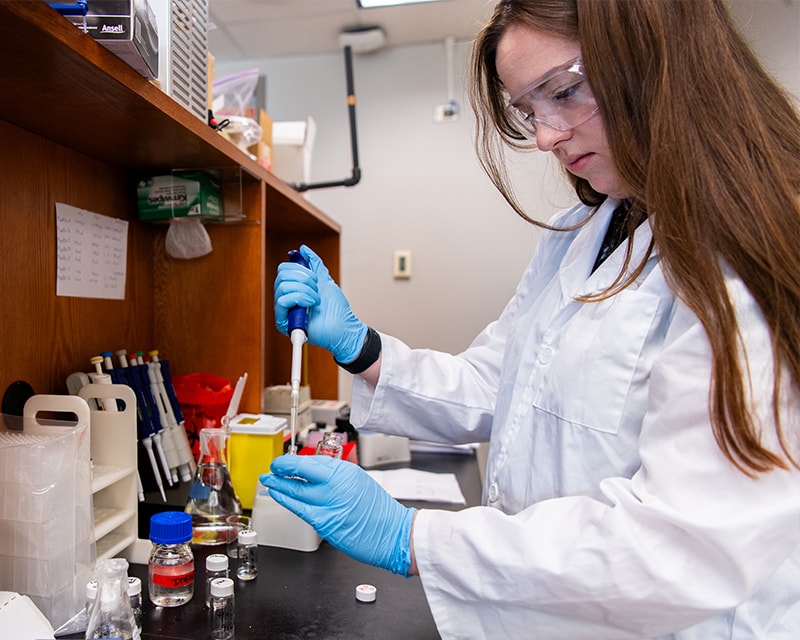
 The mission of the forensic science program is to provide our students with comprehensive graduate level educational and research experiences in the forensic sciences and to prepare them for careers in public and private laboratories. The program also provides a strong foundation for further graduate studies.
The mission is made possible through the following goals:
- Developing the students' laboratory, medico-legal, and public policy skills through the required forensic science courses
- Guiding the student through the selection and completion of a research project, and
- Providing opportunities for pre-professional, laboratory-based internships and research with the Alabama Department of Forensic Sciences (ADFS), the Jefferson County Medical Examiner’s Forensic Toxicology Laboratory, and the Jefferson County Drug Court.
In addition to completing a series of forensic science courses, students in the MSFS program are required to take courses in chemical instrumental analysis, biochemistry, quantitative analysis, and recombinant DNA technology offered by the Department of Chemistry and the Department of Biology. Students are encouraged to design a course of study (in consultation with their faculty advisor) with a specific concentration to meet their professional goals.
Download MSFS Student Handbook Downloads a Doc file
Levelling Courses
The following courses are required, but students who have taken the equivalent course as an undergraduate may opt out of one or more. Since we primarily accept students with biology and chemistry backgrounds, it is expected that applicants will have taken at least two of these courses at the sophomore or above level:
-
Biochemistry
Typical course description of a biochemistry course:
Overview of biochemical principles; chemistry of aqueous solutions, biochemical building blocks including amino acids, carbohydrates, lipids, and nucleotides; examination of metabolic pathways and enzymes that mediate catabolic and anabolic metabolism of carbohydrates, lipids, amino acids, and nucleic acids. Application of clinical correlations of metabolism to human nutrition and disease. -
Instrumental Chemistry Instrumental Analysis (with lab)
- Typical course description of an instrumental chemistry course: Focus on modern analytical chemistry instrumentation including chemical separations, spectroscopies (atomic absorption, infrared, UV-visible, fluorescence), mass spectroscopy, and thermal analysis.
- The typical lab includes: Focus on modern analytical chemistry instrumentation including chemical separations, spectroscopies (atomic absorption, infrared, UV-visible, fluorescence), mass spectroscopy, and thermal analysis.
-
Molecular Genetics
Gene structure, function, and regulation. Chromosome structure and inheritance. An overview of the human genome.
-
Quantitative Chemistry (with lab)
Typical course description of a quantitative chemistry course:
Principles of analytical measurements, statistical and volumetric techniques, spectrophotometric analysis, and chromatography, with emphasis on equilibrium and applications. Lecture and laboratory.
Course Catalog
A complete list of program requirements and courses are available in the UAB Graduate Catalog.
Ready to Apply?
Learn more about admissions requirements or start your application.
Application Deadlines
Students are admitted to the MSFS Program for the fall semester. The application deadline is January 31 for the fall semester of that calendar year. Late applications will be accepted until April 30; however, once the maximum expected enrollment is reached, late applications may not be considered.
Please review the admissions checklist (PDF) for additional details.
Application Information
Application materials are received by the graduate school, then made available to the MSFS Program Director. Please refer to the UAB Graduate School online application system for questions concerning submitting your application.
Your application is considered complete when:
- payment of the application fee is received
- the online application (including personal statement)
is completed - official transcripts are received by the UAB Graduate
School - three letters of recommendation are received by the UAB Graduate School or the MSFS Director
- standardized test scores (GRE, TOEFL for non-native English speakers) are received by the UAB Graduate School
Letters of recommendation can be completed online by the evaluator (instructions are given to the student during the online application process).
 How to Apply
The application for the MSFS program can be completed on-line at the Graduate Application and Admissions page. For information about application deadlines, contact the program director, Jason Linville, Ph.D. at
Admission Requirements
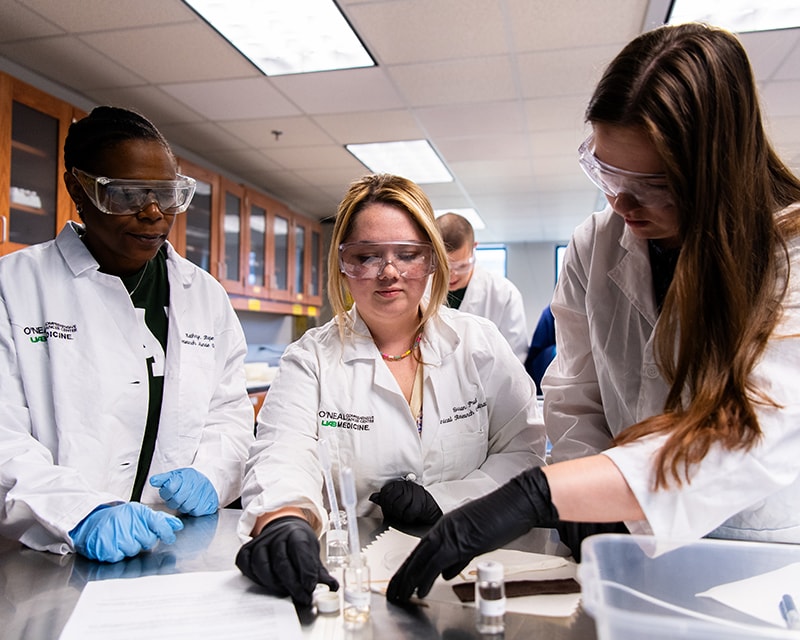
Admission to the MSFS program requires the approval of the UAB Graduate School and Jason Linville, the director of the MSFS program. Application for admission can be made online through the UAB Graduate School website, or call (205) 934-8227.
Minimum admission requirements are as follows:
- Bachelor's or master's degree in chemistry or biology from an accredited institution
- A chemistry-related degree is acceptable if it includes instrumental and quantitative chemistry courses along with biochemistry or statistics (see the levelling courses information on the program requirements page)
- A biology-related degree is acceptable if it includes statistics, biochemistry, genetics, and molecular biology courses (see the levelling courses information on the program requirements page)
- BS degree in forensics should come from a FEPAC-accredited program
- BS degrees in forensic science from non-FEPAC accredited programs will be evaluated individually for completed courses including at least three of instrumental chemistry, quantitative chemistry, biochemistry and genetics and molecular biology courses (see the levelling courses information on the program requirements page)
- Overall grade point average (GPA) of 3.0, based on a 4.0 system, or a 3.2 GPA for the last 60 semester hours in a BA/BS program
- 3.0 GPA in all previous graduate coursework
The following criteria are also considered in the admissions process:
- evidence of scholarship
- statement of career goals
- letters of recommendation (2-3)
- professional experience
The J. Frank Barefield, Jr. Department of Criminal Justice does offer assistantships and small scholarships to MSFS students. No separate application for these merit-based awards is needed. We assume all applicants are interested in funding and will contact those who are most qualified to receive some form of department aid. Other financial resources may be available through the Office of Student Financial Aid and the UAB Graduate School.
For a complete list of tuition costs and fees, visit the tuition and fees section of the UAB Students website. Note that most of the student service fees are now incorporated into the first hour of coursework each semester.
For applicants from the southeastern US, the Academic Common Market is an interstate agreement among selected southern states for sharing academic programs at both the baccalaureate and graduate levels. Participating states are Arkansas, Delaware, Florida, Georgia, Kentucky, Louisiana, Maryland, Mississippi, Oklahoma, South Carolina, Tennessee, Texas, Virginia, and West Virginia. Residents of these states may qualify to pay in-state tuition. For more information, visit the market website.