Artificial intelligence is rapidly shaping research, medicine, and clinical operations. On Monday, May 4, 2026, the Center for Clinical and Translational Science (CCTS) and the University of Alabama at Birmingham (UAB) Department of Computer Science convened a transdisciplinary audience for the 2026 AI Summit, a daylong forum focused on the current state of AI and its growing role across the research enterprise.
Held in the Altec/Styslinger Genomic Medicine and Data Sciences Building (ALGEN), the Summit brought together broad representation from across UAB, including faculty, staff, trainees, and executive leaders from 10 of UAB’s 12 schools and the health system. Participants also included representatives from four CCTS Partner Network institutions and several community organizations.
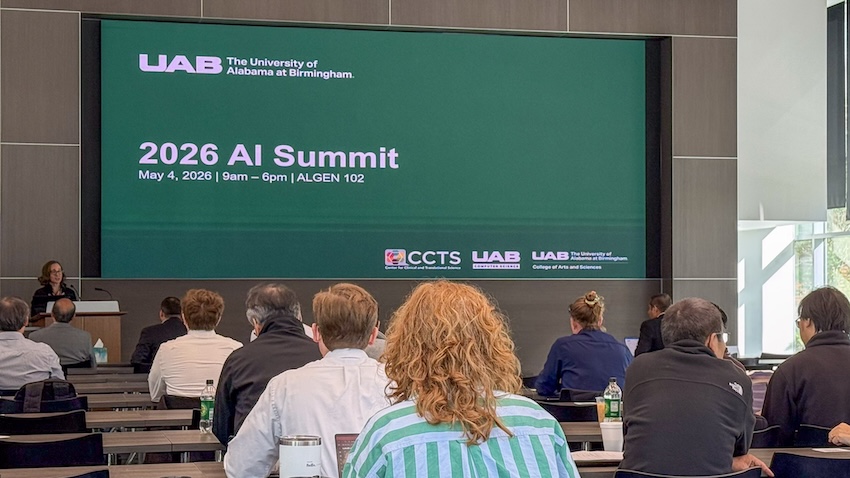 The Summit was designed to help participants better understand state-of-the-art AI methods, explore current challenges, and consider how AI may continue to shape research and medicine. The event also highlighted real-world applications through project presentations, technology demonstrations, group discussions, and networking opportunities intended to foster new collaborations among data scientists, biomedical investigators, clinicians, and research teams.
“What stood out from the Summit was the range of voices in the room. Faculty, staff, trainees, technical experts, and institutional leaders all brought important perspectives on what it will take to support responsible AI use at UAB. The discussions made clear that collaboration, communication, and practical support will be essential as this work moves forward.” — Yuliang Zheng, PhD, Professor and Chair of Computer Science in the UAB College of Arts and Sciences
The day opened with welcome remarks and an event overview from Zheng, and Orlando Gutierrez, MD, Professor of Medicine, CCTS Director, and Senior Associate Dean for Clinical and Translational Research in the Heersink School of Medicine.
The morning program featured a keynote presentation, “Trusted Artificial Intelligence,” from Barnaby Simkin, Director of Trustworthy AI Risk Management at NVIDIA. Simkin discussed how organizations can translate AI principles into practical systems for documentation, testing, and risk management, emphasizing that AI models must be evaluated in the specific settings where they will be used rather than judged only by broad benchmark performance.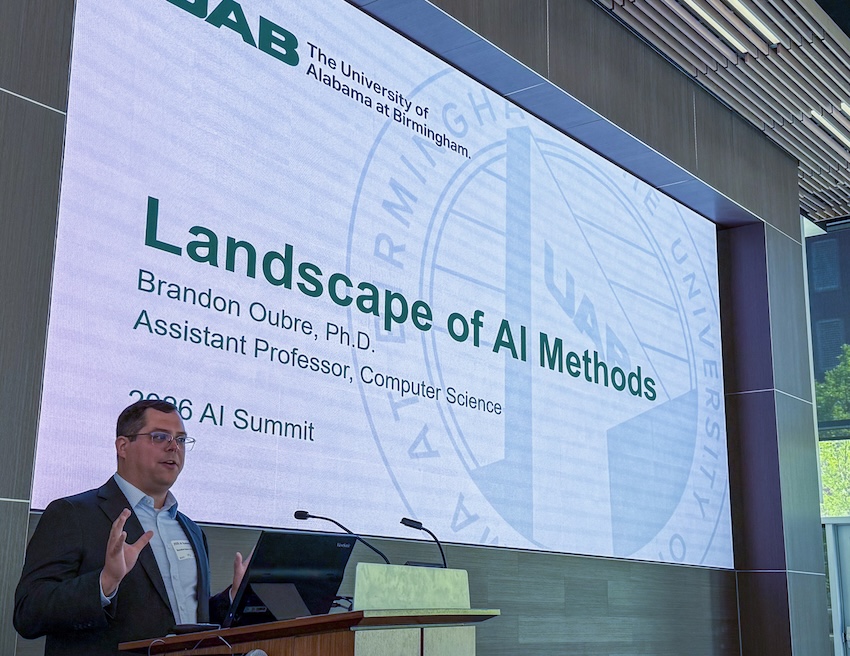 Brandon Oubre, PhD, Assistant Professor of Computer Science at UAB, followed with a presentation on the current landscape of AI methods. His presentation framed AI as a broad computational toolkit that includes large language models, agentic systems, foundation models, federated learning, differential privacy, edge models, and explainability methods. Oubre challenged attendees to consider both the scientific opportunities created by these tools and the team- and institution-scale obstacles that must be addressed to use them effectively.
A series of real-world project presentations highlighted discoveries and applications enabled by AI. Presenters included Emily “Shuya” Feng, PhD; John Osborne, PhD; Jackey Gong, PhD; Sandeep Bodduluri, PhD; and Cheng-Chien Chen, PhD. Together, the presentations demonstrated the range of AI-related work already underway across computer science, biomedical informatics, medicine, physics, engineering, and health system operations.
Following an interactive lunch and brief needs assessment, the afternoon continued with real-time demonstrations of innovative tools. Andrew Crouse, PhD; Ryan Melvin, PhD; Rahul Sharma, PhD; and Abdulhakim Tlimat, MD, showcased examples of how AI can support research workflows, data use, clinical research operations, and applied problem-solving.
A major focus of the afternoon was active discussion. Participants divided into group huddles to consider current and anticipated challenges to AI research at UAB, what UAB should consider to remain competitive in the coming years, and how AI infrastructure could better support collaboration.
- Participants emphasized the need for clearer communication about available AI tools, approved uses, institutional policies, and access procedures. They also discussed the value of a centralized registry of approved AI tools, easier access to current AI platforms, improved support for cloud-based resources and token-based systems, and a safe AI sandbox where teams could test tools with appropriate data before moving into formal approval, procurement, or production workflows.
- Training and collaboration were also recurring topics. Participants identified a need for practical AI training for faculty, staff, students, and trainees, along with more advanced support for researchers using AI in data analysis, software development, clinical research workflows, or grant-related activities. Attendees also noted the value of consultation, matchmaking, and expertise directories to help connect researchers with technical experts and collaborators.
- The discussions also highlighted the importance of clear governance and approval pathways. Participants underscored the need for transparent processes that support responsible AI use while helping researchers understand how projects move through IT, HSIS, procurement, legal, IRB, and compliance channels. The group huddles also raised the need for stronger alignment across UAB campus and UAB Medicine systems, particularly for teams whose work crosses academic and clinical settings.
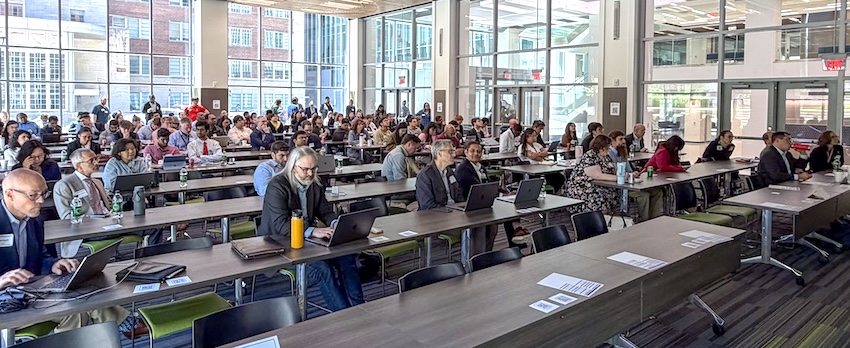 The day concluded with a full-group wrap-up session facilitated by Abu Mosa, PhD, Associate Professor and Vice Chair for Clinical Research Informatics in the UAB Department of Biomedical Informatics and Data Science. Mosa summarized the themes that emerged from the needs assessment and group huddles, including access and infrastructure; people, skills, and collaboration; and governance, trust, and enablement. Jennifer Croker, PhD, UAB Associate Professor of Medicine, CCTS Senior Administrative Director, closed the session by noting the strong engagement throughout the day and the opportunity to continue the conversation through future collaboration.
Across the Summit, one message was clear: UAB has significant AI expertise, active use cases, and strong interest from across the research community. The event also made clear that continued progress will require coordinated support, shared infrastructure, clear communication, and intentional collaboration across disciplines. These opportunities represent a high priority for the institution, as evidenced by the launch of the UAB Artificial Intelligence Strategic Initiative (AISI), which will be led through a centrally organized AI Integration Hub in the Office of the President.
The AI Summit helped lay the groundwork for continued collaboration around AI at UAB, connecting people, tools, and expertise across disciplines. As researchers explore new methods and address practical challenges, these connections can help strengthen future extramurally supported projects and advance discovery across the research enterprise. For additional updates from across the CCTS Partner Network, subscribe to the weekly CCTS Digest and follow CCTS on LinkedIn.