For Jehan Perera and Imansha Madhushan, the journey to the University of Alabama at Birmingham (UAB) began thousands of miles away in Sri Lanka. Today, the two PhD candidates in UAB’s Department of Chemistry are conducting research that could help advance an emerging approach to cancer treatment known as Targeted Alpha Therapy (TAT).
Both students work in the laboratory of Jonathan Burns, PhD, associate professor in the Department of Chemistry. Their research is supported by grants from the U.S. Department of Energy Office of Isotope R&D and Production, including the Horizon-broadening Isotope Production Pipeline Opportunities program, and the DOE Established Program to Stimulate Competitive Research (EPSCoR). Now in the fourth year of their doctoral programs, Perera and Madhushan have each published two first-author papers in highly respected peer-reviewed journals.
While their research focuses on different aspects of TAT, both are working toward a common goal: improving scientists’ ability to use radioactive materials to target cancer cells while minimizing damage to healthy tissue
Exploring the chemistry behind cancer treatment
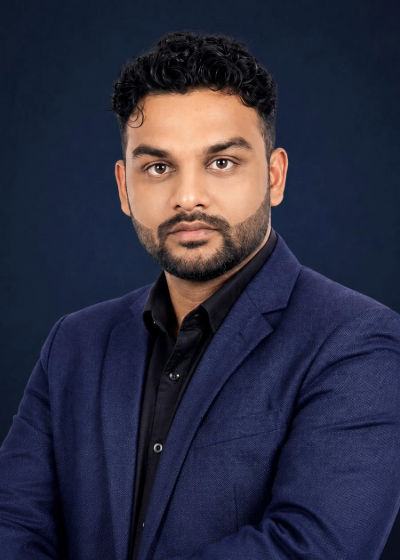 Originally from Sri Lanka, Perera earned his undergraduate degree at the University of Sri Jayewardenepura and an MS in analytical chemistry from the University of Colombo before coming to UAB.
“I have always been curious about how chemistry can help us understand the world and solve problems,” Perera said. “Over time, my interests expanded from analytical and computational chemistry into nuclear science and radiochemistry.”
Perera’s research focuses on astatine-211, or At-211, a radioactive isotope with potential applications in TAT. The isotope releases powerful alpha particles over a very short distance, offering the potential to destroy targeted cancer cells while limiting damage to surrounding healthy tissue.
His research has resulted in multiple publications, including studies on carbon–astatine chemistry and high-yield At-211 radiolabeling. He has also presented his research at national and international scientific meetings, including the World Astatine-211 Meeting and the ACS National Meeting, as well as programs at Brookhaven and Los Alamos national laboratories.
“I am most proud of contributing to the development of redox-controlled chemistry for At-211. We were able to take fundamental observations about astatine chemistry and use them to develop practical radiolabeling strategies,” Perera said.
Developing a platform for treatment and imaging
Madhushan, also from Sri Lanka, earned his bachelor’s degree in chemistry from the Institute of Chemistry, Ceylon, before coming to the United States as the first person in his family to pursue a PhD.
Growing up with limited access to advanced research resources and opportunities motivated him to seek graduate education abroad. His approach to chemistry has always been driven by questions.
“Whenever I conduct an experiment, I find myself asking, ‘Why is this happening?’ and ‘Why do we need to follow this procedure?’”
At UAB, Madhushan joined Burns’ research group with little experience in nanoparticle synthesis or radiochemistry. With mentorship and guidance, he developed the skills to conduct research in both areas.
His research focuses on developing nanomaterials for TAT. The nanomaterial he studies can accommodate multiple metal ions, creating the possibility of combining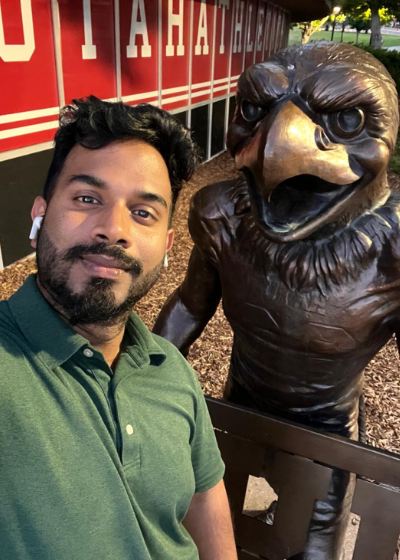 cancer treatment and diagnostic imaging in a single nanoparticle.
One radioisotope could provide the therapeutic alpha radiation, while another could provide an imaging signal. This approach, known as theragnostics, could contribute to more precise and personalized cancer treatment.
One of Madhushan’s proudest accomplishments has been publishing two first-author research papers within his first two years of graduate school.
“For me, those publications represent more than academic achievements; they reflect how much I have grown as a researcher and what can be accomplished through curiosity, persistence, strong mentorship, and access to the right opportunities.”
The impact of an international scientific community
For both students, coming to UAB has provided opportunities to grow as researchers while working alongside scientists from different backgrounds and disciplines.
“Scientific research is inherently international, and working with researchers from different countries, institutions, and scientific backgrounds has broadened the way I think about solving complex problems,” Madhushan said.
“Different people often approach the same scientific question from completely different perspectives, and I have learned that combining those perspectives can lead to stronger and more creative solutions.”
Perera has experienced a similar evolution in his approach to research.
“My experiences in Sri Lanka and the United States have taught me that complex scientific problems are often best solved through collaboration.”
Both students credit Burns and their research collaborators with helping them develop as independent scientists. As they look toward careers beyond UAB, both students hope to continue contributing to the field of radiochemistry and technologies that can improve cancer treatment.