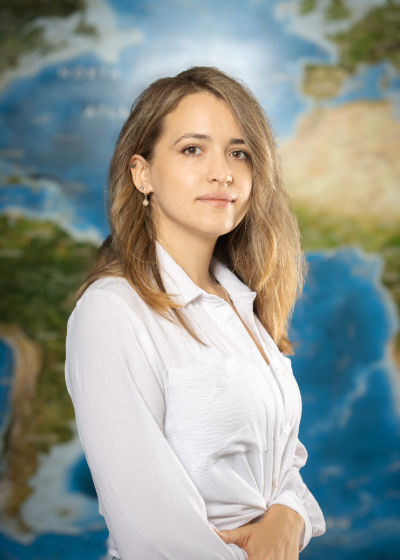
 Olga Khaybullina, a PhD candidate in chemistry at the University of Alabama at Birmingham, has received the C. Ellen Gonter Environmental Chemistry Award, the highest student honor presented by the American Chemical Society’s Division of Environmental Chemistry.
The Gonter award is presented to graduate students at U.S. and international universities who submit the highest quality research papers.
Khaybullina was recognized for her research paper, “Tracking of [14C]Polystyrene Nanoplastics in Pregnant Mice,” which explores how tiny plastic particles move through the body during pregnancy.
Her award-winning research uses carbon-14-labeled polystyrene nanoplastics to create a built-in tracking signal, allowing researchers to follow where the particles travel in the body. The study examined the distribution of nanoplastics in pregnant mice, including whether the particles could reach the placenta and developing embryos.
“Because nanoplastics are far smaller than a speck of dust, following them inside the body is extremely challenging,” Khaybullina said. “This tracking method can support future studies investigating how repeated or longer-term exposure may affect maternal health, placental function, and fetal development.”
Her research provides an important foundation for understanding the movement and accumulation of nanoplastics. The study was not designed to determine whether nanoplastics cause harm, but rather to answer fundamental questions about where these particles go and how they move through biological systems.
Khaybullina’s mentor, Outi Keinänen, PhD, said the research represents an important advancement in the tools available to study nanoplastic bioaccumulation and retention.
“Olga's research focuses on developing 14C-radiolabeled nanoplastic particles and applying them to investigate their fate in mammalian systems,” Keinänen said. “The radiolabeling approach that Olga developed enables quantification of particle biodistribution without altering the particles' intrinsic physico-chemical properties.”
The award adds to a series of accomplishments for Khaybullina and her research team. A paper based on the project was published this spring in Advanced Science and was selected for the journal’s inside back cover.
Khaybullina came to UAB in 2021 to pursue her PhD after earning her bachelor’s degree in chemistry from South Ural State University in Chelyabinsk, Russia. Her interest in environmental chemistry developed during her doctoral studies after joining Keinänen’s lab and discovering how radiochemistry could be combined with her background in synthetic and polymer chemistry.
“The idea that radioactivity could make nearly invisible plastic particles traceable and help us answer environmental and health-related questions fascinated me,” Khaybullina said.
Beyond her research, Khaybullina has taught introductory chemistry laboratories, mentored undergraduate students and serves as the founding president of the Chemistry Graduate Advisory Board.
For Khaybullina, receiving the Gonter Award provided an opportunity to reflect on the collaborative effort behind the research.
“In research, we are usually focused on the next experiment, the next problem, or the next deadline,” she said. “This award gave me a moment to step back and appreciate how far the project had come.”
She credits Keinänen, co-author Pallavi Sarkhel and her collaborators for their contributions to the work.