The University of Alabama at Birmingham acknowledges that there are productive reasons for minors to be present in university work areas. Because of the concerns related to potential exposures to physical, chemical, radioactive and biological hazards, particularly in research laboratories, the following guidelines are necessary to ensure potential exposures are minimized.
This procedure is intended for any individual who is 16-17 years old (enrolled or not enrolled in high school) or 18 years old and currently enrolled in high school. The University does not employ anyone under 16 years of age in any capacity. Individuals working in the Hospital must be at least 18 years of age. UAB Human Resources maintains a Class II Child Labor Certificate for employing 16 and 17 year olds (this certificate replaces the need for individual work permits).
Request for Clearance/Consent for Employing Minors Form
*Clearance request and health enrollment form must be submitted to UAB Occupational Health & Safety (OH&S) at least two weeks prior to hire date for timely processing.
-
Responsibilities
- The Principal Investigator, UAB faculty-in-charge and/or Department Head/Director must submit a Request for Clearance/Consent Form for minors seeking employment in any laboratory, patient care or potentially hazardous area. The request must be approved by UAB Occupational Health & Safety (OH&S), before it is forwarded to UAB Human Resources for appointment processing (see Approval Process tab).
- The Principal Investigator, UAB faculty in charge and/or the Department Head/Director shall be responsible for ensuring that minor employees under their direction have had appropriate immunizations, safety-related training, issued necessary personal protective equipment and that associated documentation has been completed.
- Documentation should be provided showing that the minor’s proposed work/potential exposure at UAB and the minor’s medical history has been reviewed by his/her personal physician. A statement indicating this, to include any work restrictions, must be signed by the physician on his/her office letterhead and provided to the UAB OH&S Employee Health Program, 933 S 19th St, Suite 445, Birmingham, AL 35294.
- If the minor will not work in a lab or potentially hazardous area, lab clearance is not required. However, you must complete the top section of the Request for Clearance/Consent and submit the form with the ACT and other attachments to HR Records Administration & Compliance. Be sure to add a note in the comment section of the ACT document: “minor will work in a non-hazardous area”.
- The Principal Investigator, UAB faculty and/or Department Head/Director in charge shall be responsible for ensuring that employees working with minors have reviewed the information on the UAB Youth Protection website.
- The following are applicable to minors employed in UAB laboratories or other hazardous areas:
- Minors under 16 years of age may not be employed in any capacity at UAB (See HR Policy 125: Employment of Minors).
- Minors may not be employed in any of the 17 FLSA prohibited occupations, such as driving a motor vehicle, operating power-driven machines, or roofing operations. For a complete listing of prohibited occupations visit U.S. Department of Labor website.
- No minor may participate in research related activities
- Minors may not work with regulated amounts of radioactive materials or ionizing radiation. See the UAB Radiation Safety Procedures Manual or contact UAB Radiation Safety for additional information on exempt quantities and exempt concentrations.
- No minor may participate in activities where there is potential exposure to reactive or highly energetic material, carcinogens, reproductive toxins, or highly toxic agents.
- Minors must be instructed on occupant life safety such as familiarity with the building, normal egress routes, emergency egress routes, changes in egress due to construction or maintenance operations, fire safety procedures and emergency preparedness.
- The minor must be informed of potential hazards in the lab area and receive documented training in safe laboratory procedures, including, but not limited to, emergency procedures.
- The parent or guardian must acknowledge in writing that they have been informed of the minor’s participation in a program where hazardous material may be present or hazardous activities may take place and consent to such participation.
- Minors with approval to enter a laboratory or other restricted area must be directly supervised by a responsible employee of that area at all times.
- The Supervisor/Principal Investigator may place additional restrictions on the presence of minors in their work area
Compliance with the above is monitored through periodic OH&S audits. Appeals can be made to the Assistant Vice President, Occupational Health and Safety, CH19, Room 445 or 934-2487. Please contact UAB Talent Acquisiton at 205-934-4030 for questions about this process.
The policy which addresses non-compensated minors (volunteers/visitors) falls under the scope of the Minors in Laboratories and Animal Facilities Policy. For more information, contact the Office of the Vice President for Research and Economic Development, AB 720 or 205-934-4224.
-
Employing Minors Approval Process
It is the responsibility of the PI/Faculty Member/Dept Head/Director/Appointing Department to obtain approval from OH&S before submitting the approved request for clearance form along with documents below to HR Records Administration & Compliance.
The following documents must be submitted to UAB Occupational Health & Safety (OH&S) for approval. Request must be submitted to OH&S two weeks prior to hire date for timely processing.
- Completed Request for Clearance/Consent for Employing Minors Form
- Statement from minor’s physician regarding minor’s medical history
The following documents must be submitted to HR Records Administration & Compliance for appointment processing. If your department has an internal ACT approval process (approval through chairman’s or dean’s office, etc.), please adhere to your department’s internal approval process and follow up with your appropriate department contact to ensure ACT documentation is routed to HR Records Administration & Compliance for final approval.
- Student/Irregular Application (Irregular and student employees are not eligible for any UAB benefits or privileges of employment.)
- I-9
- Approved Request for Clearance/Consent Form
- ACT Document
- For non-UAB students, use assignment category = 04 (irregular), Title = Non-UAB Student Assistant
- For UAB students, use assignment category = 06 (student), Title = Student Assistant (Irregular and student employees are not eligible for any UAB benefits or privileges of employment)
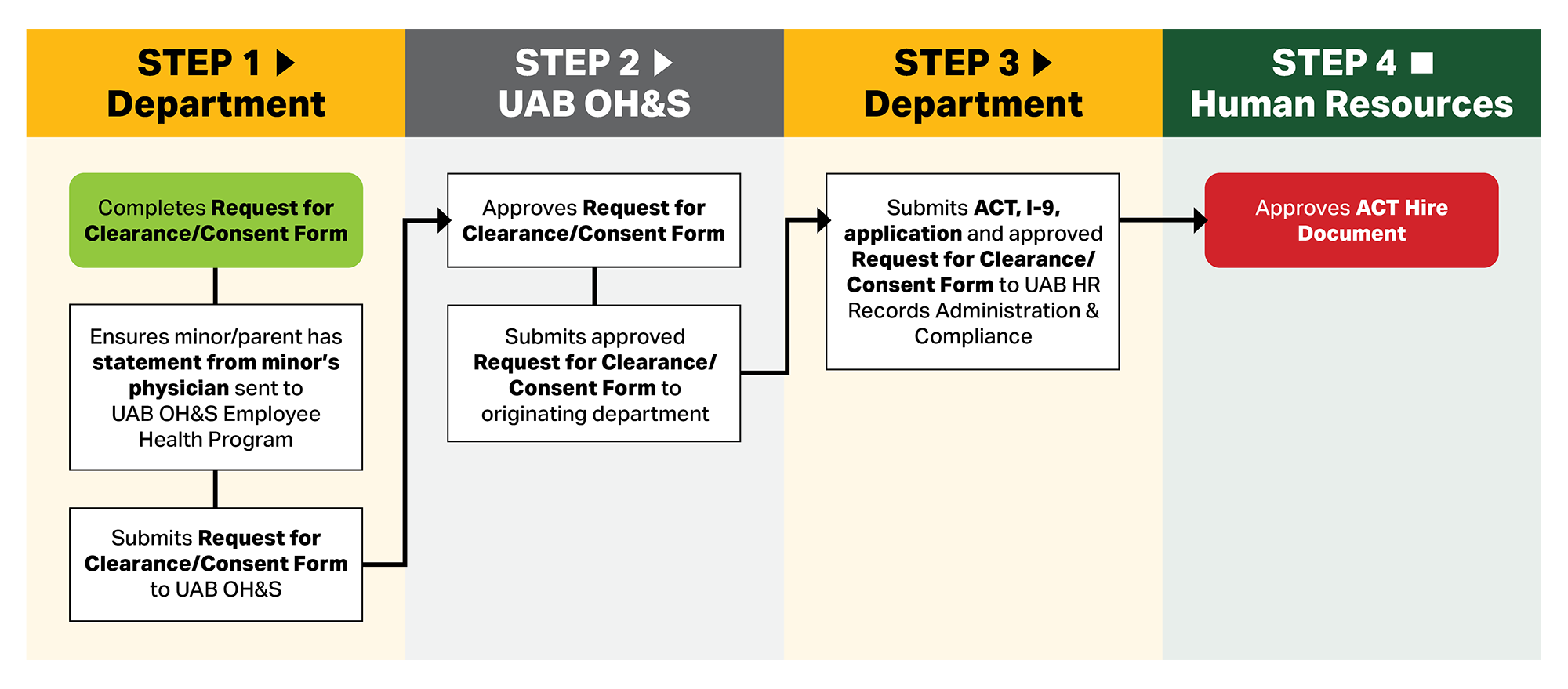
Employing Minors Approval Process: Text EquivalentThe approval process to employ a minor in UAB labs or other hazardous areas is as follows:
Step 1
- The Department completes the Request for Clearance/Consent Form.
- The Department ensures minor/parent has statement from minor’s physician sent to UAB Occupational Health & Safety (OH&S) Employee Health Program.
- The Department submits Request for Clearance/Consent Form to OH&S
Step 2
- OH&S approves Request for Clearance/Consent Form.
- OH&S submits approved Request for Clearance/Consent Form to originating department.
Step 3
- The Department submits ACT, I-9, application and approved Request for Clearance/Consent Form to HR Records Administration & Compliance.
Step 4
- HR Records Administration & Compliance approves ACT Hire Document.
-
Potential Hazard Information Table
This table is to be used as reference for the Consent for a Minor in Laboratories or Animal Facilities Form and the Request for Clearance/Consent for Employing Minors Form.
Potential Hazards General Information Examples Animals Research animals represent a variety of species, temperaments and health conditions. They can cause physical injuries; transmit zoonotic diseases (diseases passed from animals to humans); or be a source of allergens or toxins. Scratch, bite (physical injury) Rabies, toxoplasmosis (zoonotic disease) Chemicals A chemical is a refined compound that may be in the form of a solid, liquid or gas. Potential injuries include burns of the skin or eyes; respiratory problems; allergic reactions; irritation of skin, eyes, and mucous membranes; and illness. Based on their specific effect, chemicals may be classified in one or more of these categories: - Allergens — cause allergic reactions
- Carcinogen — produce cancer
- Teratogen — affect male and female reproductive systems; may cause birth defects in the developing fetus.
- Flammables — burn or explode
- Reactives — react explosively
- Corrosives — cause tissue damage with contact including inhalation
- Toxins — cause illness or death upon exposure. (Neurtoxins specifically affect the nervous system).
Benzene (carcinogen)
Thalidomide (teratogen)
Acetone, xylene, alcohol (flammables)
Peroxides, acrylamide (reatives)
Acids & bases (corrosives)
Cyanide (toxin)Equipment and Instrumentation Potential hazards from mechanical or electrical equipment include loud noises, very high or very low temperatures, electrical shock, and pinching/crushing injuries. FLSA prohibits minors from engaging in certain dangerous occupations — see examples. For a complete listing of the prohibited occupations visit the U.S. Department of Labor website. Autoclaves/sterilizers (burns)
Driving a motor vehicle
Power-driven machines, hoisting apparatus, saws and guillotine shears
Roofing operationsGases Gases may be toxic, corrosive, or flammable. They may cause eye and skin irritations, respiratory problems, light-headedness, asphyxiation, and fainting. Some gases are stored in metal cylinders under high pressure. Compressed gas cylinders can explode, causing injury from high speed projectiles. Nitrogen, helium, any other non-oxygen gas (asphyxiant)
Hydrogen (flammable)
Ammonia (toxic) /td>Lasers Light of a single color emitted in a narrow beam. Hazards from lasers are classified as - Class 1 – No hazard
- Class 2 – Insufficient power to cause eye damage within the normal aversion response time. (Class 2a is a Special-case Class 2 laser designed to be inaccessible to viewing.)
- Class 3a – Direct viewing of the beam can cause eye injury
- Class 3b – Direct and indirect viewing of the beam can cause eye injury.
- Class 4 – Direct and indirect viewing of the beam can cause eye injury. Also, a potential fire hazard.
Nitrogen lasers (Class3b)
Examples of Class 4 lasers used at Jefferson Lab: Free Electron Laser; Argon ion laser, Ti-Sapphire laser,
and diode laserMicrobiological Agents Living organisms such as viruses, bacteria, fungi, prions, and parasites. Those that are capable of causing disease are called pathogens. The affects of these agents are organism dependent and can range from mild, treatable to severe, untreatable. Hazards from microbiological agents are classified as. - Biological Safety Level 1 – no hazards to healthy adults
- Biological Safety Level 2 – cause mild to severe illness
- Biological Safety Level 3 – cause severe illness and possible death
- Biological Safety Level 4 – Not allowed at UAB
Baker’s Yeast & E. coli K12 (Level 1)
Influenza, Polio & Salmonella (Level 2)
Tuberculosis & AIDS (Level 3)Radiation/Radioactive Materials High energy particles (alpha & beta) or waves (X-rays). Unprotected exposure can cause skin or eye damage, cellular damage, and long-term health problems. Uranium, Phosphorus32, Sodium35, X-rays Recombinant Materials DNA that has been genetically engineered (altered) by combining it with DNA from another source. Viruses may be used as vectors to infect (transfect) cells with the foreign DNA. A transgenic organism is one that has had genes from another organism inserted into its genes. The consequences of introducing such foreign genes into a human body may be difficult to predict. Adenovirus, adeno-associated virus (viral vector) Toxins Poisons produced by microbiological organisms, plants, or animals. These agents can cause tissue and organ damage or death. Ricin (plant)
Snake venom (animal)