 When founders took the stage at the gBETA Prosper HealthTech Showcase in June, they weren't simply pitching ideas. They were presenting solutions forged through weeks of rigorous mentorship, customer discovery, commercialization planning, and entrepreneurial training.
It was a big spring for UAB students. Two startups advised by the UAB Marnix E. Heersink Institute for Biomedical Innovation — MAMU Digital Solutions and GuidelinesIQ — landed spots in the Spring 2026 gBETA Prosper HealthTech accelerator, joining just six Alabama startups selected for the cohort.
Their participation spoke to something bigger than startup success. It reflected the Institute's growing commitment to preparing students not just to develop innovative biomedical technologies, but to understand how those ideas travel from a research environment into the real world.
Operated by Gener8tor in partnership with Prosper, gBETA is a free, non-equity accelerator that helps early-stage founders build stronger strategies, sharpen their market positioning, and ready their technologies for growth. Over seven weeks, participants work side by side with mentors, investors, and innovation leaders to gain the practical skills it takes to build something that lasts.
For Stevan Fairburn, M.D., MS, a recent graduate of the UAB Heersink School of Medicine and the Master of Science in AI in Medicine program, the mission of the institute is to connect medicine, engineering, and artificial intelligence with real-world innovation, which became personal the moment he spotted a problem hiding in plain sight during clinical care.
Fairburn founded GuidelinesIQ, an AI-powered clinical decision support platform designed to help healthcare teams access institution-specific protocols and guidance at the point of care. The platform transforms scattered protocols and standard operating procedures into a single, searchable knowledge hub so clinical teams can find information they need when they need it.
Fairburn had already identified the problem and built something to solve it. What gBETA gave him was a clearer picture of what comes after. The harder, less obvious work of transforming a strong idea into a sustainable company.
"The program taught us how to be founders, how to stand up a company, and how to build a team around us that can implement and scale our companies," Fairburn said.
At the showcase, founders didn't just walk the audience through what they built. They made the case for why it matters, who it serves, and what it will take to get it into the hands of the people who need it most.
For Stéphanie Marie Aguilera, founder of MAMU Digital Solutions and an engineering Ph.D. student collaborating with the institute's experts, that entrepreneurial perspective became one of the most valuable parts of the experience.
MAMU Digital Solutions is tackling one of healthcare's quieter but costly problems: the sheer volume of medical imaging data. Their technology compresses and optimizes that data without sacrificing the diagnostic quality clinicians depend on.
Aguilera was no stranger to the technical side of innovation, but gBETA revealed an entirely different side of innovation than the technical development she was familiar with.
"As an engineering student, I know how to build things," Aguilera said. "What I didn't know were all the pieces that come with commercialization."
Through mentorship and direct feedback from startup and business leaders, she began to see the full architecture of what building a company requires, including business planning and company formation to executive communication and long-term growth strategy.
Aguilera came in with an early concept and a minimum viable product. What she left with was a fundamentally different way of thinking about how technology finds its audience and earns its place in the market.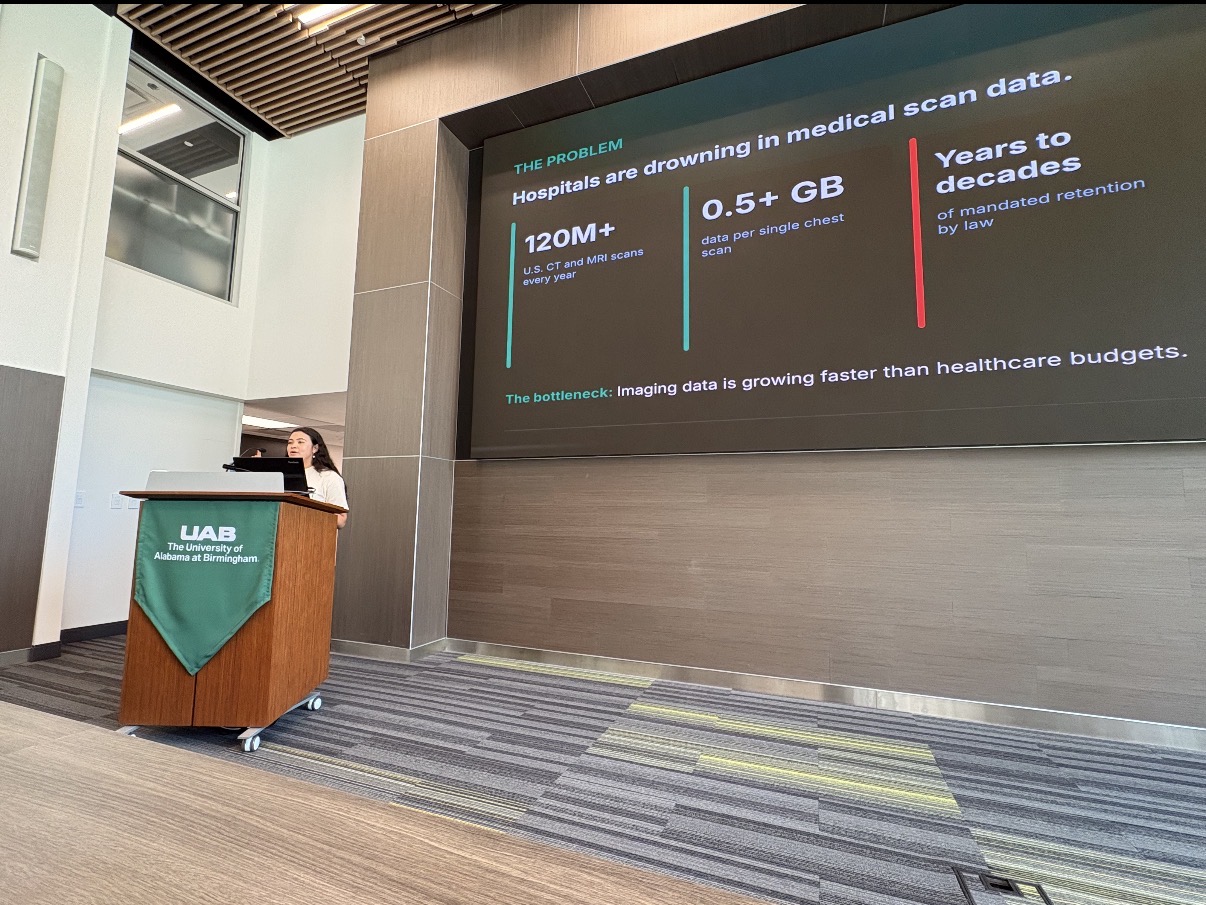
"We saw value in what we created," she said. "But learning whether other people would adopt it, how to position it, and what building a company actually looks like was a completely different process."
That shift from invention to implementation is one of the institute's intentional cultivations. By connecting students with programs like gBETA, the institute moves emerging innovators beyond traditional academic training and into the real work of turning ideas into usable products, scalable ventures, and sustainable impact.
The showcase closed out seven weeks of accelerator programming, but for Fairburn and Aguilera, it opened something else: a clearer path from the idea to the lab and, eventually, the clinic to solutions that reach the people who need them most.
As UAB continues strengthening its health innovation ecosystem, experiences like these aren't just preparing students to participate in the future of healthcare. They're preparing them to shape it.
For UAB students with an early-stage AI startup or ideas for one, the Heersink AI Founders Club offers a next step worth taking. The selective pilot program accepts up to five startups each year, providing equity-free mentorship, founder-to-founder peer learning, UAB ecosystem connections, and up to $1,500 in financial support per startup for program events. Applications for the current cohort are open through August 1.
Learn more and apply at uab.edu/medicine/biomedicalinnovation/programs/heersink-ai-founders-club.