
The Marnix E. Heersink Institute for Biomedical Innovation (MHIBI) recently hosted two cohorts of visiting medical students from Mahidol University and Thammasat University, offering an immersive, hands-on experience in artificial intelligence (AI) research alongside UAB faculty.
Across both visits, four students engaged directly with interdisciplinary teams, gaining firsthand insight into how collaboration between clinicians, engineers, and data scientists is accelerating innovation in healthcare.
Advancing AI in medicine
The first cohort, visiting in December 2025, included Mahidol University students Monrada Chiewhawan and Watcharapong Timklaypachara, both of whom were part of a competitive M.D.–M.Eng. program that integrates medicine and engineering.
Their work focuses on cutting-edge applications of AI, including medical image processing, natural language processing, and AI for science, rapidly transforming clinical care.
During his time at MHIBI, Watcharapong advanced research on Kolmogorov–Arnold network architecture for polyp detection, a project that became his master’s thesis and was successfully defended in March 2026. Conducted under the mentorship of Sandeep Bodduluri, Ph.D., and in collaboration with MHIBI and the Diagnostic Intelligent Group (DIG), the work has also been submitted to the Medical Image Computing and Computer-Assisted Intervention Society (MICCAI).
Monrada contributed to the development of an automated pipeline for detecting and labeling white blood cells, an extensive project that continues in collaboration with MHIBI, DIG, and the Wells Lab, with the goal of releasing an open-source model.
Prior to arriving at UAB, both students had already been collaborating with UAB researchers for nearly a year, highlighting the strength of sustained global partnerships.
A second cohort builds clinical AI applications
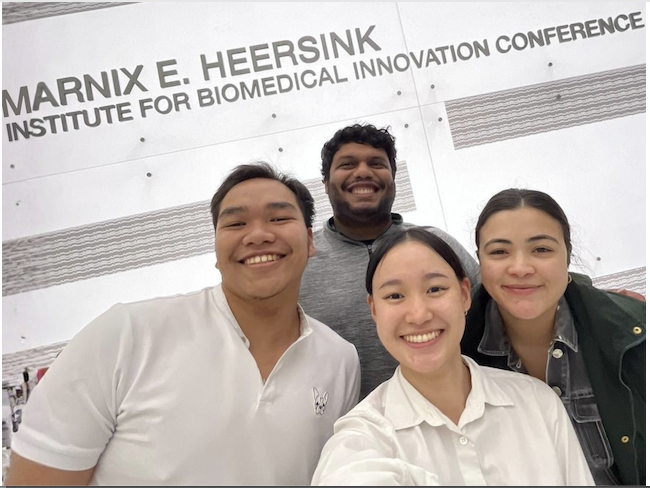 In March 2026, MHIBI welcomed a second cohort of two final-year medical students, Atom Apiwongsuwan and Krisd Sirayanyong from Thammasat University.
During their three-week AI rotation, the students were introduced to foundational AI concepts, large language models, and application development. They quickly applied this training to real-world clinical challenges, particularly in cardiology.
Their projects include developing datasets to address electrocardiogram (ECG) complexities and building tools such as ZipBeat-ANC, a software solution designed to remove motion artifacts (such as tremors or shivering) to improve ECG accuracy. They are also developing ACLS Co-Pilot, an application intended to assist physicians in documenting and managing cardiac arrest events in real time.
While aspects of their research remain in progress, the team is nearing publication of their dataset and accompanying paper.
A culture of collaboration
Across both cohorts, one theme stood out: the institute’s uniquely collaborative environment.
Students worked closely with teams across the institute, including the CLAIR Lab, Lung Health Center, and DIG, and connected with faculty such as Rubin Pillay, Ph.D., M.D., executive director of the institute and chief innovation officer for the UAB Health System, along with researchers including Abhiraj Pudhota and interdisciplinary teams spanning medicine and engineering.
“What stood out most was how naturally collaborations begin,” Watcharapong said. “Physicians and researchers would actively approach us to discuss ideas. This openness felt unique.”
Monrada reiterated this reaction, noting she had “never felt more integrated in a scientific community.”
For the Thammasat students, the experience offered something new: a true interdisciplinary workflow.
“This was our first opportunity to bridge biomedical engineering and clinical medicine in a real-world setting,” Apiwongsuwan shared. “It provided a blueprint for how we can bring this model back to Thailand.”
Learning beyond the lab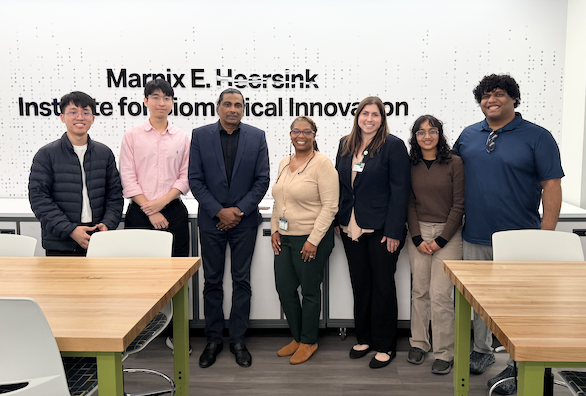
Beyond research, the experience fostered strong personal connections. Students emphasized the welcoming, supportive environment created by MHIBI teams.
“They helped us settle in and made us feel welcome,” Watcharapong said. “We connected not just professionally, but personally.”
The Thammasat cohort similarly reflected on the camaraderie and mentorship they received, describing the experience as both academically and personally meaningful.
The next generation of innovators
The impact of the visit extends far beyond the duration of the rotations.
For the Mahidol students, the experience reinforced the importance of interdisciplinary collaboration in solving complex healthcare challenges. For the Thammasat students, it expanded their understanding of what it means to be a physician in an increasingly technology-driven field.
“Working alongside engineers and visionary leaders broadened our perspective on the role of a physician,” Sirayanyong noted. “It showed us that our potential extends beyond traditional clinical practice.”
All four students will continue collaborating with MHIBI faculty and teams, maintaining the partnerships formed during their time at UAB.
As they return to Thailand, they bring not only new technical skills and research experience, but also a shared vision: that the future of medicine lies at the intersection of global collaboration, artificial intelligence, and interdisciplinary innovation.