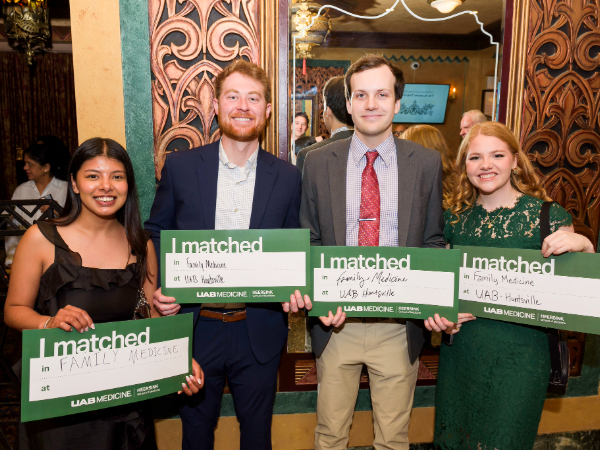
 Wade Jones poses on Match Day with three other Heersink School of Medicine students who matched into Family Medicine. A few months after graduating from the UAB Heersink School of Medicine and starting residency, Wade Jones, M.D., is still getting used to his new title.
“It still feels weird,” Jones said, recalling the moment a colleague sent him a screenshot identifying him as “Dr. Jones, PCP” in a clinical system. “I was like, ‘Oh my gosh.’”
The title may be new, but the path that led Jones to matching into family medicine has been years in the making. A native of Guntersville, Ala., who matched into the UAB Huntsville Family Medicine Residency program, family medicine was the career he envisioned long before entering medical school.
As a high school and college student, he explored several medical specialties through shadowing, including radiology, emergency medicine, and dermatology. While observing a family physician, Jones watched the doctor move seamlessly from managing chronic conditions and same-day appointments to comforting a sick child with a sticker from the office treasure chest.
“I got some shadowing opportunities and there were some that I immediately wrote-off as just not me, but I did love the primary care setting,” Jones said. “When I pictured a physician, I thought of my general practitioner growing up in Guntersville. The first doctors in my mind are the primary care doctors.”
That vision only became clearer through his participation in the Rural Medical Program (RMP). RMP, a five-year program which includes a year of prematriculation study in Auburn University’s College of Sciences and Mathematics, prepares students from rural communities for careers in medicine and encourages them to practice in Alabama’s most vulnerable areas.
Joining RMP provided early clinical exposure before medical school, allowing Jones to develop skills such as taking vital signs and performing basic physical exams. By the time he entered medical school, Jones felt more comfortable interacting with patients than many of his peers.
Beyond clinical training, RMP provided a close-knit community of students and mentors who shared a commitment to rural health care and service to Alabama communities.
“I definitely think we had a leg up coming into first year,” he said. “One of the major benefits is that I got a great group of people that I became close with and could all prepare for moving to Birmingham. Then we got that clinical training that other people didn't have.”
 The Dean’s Primary Care Scholars Program reinforced his commitment to family medicine. Led by Family and Community Medicine Assistant Professor Sumayah Abed, M.D., the program offers medical students additional training, mentorship, and service opportunities focused on primary care.
Jones said one of the most meaningful experiences came through a co-enrolled elective that allowed him to work with the Live HealthSmart Alabama Mobile Wellness Van, providing screenings and outreach in community settings.
“During your first two years, you don’t see patients very often,” he said. “That was a great experience because we got to work with people directly.”
Now entering the next stage of his medical journey, Jones remains convinced family medicine offers exactly what he wants in a career.
“Family medicine gives me the perfect mix,” he said. “I can see all ages, work in the outpatient setting and have so much variety within the same specialty.”
His decision to remain in-state was equally simple. Jones and his wife, whom he met at Auburn University, have built their lives in Alabama and picture raising their growing family here.
“This is our home, and this is where we want to be,” he said.
Even as he begins his intern year in Huntsville, Jones has imagined his own practice and life in the future and believes practicing family medicine here will allow him to connect more deeply with patients because he understands the communities and culture.
“I love Alabama and want to give back to a state that’s five so much to me,” said Jones. “I always knew that after residency, I’d want to stay here. I’m invested in this state, and I don’t want to be anywhere else.”
While workforce shortages continue to challenge access to primary care across Alabama, Jones hopes to become part of the solution. He also plans to mentor future students, particularly those coming through rural programs like the ones that shaped his own journey. Just as important as mentorship, however, is financial support.
Jones was one of 14 Heersink School of Medicine graduates who received a 2026 Primary Care/Family Medicine Match Scholarship award from the Department of Family and Community Medicine’s Comprehensive Urban Underserved and Rural Experience (CU2RE) program. He also received support from the UAB Dean’s Primary Care Scholars program. While he emphasizes financial incentives did not drive his specialty choice, the support made a meaningful difference in reducing the burden of medical school debt.
The scholarships eased financial pressures during medical school and, in his fourth year, allowed him to avoid taking out additional loans. The support became even more meaningful when the couple learned they were expecting a child.
“That just helped take the pressure off of us,” he said. “Life brings a lot of curveballs. Having these scholarships allowed me to focus on my last year of school, go through the (residency) application process, and just know that I don’t have to stress about it as much.”
Although he still graduated medical school with debt, Jones said the financial assistance made that burden significantly more manageable.
Looking back, he sees the scholarships, mentorship, and educational opportunities the Department of Family and Community Medicine provided as investments that helped him stay focused on serving patients instead of worrying about finances.
“I’m incredibly thankful,” Jones said. “It’s taken so much weight off my shoulders.”
As he begins residency in Huntsville, Jones is bringing lessons from the programs that supported him, along with a commitment to remain in Alabama and care for its communities.
For Jones, family medicine is about relationships, service, and home.
And home, he says, is Alabama.
The CU2RE Program is supported by the Health Resources and Services Administration (HRSA) of the U.S. Department of Health and Human Services (HHS) as part of an award totaling $17.175 million, with 10% financed with nongovernmental sources. The contents are those of the author(s) and do not necessarily represent the official views of, nor an endorsement by, HRSA, HHS, or the U.S. Government.