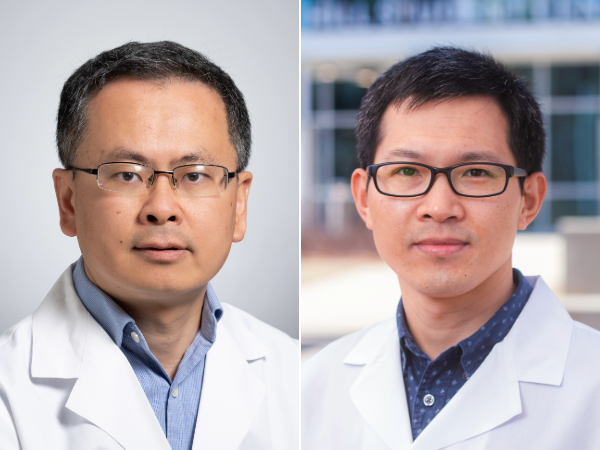
 Gang Liu, M.D., Ph.D, and Huachun Cui, Ph.D.Gang Liu, M.D., Ph.D., professor, and Huachun Cui, Ph.D., assistant professor, in the Department of Medicine, have been named the latest recipients of the school’s Featured Discovery award. This recognition celebrates notable research contributions made by faculty and highlights the impact of their scientific advancements.
Liu’s study, “TREM2 promotes lung fibrosis via controlling alveolar macrophage survival and pro-fibrotic activity,” explores the effects of the TREM2 molecule on the lungs. Liu and his team aim to learn more about how TREM2 works in order to prevent lung scarring.
TREM2 can be located on certain immune cells in the lungs. These cells are known as macrophages.
“These macrophages come from blood cells called monocytes and move into the lungs after injury,” said Liu. “TREM2 helps these cells stay alive and become more active in promoting scarring. It does this by binding to fats (lipids) found in the air sacs of the lung.”
The Heersink communications team met with Liu and Cui to gain insights into the study and help raise awareness about both the research and the Heersink School of Medicine.
What compelled you to pursue this research?
There is extensive evidence that lung macrophages contribute to the development and progression of pulmonary fibrosis. However, the mechanisms that regulate their activation, differentiation, and persistence remain poorly understood. This knowledge gap motivated us to investigate how macrophage fate and function are controlled in the fibrotic lung.
How do you feel your research will impact the science community?
Our study identifies TREM2 as a key regulator of macrophage survival and fibrotic activation in the lung. By defining how this receptor shapes macrophage behavior, we provide new insights into the cellular and molecular mechanisms that drive fibrosis—insights that could inform future therapeutic strategies targeting macrophage signaling in chronic lung disease.
What is the relevance of your research to human disease?
Our findings reveal that macrophage TREM2 represents a promising therapeutic target for treating pulmonary fibrosis. Modulating this pathway may help prevent or reverse fibrosis in patients by limiting the persistence of pro-fibrotic macrophages.
When did you know you had an important discovery?
We realized the significance of our finding when conditional deletion of TREM2 in monocyte-derived macrophages markedly protected mice from developing lung fibrosis. This result provided clear functional evidence linking TREM2 to fibrotic disease progression.
How has being at UAB and living in Birmingham affected your research?
The collaborative and supportive research environment at UAB, coupled with the strong culture of interdisciplinary interaction across Birmingham’s biomedical community, has been instrumental in advancing our program. This environment has allowed our team to thrive and pursue innovative, high-impact research.
Read more about the study on the UAB News site.
Featured Discovery
•
December 17, 2025