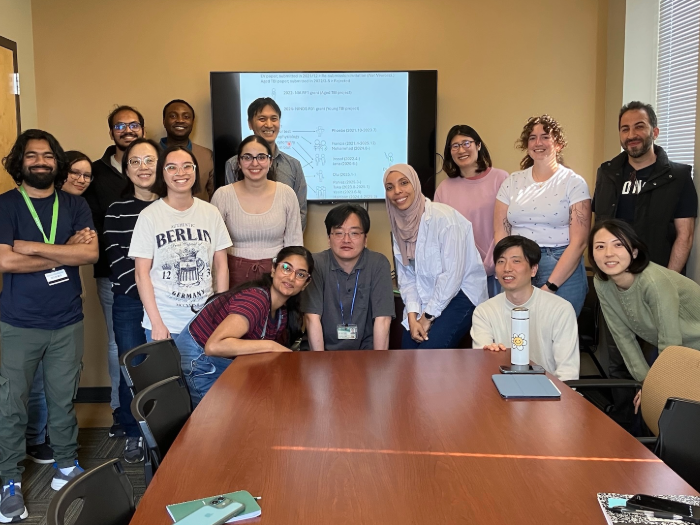
 Shin-ichi Kano, M.D., Ph.D, with his research teamShin-ichi Kano, M.D., Ph.D., professor in the Department of Psychiatry and Behavioral Neurobiology, has been named the latest recipient of the school's Featured Discovery award. This recognition celebrates notable faculty research contributions and highlights the impact of their scientific advancements.
His study, “Circulating extracellular vesicle microRNAs mediate immune modulation of social behavior in male mice,” was published in Nature Communications.
Through their research, Kano and his team studied the impact of cell-derived small membrane vesicles, known as extracellular vesicles (EVs), on brain function and behavior. The team discovered that EVs in wild-type mouse models successfully increased sociability in socially impaired male mice.
The Heersink communications team met with Kano to gain insights into the study and help raise awareness about both the research and the Heersink School of Medicine.
What compelled you to pursue this research?
Molecules circulating in the blood are widely studied to identify diagnostic and prognostic markers for brain disorders, including neurological and psychiatric disorders. However, it is unclear whether those changes in the blood are part of pathological changes causing brain dysfunction. So, we tested whether normal healthy blood may have any beneficial effects on behavioral changes in rodents.
What was your most unexpected finding?
Serum transfusion from socially normal mice to socially impaired mice restored their social behavior. Specifically, we found that blood-to-neuron communication via microRNAs (miRNAs) associated with extracellular vesicles plays a crucial role in regulating social behavior in mice. Notably, adding the identified miRNAs back into socially impaired mouse EVs and into the bloodstream restores social behavior.
How do you feel your research will impact the science community?
The deleterious effects of aging-associated molecular changes in the blood, mostly protein changes, on the function of the brain and other organs have been studied for the last 15 years. However, it remains unclear whether blood molecular changes influence brain homeostasis and function in a non-aging context. Our research is the first to show that blood-borne factors are necessary for normal social behavior. Furthermore, our findings highlight the biological significance of long-range intercellular communication mediated by miRNAs.
What is your research’s relevance to human disease (if applicable)?
The miRNAs that we identified were previously reported to be dysregulated in human patients with schizophrenia and autism spectrum disorders. Although our findings come from basic biology studies in rodents, these miRNAs may have therapeutic potential. We are considering moving this research in a translational direction. With support from the Bill L. Harbert Institute for Innovation and Entrepreneurship, we could also submit a patent based on our findings.
When did you know you had an important discovery?
When we first observed that socially impaired mice acquire sociability upon receiving serum and EVs from socially normal mice.
How has being at UAB and living in Birmingham affected your research?
As the only large research institution in the area, we occasionally need to seek help outside the area for certain expertise. Otherwise, we don't have much. Birmingham life has more positives, including an affordable cost of living and a relaxed city atmosphere. I think prospective faculty, postdocs, and graduate students should seriously consider training at UAB next. I am sure they will strengthen UAB's research environment, helping us reach the next level of excellence.
What made you come to UAB?
I moved to UAB from Johns Hopkins University in 2019 to expand my research potential and pursue new opportunities. Although my primary research area is psychiatry, my lab conducts interdisciplinary research in neuroimmunology at the interface of neurobiology and immunology. UAB is strong in both areas, so I had no second thoughts and was thrilled to have the opportunity to be part of it.
What do you find makes the science community here unique?
The major strength here is the borderless community. We work together beyond department and school boundaries, which is occasionally challenging at other institutions.