 Frances Lund, Ph.D.Frances Lund, Ph.D., professor in the Department of Microbiology, has been named the latest recipient of the school's Featured Discovery award. This recognition celebrates notable faculty research contributions and highlights the impact of their scientific advancements.
Her study, “Topography of the HLA-A protein enforces shared and convergent immunodominant B cell and antibody alloresponses in transplant recipients,” was published in Immunity.
“Kidney transplantation is the only treatment beyond lifetime dialysis for patients who have experienced kidney failure,” said Lund. “The kidney that is donated to the patient is almost always provided by a donor who is not an identical twin to the recipient patient, which means that the donated kidney is ‘foreign’ to the recipient’s immune system. In order to prevent the recipient’s immune system from attacking the donor kidney, we must treat the patients with drugs that suppress the immune system—leaving the recipient very vulnerable to infections.”
Because of this risk, Lund and her team developed a new approach that aims to make kidney transplants more tolerable for the recipient’s immune system. The goal of this project is to identify novel immune modulators that in the future may be used to prevent kidney rejection.
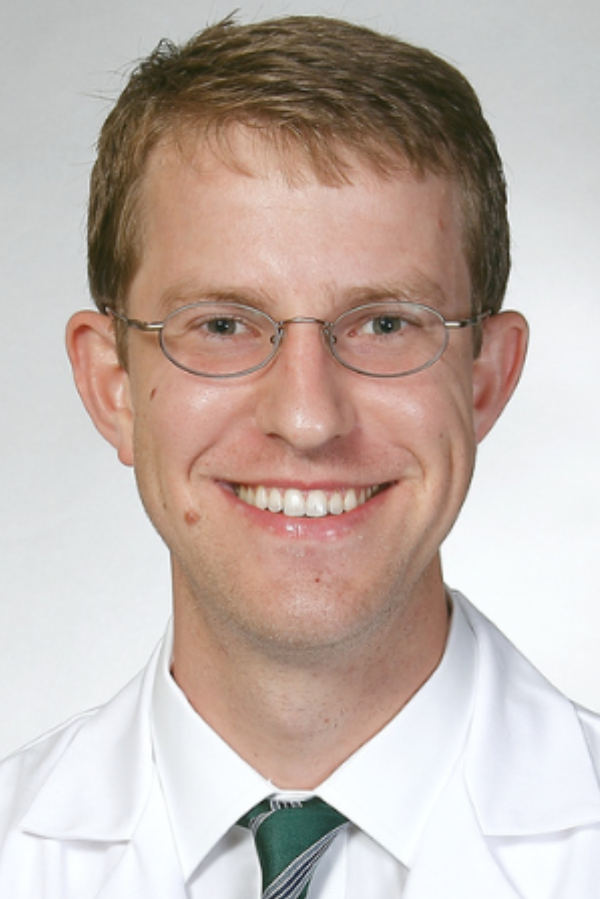 John Killian, M.D.“Our goal was to identify the most harmful types of mismatches between the donor and recipient,” said John Killian, M.D., the study’s first author. “Long-term, we hope that this knowledge might improve matching of donors and recipients and potentially facilitate the use of less intensive immunosuppression.”
The Heersink communications team met with Lund to gain insights into the study and help raise awareness about both the research and the Heersink School of Medicine.
What compelled you to pursue this research?
The researchers who worked on this project, including individuals from the Lund/Randall, King, and Green research groups, wanted to understand how the immune system, particularly B lymphocytes and antibodies, detects the transplanted kidney. The transplant field has known for decades that when the recipient and donor express different variants or alleles of proteins, called Human Leukocyte Antigens (HLA), the immune system is triggered to respond.
However, despite the many different variations of HLA proteins in the human population, the proteins are actually highly conserved with only relatively small differences between the HLA that may be expressed by the donor and the recipient. It was unknown exactly which small differences in HLA proteins trigger the immune response. We reasoned that if we could better understand which differences in HLA matter, we might be able in the future to design better therapies to prevent the immune system from responding to those differences.
What was your most unexpected finding?
We were expecting to find that the differences in the donor and recipient HLA that are targeted by the immune system would be unique to each recipient and donor pair. However, we found that the immune system seems to target highly specific areas on one HLA molecule called A*01:01. We found that regardless of what HLA is expressed by the recipient, if they receive a kidney that expresses HLA A*01:01 (and the recipient does not), the immune system will preferentially target two to three sites on the A*01:01 molecules. We were able to make antibodies that recognized those sites on A*01:01 and use them to block the antibody responses of 20 transplant recipients who each received mismatched A*01:01-expressing transplanted tissue.
How do you feel your research will impact the science community?
The findings in this paper suggest that very specific regions of HLA proteins are targeted by the immune system. From a clinical standpoint, understanding why these regions are targeted specifically might help us, in the future, make better “matches” between donors and recipients to minimize immune recognition and responses to the foreign transplanted tissue.
From a fundamental science perspective, this discovery suggests that the regions (called epitopes) in HLA A*01:01 proteins that are seen by the immune system are more “public” epitopes. What that means is that the immune systems of all of us are trained to recognize very specific differences in HLA. Understanding what is “seen” by the immune systems of most people will help us learn more about immune recognition. This is important in everything from infectious disease to cancer to autoimmunity.
What is your research’s relevance to human disease (if applicable)?
The findings in our publication are relevant to human disease for two reasons. First, the antibodies we identified and tested in this paper could be potentially modified to use in humans who have received an A*01:01 mismatched tissue transplant. We predict that these modified “stealthy” antibodies might be useful to cover up and hide the parts of A*01:01 that the recipient’s immune system will target.
The second reason that these data are relevant is that we now know which parts of one HLA molecule (A*01:01) are recognized by the immune system of recipients. Going forward, we will see whether the rules we learned in this study can be applied to other kinds of HLA molecules that are also targeted by the immune system.
When did you know you had an important discovery?
We knew our findings were likely to be important when we found that the same regions of the donor HLA A*01:01 molecule were recognized by many different B cells in the body of the transplant recipient. We expected to find many recognition sites on HLA rather than just two or three targeted repeatedly. When we learned that the same regions in A*01:01 that were targeted repeatedly by our first transplant recipient were also targeted by many other patients who received a mismatched A*01:01 transplant, we knew that this was going to be a new and very novel discovery that could have a clinical impact and was also likely to change our fundamental understanding of immune recognition of proteins that are unique but also very similar to self-proteins.
Check out previous Featured Discoveries or nominate yourself or a colleague.