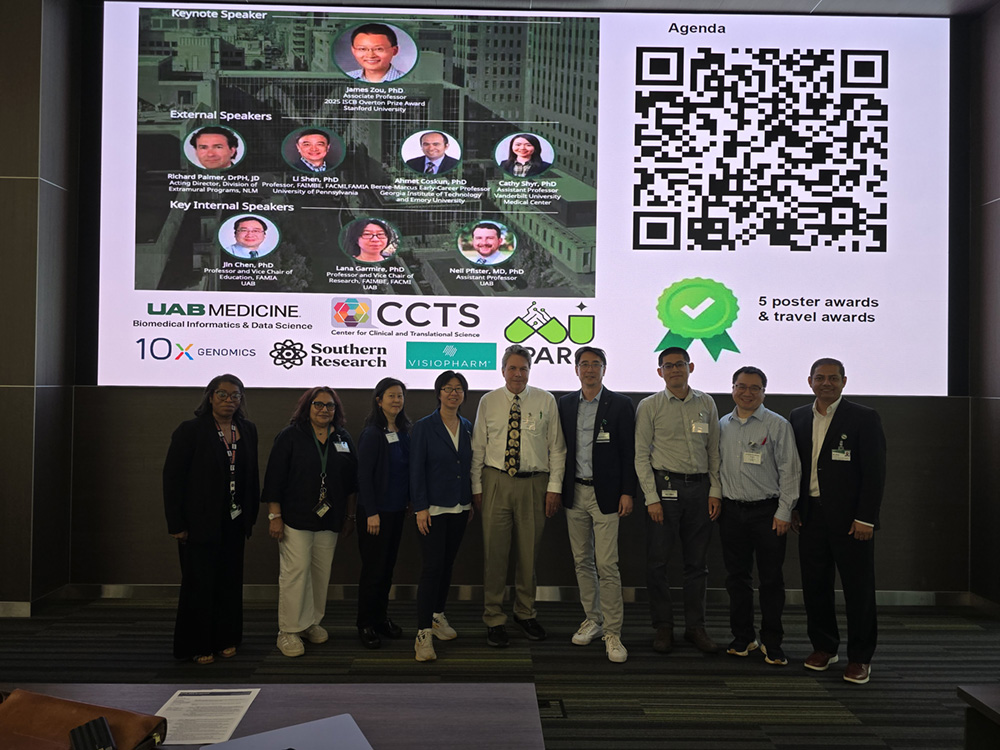
 2026 ATTIS Program CommitteeOn Tuesday, May 5, the 10th Annual Translational and Transformative Informatics Symposium (ATTIS), hosted at UAB’s Altec/Styslinger Genomic & Data Sciences Building by the Department of Biomedical Informatics and Data Science and the Systems Pharmacology AI Research Center (SPARC), brought together investigators, clinicians, trainees, and industry leaders to explore how artificial intelligence is accelerating discovery and improving patient care.
ATTIS 2026 was organized around the theme “AI in Precision Medicine” and held jointly with the UAB AI Summit. The symposium featured keynote presentations, multidisciplinary scientific sessions, trainee flash talks, a panel discussion on deep-south AI ecosystem building, and a record-high submission of posters highlighting emerging AI research in Precision Medicine.
Jake Chen, Ph.D., professor in the Department of Biomedical Informatics and Data Science and director of SPARC, began with opening remarks illustrating ATTIS’s success over the last decade. Keynote sessions featured James Zou, Ph.D., associate professor in the Department of Biomedical Data Science at Stanford University, who virtually presented “AI agents to accelerate biomedical discoveries,” emphasizing how agentic AI can make biomedical research more scalable, reproducible, and translational. The program also reinforced how AI is moving from model development toward practical, collaborative, workflow-level deployment in precision medicine.
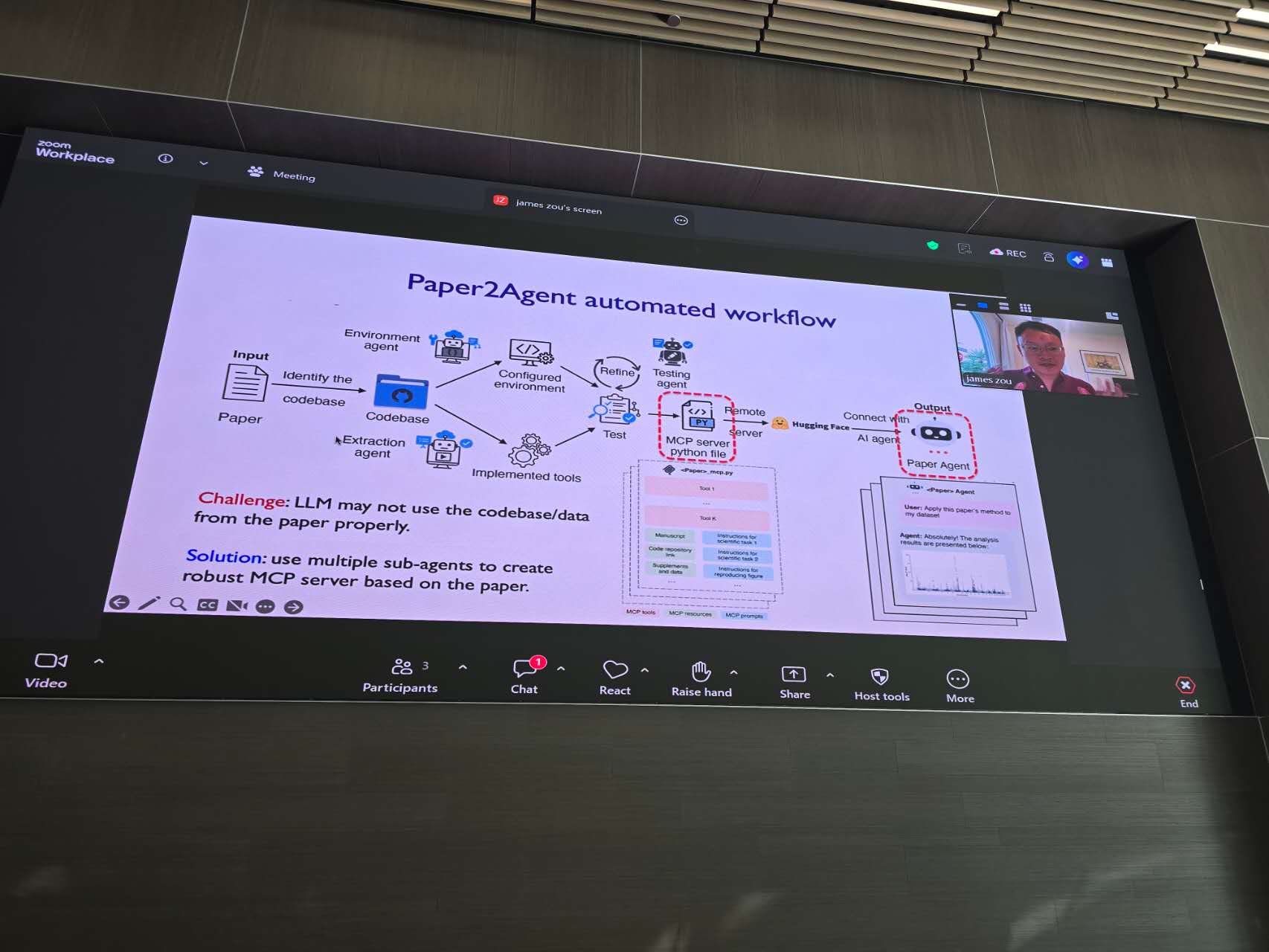 James Zou, Ph.D., delivers a virtual keynote on agentic AI in biomedical research.Scientific sessions reflected the breadth of innovation with speakers from external academic institutions, including Li Shen, Ph.D., FAIMBE, FACMI, FAMIA, the University of Pennsylvania, Ahmet Coskun, Ph.D., Georgia Institute of Technology, and Cathy Shyr, Ph.D., Vanderbilt University Medical Center.
UAB speakers and program committee members included Jin Chen, Ph.D., Department of Medicine; Lana Garmire, Ph.D., Department of Biomedical Informatics and Data Science; Jinzhuang Dou, Ph.D., Department of Biomedical Informatics and Data Science; James J. Cimino, M.D., chair of the Department of Biomedical Informatics and Data Science; Abu Saleh Mohammad Mosa, Ph.D., M.S., FAMIA, Department of Biomedical Informatics and Data Science; Zechen Chong, Ph.D., Department of Biomedical Informatics and Data Science; Amy Wang, M.D., Department of Biomedical Informatics and Data Science; John D. Osborne, Ph.D., Department of Biomedical Informatics and Data Science; and Neil Pfister, M.D., Ph.D., Department of Radiation Oncology.
Industry sponsored talks featured 10x Genomics, Southern Research, and Visiopharm. Through these talks, presenters highlighted AI and informatics for a variety of clinical fields, including dementia and aging research, immunity and cancer, rare disease diagnosis, ICU outcome prediction, clinical world models, digital pathology, and real-world implementation of precision medicine tools through high-quality data and predictive analytics.
A featured panel discussion, “Building a Competitive AI for Medicine Ecosystem,” emphasized the collaborations required to translate AI innovation into measurable health impact. Panelists from UAB, the University of Pennsylvania, and Southern Research discussed cross-institutional data infrastructure, workforce and talent development, and practical pathways to scale AI from discovery through deployment in healthcare settings.
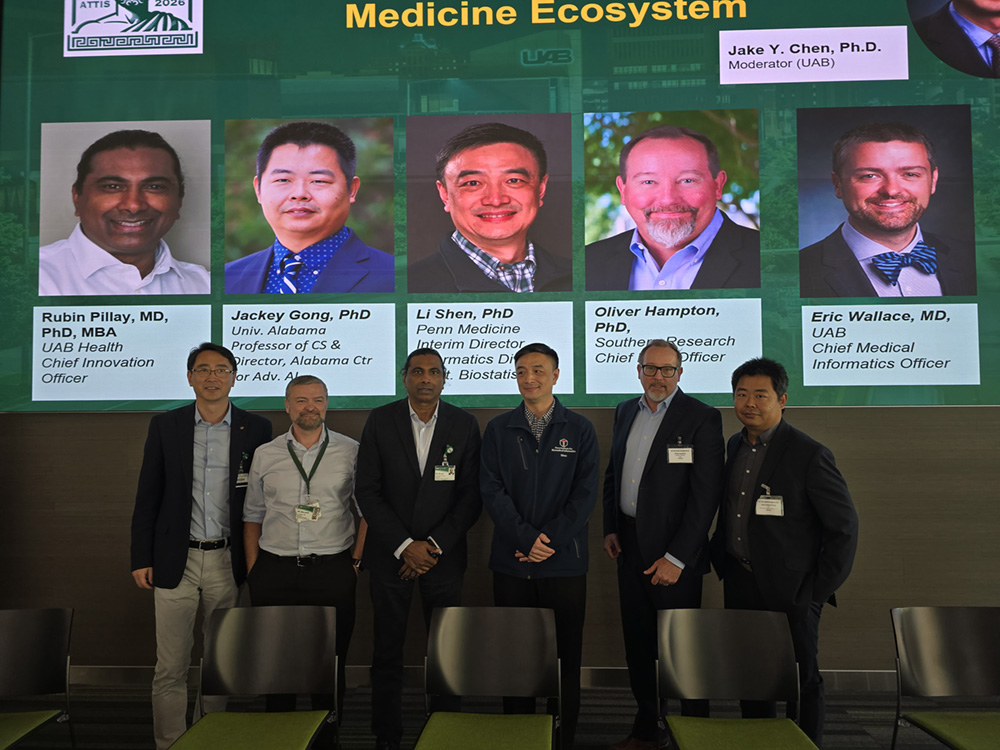 Panelists from UAB, Penn, and Southern ResearchThe symposium also spotlighted a dedicated early-career session. Richard Palmer, DrPH, J.D., acting director of the Division of Extramural Programs at the National Library of Medicine, delivered an education-focused talk for early-stage investigators. Trainees presented six flash talks selected from 37 abstracts, a record-high number of submissions in ATTIS history. Five poster awards were presented to trainees to recognize excellence in AI, informatics, and translational biomedical research.
By convening experts across disciplines and career stages, ATTIS 2026 reinforced UAB’s commitment to building collaborative AI ecosystem in the deep-south that advances AI in precision medicine and improves health outcomes.
For program information and event updates, visit the ATTIS website. Click here to view photos from the event.