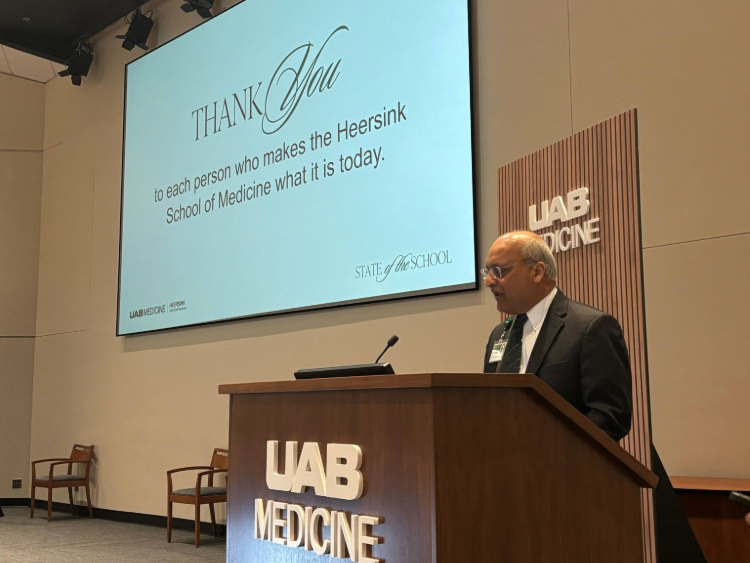
 On Wednesday, Feb. 4, Anupam Agarwal, M.D., senior vice president for Medicine and dean of the Heersink School of Medicine, delivered the 2026 State of the School address in Margaret Cameron Spain Auditorium and via livestream. The annual update focused on how the school navigated a year of national uncertainty while continuing to advance research, expand access to care, and invest in its people.
Agarwal opened by thanking faculty, staff, trainees, and students, calling them the “heartbeat” of the school. He also recognized UAB and UAB Medicine key leadership and partners, including Children’s of Alabama and the Medical Alumni Association.
“Today, we celebrate our shared achievements and reflect on the resilience that defines the Heersink School of Medicine,” said Agarwal. “This gathering is about more than just numbers. It’s about people, progress, and purpose.”
A year like no other
In response to federal changes, the Heersink School of Medicine focused on transparency, advocacy, and communication. School leadership hosted a series of open research town halls to share updates on federal funding and answer questions from faculty, staff, and trainees.
Leaders also worked with national partners and policymakers to ensure the voices of academic medical centers were represented in discussions affecting biomedical research. At the same time, Heersink established a strategic refresh committee to review research priorities and guide future planning.
Throughout the year, the school remained focused on supporting its people, protecting core programs, and maintaining forward momentum.
Innovation and discovery
Innovation and discovery remained central to Heersink’s mission in 2025. The school advanced a strategic refresh of its research priorities to better align strengths with emerging scientific opportunities. New bridge funding mechanisms and targeted recruitment efforts were introduced to support faculty and sustain research growth.
Heersink researchers continued to make important contributions across multiple fields. Highlights included advances in kidney disease, neuroscience, and cancer research. Clinical trials remained a critical driver of innovation, with both federal and non-federal trial expenditures increasing compared to the prior fiscal year.
Research discoveries also continued to move beyond the lab. Through the Heersink Institute for Biomedical Innovation, new startup ventures were launched to translate research into practical applications. These efforts included tools designed to expand access to specialized care.
Global partnerships further strengthened the research enterprise. Faculty were engaged in research, training, and clinical care activities in more than 44 countries. Key collaborations included the UAB–McMaster Joint Pilot Program and international work focused on biomedical data science.
These efforts were supported by continued investment in facilities. Progress continued on the Biomedical Research and Psychology Building, a $190 million project that will support interdisciplinary collaboration. Renovations to the McCallum Building were also completed, providing updated research spaces and improved infrastructure.
Patient and community impact
Improving health and expanding access to care across Alabama remained a key focus throughout the year.
November marked one year since UAB Medicine acquired the St. Vincent’s Health System. Since the acquisition, more than 400 patients per month have been transferred from the UAB Emergency Department to UAB St. Vincent’s facilities. This has helped reduce wait times and improve patient flow.
Access to care expanded further through telehealth and rural health initiatives. Tele ICU services reached new milestones with additional sites and more than 500 admissions. Partnerships such as Live HealthSmart Alabama’s collaboration with Uber Health helped address transportation barriers for patients.
The year also included major clinical achievements. UAB completed its first split liver transplant in nearly a decade, providing life-saving care to two patients from a single donor organ.
Together, these efforts reflect a commitment to delivering high-quality care and meeting the needs of patients and communities across the state.
People and training
The achievements highlighted during the State of the School address were made possible by the people of Heersink.
Across four campuses, the school is home to more than 800 medical students, 1,100 residents, and over 2,000 faculty members. The incoming medical student class continues to grow, with 82% of students coming from Alabama. This supports the school’s role in strengthening the state’s physician workforce.
Match Day results further demonstrated this impact. The school achieved a 99% match rate. Nearly one-third of graduates matched at UAB, and 38% matched within Alabama.
Agarwal also announced the 2026 Pittman Scholars. The program recognizes early career faculty who demonstrate excellence in research and strong potential for sustained impact. The awards reflect Heersink’s ongoing commitment to faculty development and retention.
Looking ahead
As the Heersink School of Medicine looks to the future, its priorities remain clear. The school will continue to advance discovery, expand access to care, and invest in the people who drive its mission.
The 2026 State of the School highlighted a year marked by resilience and progress. It also affirmed a shared commitment to collaboration, innovation, and improving health across Alabama and beyond.
For a deeper look at the year’s accomplishments, view the replay of the 2026 State of the School address (presentation begins at 18:15 mark) and explore the 2025 Annual Report.