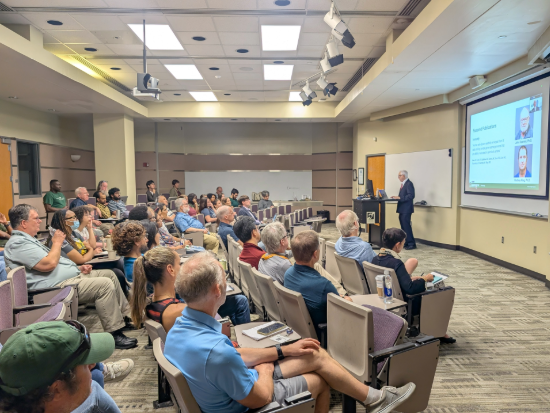
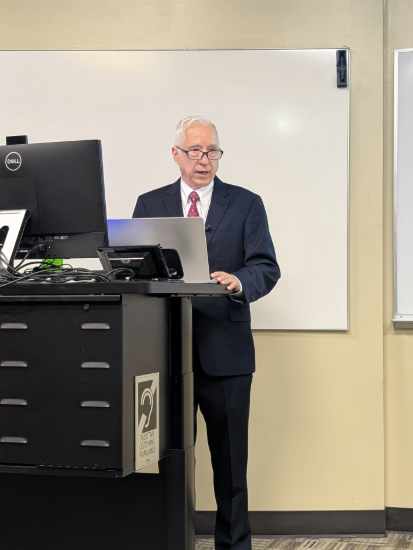
 J. Victor Garcia-Martinez, Ph.D., professor and chair, Charles H. McCauley Endowed Chair in the UAB Department of Microbiology, presented the 2026 State of the Department on Monday, Aug. 10. The annual address highlighted departmental accomplishments across research, education, service, and faculty development, while outlining a vision for continued growth and innovation. Watch a recording of the presentation here.
Garcia-Martinez opened the presentation by reflecting on the critical role microbiology and immunology play in addressing some of the world's most pressing health challenges, including emerging infectious diseases, antimicrobial resistance, tuberculosis, malaria, and cancer.
"From pandemic preparedness to cancer cures, some of the most consequential advances in human health begin with discoveries in microbiology and immunology," Garcia-Martinez said. "This is what we’re here to do, and this is what we do on a daily basis."
Garcia-Martinez pointed out how the department's commitment to advancing human health continues to earn national recognition, highlighting its No. 15 national ranking in the 2025 Blue Ridge Institute for Medical Research rankings and recognizing several faculty members who ranked among the nation's top-funded investigators.
 Advancing education and training
Education remains a defining component of the department's mission. The Department of Microbiology currently supports 130 undergraduate students, 31 graduate students, and 21 postdoctoral fellows. Faculty members contribute to educational programs across UAB, including undergraduate, graduate, medical, dental, and optometry education.
Garcia-Martinez recognized the department's faculty and educational leaders, Jared Taylor, Ph.D., and Louis Justement, Ph.D., for their dedication to training the next generation of scientists and clinicians. He also highlighted UAB's undergraduate immunology program, describing it as the only such program in the nation.
"The fact that we continue to attract students from all over the country and some parts of the world reflects that we can provide a robust and well-rounded education to our trainees," Garcia-Martinez said.
The department also celebrated five doctoral graduates this year and recognized numerous trainees who received competitive fellowships, leadership appointments, and national honors.
Research excellence and innovation
Research productivity remained strong throughout the year. The department received nearly $15 million in grant funding, secured 20 awards, and produced 52 published manuscripts. Faculty members authored several high-impact publications, including four papers in Immunity, while others earned national recognition through prestigious lectureships, leadership appointments, patents, and entrepreneurial ventures.
“I cannot be prouder of our faculty for such incredible accomplishments,” Garcia-Martinez said.
Garcia-Martinez noted that collaboration continues to be a cornerstone of the department's research success. Through initiatives such as the Microbiology Grants Club directed by Alan Zajac, Ph.D., Vice Chair for Research, faculty members work together to strengthen grant applications and support one another's scientific pursuits.
The department also celebrated major achievements in innovation, including faculty-launched startups and new patents with the potential to advance biomedical discoveries into real-world applications.
Expanding impact beyond Birmingham
Faculty members continued to extend the department's reach nationally and internationally through scientific leadership, collaborative partnerships, and outreach initiatives. Highlights included research sent to the International Space Station, leadership appointments within national scientific organizations, and the development of a new international partnership between UAB and Fujita Health University in Japan.
Garcia-Martinez also reflected on visits to UAB-affiliated research programs in South Africa and Zambia, emphasizing the department's global presence in infectious disease research and public health.
"Our footprint in Africa is unbelievable," Garcia-Martinez said. "Our faculty staff there are actually making a big difference every day in that setting."
The department additionally hosted several distinguished lectures and welcomed nationally recognized scientific leaders to campus throughout the year, including the Bertram M. Marx Lectureship featuring E. John Wherry, Ph.D., from the University of Pennsylvania; the Susan Roberts Dubay Lecture featuring Lora Hooper, Ph.D., from UT Southwestern; and the David E. Wells Symposium, featuring Anne Moscona, Ph.D., from Columbia University.
Looking toward the future
To conclude the presentation, Garcia-Martinez outlined aspects of the department’s forward-facing vision, which includes garnering feedback from various members of the department. For example, in an effort to strengthen its culture and support its people, leadership recently conducted listening sessions with staff, graduate students, and postdoctoral fellows to gather feedback and identify opportunities for growth.
"I think it's very important to hear directly from the people who experience the department every day and to use their insights to make the department stronger," Garcia-Martinez said. "By listening and acting, we can strengthen our culture, support our people, and advance our research, education, and service missions."
The department also successfully recruited three new faculty members who will join the department during the coming academic year, further strengthening expertise across key research areas.
In closing, Garcia-Martinez expressed gratitude to faculty, staff, students, postdoctoral fellows, and supporters for their contributions to the department's success and shared an optimistic vision for the years ahead.
"Our foundation is very strong,” Garcia-Martinez said. “Our momentum is accelerating. Our greatest opportunities to transform health still lie ahead. By fostering talent, advancing discovery, and strengthening collaboration, we will certainly expand our impact across science, medicine, and society.”
He continued: “Together and with the continued leadership and strong support from Dr. Watts, Dr. Agarwal, and Dr. Benveniste, we will educate future leaders, drive biomedical innovation, and advance the Heersink School of Medicine vision of improving lives through knowledge.”