 September is Ovarian Cancer Awareness Month, and while treatment for the disease has come a long way, one hard truth remains: many women with late-stage ovarian cancer relapse, and most run out of options when they do.
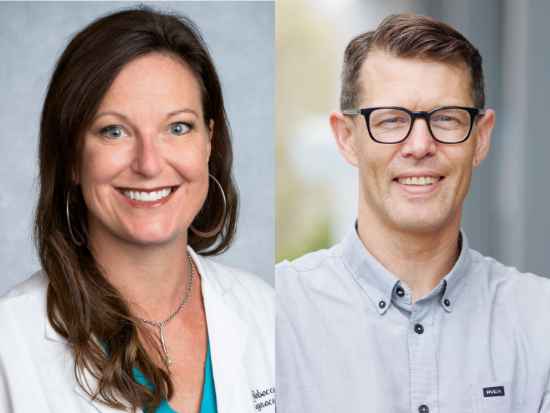
That’s what makes UAB’s BiTE trial so significant. Associate Professor in the Department of Obstetrics and Gynecology, Rebecca Arend, M.D., and CEO and Co-Founder of 92Bio Inc., Ben Buelow, M.D., Ph.D., share more about the science behind their trial, why UAB was the right place to run it, and what it could mean for patients who have waited for new options.
The problem with platinum resistance
Up to 70% of patients with high-grade ovarian cancer see their cancer return after the standard combination of surgery and platinum-based chemotherapy. When that happens, and the disease stops responding to platinum drugs altogether, patients enter a category called platinum-resistant ovarian cancer, or PROC, where there is currently no standard therapy.
Right now, most new PROC drugs work like a delivery service. They attach chemotherapy to an antibody, which then homes in on the tumor and drops the chemo off directly onto cancer cells. Many of these drugs target a marker called folate receptor alpha (FRα), which shows up in large amounts on PROC cells, making it a good target to aim for. The problem is that this approach hasn't worked as well in practice as researchers had hoped.
“Because PROC is often resistant to chemotherapy and exhibits a more aggressive disease biology, clinical responses to antibody-drug conjugates (ADCs) have generally been shorter and less complete than initially anticipated,” Arend and Buelow said.
A new chapter in ovarian cancer treatment
Instead of chemotherapy delivery, the BiTE trial is testing an investigational drug called NTB-928, a T-cell engager (TCE) designed to redirect a patient's own immune system to attack the tumor. TCEs have already produced long-lasting responses in some blood cancers, but they're only just beginning to be tested in ovarian cancer. Notably, NTB-928 is currently the only TCE targeting FRα, largely because trace amounts of the protein on normal, healthy cells had raised safety concerns for other developers.
“NTB-928 is designed to address these safety concerns in two ways: First, it activates immune cells gently, which in other programs developed by the TeneoSeven team has reduced immune-related side effects in patients and, based on data so far, without sacrificing tumor killing,” Arend and Buelow said. “Second, it is engineered to bind cells that overexpress FRα (cancer) rather than those with only trace levels in normal tissues.”
The UAB advantage
Running an early-phase clinical trial is far more complicated than a typical lab experiment. It involves a long list of stakeholders, including the drug's sponsor, outside vendors, multiple site teams, and, most importantly, the patients themselves. The complexity is even more magnified in trials like the BiTE trial, where so much remains unknown. All these moving pieces are exactly why UAB stood out as the right place to run this study.
“In early-phase trials, where we still know little about how a drug behaves in people, that complexity is especially high, so teamwork, flexibility, and transparency across everyone involved are essential,” Arend and Buelow said.
UAB's remarkably collaborative research environment, amplified by Arend and her team, checked every one of those boxes, which is a big part of why Buelow and his team are ecstatic to be running this study here.
Putting patients at the center
If there's one thing Arend and Buelow want people to understand about the BiTE trial, it’s that it is “built around patients.”
In an early-phase study such as this, the odds that any single participant will personally benefit are small, no matter how promising the drug looks on paper. That makes the decision to enroll genuinely selfless. Patients take on real time and real risk, not because it's likely to help them directly, but because it may help improve care for the next person diagnosed.
“With so many stakeholders in a trial, it's easy for that focus to drift, so for every element of this study, we asked: how does this affect patients and the people caring for them?” Arend and Buelow said. “UAB's team helped shape those decisions from the start, and we're proud of the result.”
This work matters because ovarian cancer patients have faced limited treatment options for far too long. And because NTB-928 is typically active on its own, even this initial study should provide meaningful insight into both its safety and anti-tumor activity.
The hope ahead
When mobilized effectively, the immune system is a remarkably powerful weapon against cancer. Although TCEs do come with known risks, most notably a reaction called cytokine release syndrome (CRS), which typically appears after the first dose or two, treatment teams have become incredibly skilled at catching, managing, and monitoring it. Beyond that early window, side effects are limited.
“What we are most hopeful about is that NTB-928 could do for ovarian cancer something like what TCEs have done in certain other cancers, where they've meaningfully improved how deep and durable a response can be, even in relapsed patients,” Arend and Buelow said.
For decades, front-line ovarian cancer treatment has not significantly changed patient survival outcomes. That's what makes Arend and Buelow’s outlook feel so significant. They hope that agents such as NTB-928 can open a brand-new chapter for ovarian cancer, while recognizing that the primary purpose of this first-in-human study is to “test that hope, not assume it."
A disease that's waited long enough
Ultimately, Arend and Buelow hope that studies like this one move the field toward better, more durable treatment options for the roughly 70% of high-grade ovarian cancer patients who relapse after chemotherapy. Just as important, they hope NTB-928's side effect profile allows patients to preserve their quality of life, not just extend it.
“It's early, and this trial exists precisely to find out whether that hope is warranted,” Arend and Buelow said. “But even asking the question with a genuinely new approach is progress for a disease that has waited a long time for one.”
Ovarian Cancer Awareness Month is a reminder that behind every statistic is a patient and a family waiting for better options. Trials like the BiTE trial are a reminder of what that work looks like: years of research, careful science, and a team willing to ask hard questions in pursuit of real answers. It's how UAB is working to get patients there, one study at a time.