
Can indigo light help protect children’s vision? That’s one of the questions guiding the work of Rafael Grytz, Ph.D., Dennis Endowed Professor of Glaucoma Research in the UAB Department of Ophthalmology and Visual Sciences. His lab is uncovering new ways to understand and treat prevalent eye conditions, with discoveries that span from childhood myopia to adult glaucoma.
In May, the Grytz Lab, in collaboration with Richard Lang, Ph.D., director of the Visual Systems Group at Cincinnati Children’s Hospital Medical Center, presented a landmark study establishing the µ-optic spectral sensitivity curve — a tool that evaluates violet, indigo, and blue-light wavelengths for their role in suppressing myopia. The findings strongly suggest that supplementing indoor lighting with indigo wavelengths may reduce the progression of myopia in children and adolescents.
“We are living through a global myopia epidemic,” Grytz said. “In some populations, its prevalence has jumped from 20 percent to over 90 percent. If we don’t intervene with effective, scalable solutions, we’re going to see long-term consequences to global eye health.”
Building on the recent µ-optic breakthrough, Grytz founded Electric Indigo, his UAB startup company that translates decades of research into practical application. Through a partnership with Hardware Park, a nonprofit MedTech device prototyp development firm based in Birmingham, Alabama, Electric Indigo is currently developing light-emitting eyewear and pursuing FDA approval for this patented prototype.
“Our work suggests that indigo light is critical for eye development,” said Grytz. “This treatment strategy offers a new approach to myopia management and is safe, noninvasive, and easy to use. With years of research supporting it, this prototype has the potential to be highly effective.”
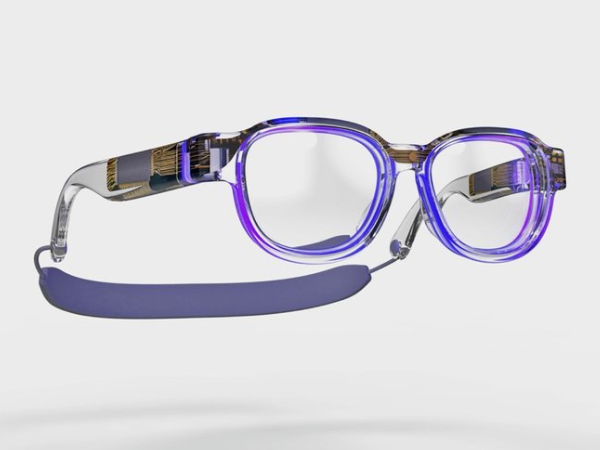 Electric Indigo prototype — PUSH Product DesignGrytz works alongside Electric Indigo’s chief executive officer, Andrew Pucker, O.D., Ph.D., FAAO, who brings expertise in medical device regulation and is overseeing the FDA approval process. With the support of a Phase I Small Business Innovation Research grant from the National Eye Institute, awarded in September, Grytz and Electric Indigo are developing a production-ready prototype, conducting a formal safety evaluation, and preparing for a pilot clinical study.
Beyond myopia, Grytz leads projects that shed light on how the eye grows and remodels during both healthy and disease states. His research explores how changes in the sclera (the white of the eye) affect eye shape, how collagen loss contributes to keratoconus, and how intraocular pressure impacts the optic nerve in glaucoma. His team uses preclinical experiments, clinical data, and sophisticated computational simulation tools to translate these biological insights into potential new diagnostics and therapies tailored to individual patients.
Originally trained in civil engineering, Grytz earned his master’s degree and Ph.D., both with distinction, from Ruhr University Bochum in Germany. His innovative doctoral research on ocular remodeling earned him the prestigious Deutscher Studienpreis, an annual award by the Körber Foundation in Germany recognizing outstanding dissertations across all academic disciplines. He later completed a postdoctoral fellowship at the Devers Eye Institute in Portland, Oregon, under the mentorship of J. Crawford Downs, Ph.D., and met Massimo Fazio, Ph.D. Grytz joined the UAB Department of Ophthalmology and Visual Sciences alongside Downs and Fazio in 2012.
Today, Grytz and his team continue to push the boundaries of vision science, driven by a mission to understand the biomechanics of the eye and transform that knowledge into better care and treatment options for patients.