Corey Speers, M.D., Ph.D., professor and chair, Merle M. Salter Endowed Chair of Radiation Oncology in the Department of Radiation Oncology, presented the 2026 State of the Department on Tuesday, Aug. 25.
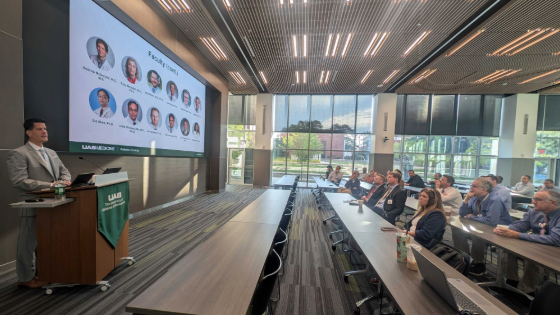
Faculty, staff, trainees, and institutional leaders attended the presentation, highlighting a year marked by clinical growth, research excellence, educational achievements, and continued innovation. Watch a recording of the presentation here.
Speers opened the presentation by recognizing the people behind the department's success and reflecting on a year of significant progress.
"The strength of our department and this institution is the people that are here," Speers said as he thanked faculty, staff, trainees, and partners from across UAB and the O'Neal Comprehensive Cancer Center.
The presentation also honored James Bonner, M.D., who led the department for more than 30 years before transitioning to professor emeritus. Under Bonner's leadership, the department grew into a nationally and internationally recognized program known for clinical excellence and technological innovation.
Record growth in patient care
Speers explained how UAB Radiation Oncology continues to experience substantial clinical growth, with nearly 2,800 projected treatment starts this year, a department record. The department has also recorded nearly 40,000 patient visits through July and reported a 30 percent increase in patient volumes over the past 18 months.
Despite periods of reduced treatment machine capacity due to equipment upgrades, the department maintained and expanded patient access while managing increasingly complex treatments, including stereotactic radiosurgery and stereotactic body radiation therapy.
Speers highlighted several major clinical milestones from the past year, including the opening of Alabama's first dedicated brachytherapy suite. The facility allows patients to receive multiple aspects of their care in one location, streamlining treatment and improving the patient experience.
The department also expanded its osteoarthritis radiation treatment program and continued to lead the adoption of hypofractionated treatment approaches, allowing some patients to complete radiation therapy in as little as one week.
Patient satisfaction remained a hallmark of the department's work, with both the Hazelrig-Salter Radiation Oncology Center and Acton Road locations earning Level 5 ratings from UAB's Office of Patient Experience and Engagement.
“We’re also very excited that so many of our providers were recognized for their exceptional patient care in 2025,” Speers said. “Our recognition rates for our physician providers was incredibly high, as well as our APPs.”
Advancing research and discovery
Speers highlighted how research activity continued to expand across the department. In 2025, faculty produced more than 100 publications, secured nearly $4 million in extramural funding, and are currently supporting 34 active clinical trials. Faculty and trainees also delivered more than 80 national and international presentations.
Clinical trial participation surpassed expectations, Speers said, with 36% more accruals than even our ambitious goal. Speers noted that strong accruals reflect the department's commitment to advancing cancer care through research while providing patients access to innovative treatments.
Faculty members earned numerous national recognitions during the year. Highlights included Reza Djavadian, M.D., Ph.D., PGY4, who received a highly competitive ASTRO Foundation research grant, Lewis Zhichang Shi, M.D., Ph.D., who received the Heersink Featured Discovery Award, and Richard Popple, Ph.D., who was induction into the UAB chapter of the National Academy of Inventors.
The department also continued to build national leadership in adaptive radiotherapy, artificial intelligence and automation, areas that are helping improve treatment quality and expand access to advanced cancer care across Alabama and beyond.
“None of this would be possible without federal funding, without extramural research funding, and we are so blessed to have the ROAR group work with us,” Speers said. “This past year we had the 15th anniversary James Bond Gala, so for 15 years this group, that started as a grassroots group, has been raising funds to support research in radiation oncology.”
Investing in education and the future
Education remains a core mission of the department, which now includes 11 physician residents and four medical physics residents. The medical physics residency program doubled in size during the past year, reflecting growing demand for highly trained specialists in the field.
The department also continued to attract learners from around the world through specialized educational programs focused on SRS, SBRT and adaptive radiotherapy. Participants traveled to Birmingham from across the United States and several international locations to learn from UAB faculty and experience the department's innovative approaches firsthand.
“There really is international reach to these courses.” Speers said. “People come in, they recognize us for our expertise here at UAB. They want to learn from that expertise.”
Looking ahead
Speers outlined strategic priorities for fiscal year 2027, including expanding access to care, strengthening research infrastructure, enhancing educational opportunities, supporting faculty and staff development, and growing the department's footprint throughout Alabama.
"We celebrate all of your successes this year," Speers said. "We couldn't do what we do without each and every one of you."