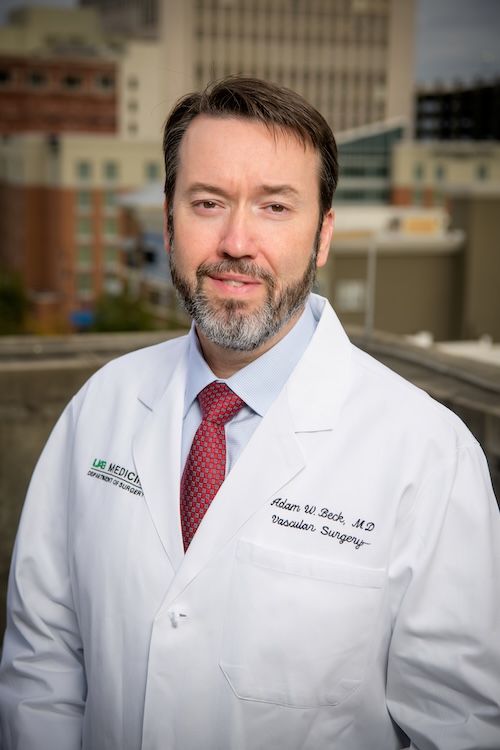
Adam W. Beck, M.D., professor of surgery and director of the Division of Vascular Surgery and Endovascular Therapy at the University of Alabama at Birmingham, has led an international multidisciplinary consortium that has published a landmark consensus report in Circulation, one of the world’s leading cardiovascular journals.
 The publication, "Standardized End Point Definitions for Clinical Trials in Thoracic Aortic Repair: A Consensus Report From the ARCH–Academic Research Consortium (ARCH-ARC)," establishes the first comprehensive framework for evaluating new technologies designed to treat diseases of the ascending aorta and aortic arch.
Beck co-chaired the effort alongside Nimesh D. Desai, M.D., Ph.D., of the University of Pennsylvania and Gregory Piazza, M.D., M.S., of Brigham and Women's Hospital and Harvard Medical School.
The aortic arch remains one of the most challenging regions in cardiovascular medicine. Traditionally, repair has required highly invasive open surgery involving cardiopulmonary bypass and circulatory arrest. Recent advances in catheter-based and hybrid technologies are creating new opportunities to treat these life-threatening conditions with less invasive approaches.
"Endovascular treatment of the aortic arch represents one of the last major frontiers in cardiovascular innovation," Beck said. "These technologies have the potential to dramatically expand treatment options for patients, but innovation must be accompanied by rigorous clinical science. Our goal was to create a common language that allows investigators, regulators, physicians, and industry partners around the world to evaluate these therapies consistently and objectively."
The ARCH-ARC consortium brought together an unprecedented group of experts from vascular surgery, cardiac surgery, cardiology, vascular medicine, neurology, radiology, imaging science, clinical trial methodology, and device development. Participants represented leading academic medical centers across North America and Europe and worked collaboratively over four years to develop consensus recommendations.
Importantly, the initiative also included engagement from the U.S. Food and Drug Administration, clinical research organizations, and medical device manufacturers, creating a unique public-private partnership focused on accelerating safe innovation in aortic care.
"The development of transformative medical technologies requires collaboration that extends well beyond any single institution or specialty," Beck said. "This project demonstrates what can be accomplished when physicians, scientists, regulators, and industry partners come together around a shared mission to improve patient outcomes."
The publication provides standardized definitions for clinical trial outcomes, imaging assessments, procedural success, neurologic complications, device performance, and long-term follow-up. By establishing these standards, the consortium aims to improve the quality of future clinical trials and facilitate regulatory review of novel devices intended to treat complex aortic disease.
The work is expected to serve as the foundation for future studies evaluating endovascular and hybrid approaches to diseases of the ascending aorta and aortic arch, including aortic aneurysms and aortic dissections—conditions responsible for significant morbidity and mortality worldwide.
For UAB, the publication highlights the institution's growing leadership role in complex aortic disease, cardiovascular innovation, and clinical trial science.
"UAB has built one of the nation's leading multidisciplinary aortic programs," Beck said. "Being entrusted to lead an international effort of this magnitude reflects the expertise of our faculty and the institution's commitment to advancing cardiovascular care through innovation, collaboration, and rigorous research."
The consensus report appears in the June 2026 issue of Circulation and was published on behalf of the ARCH–Academic Research Consortium.