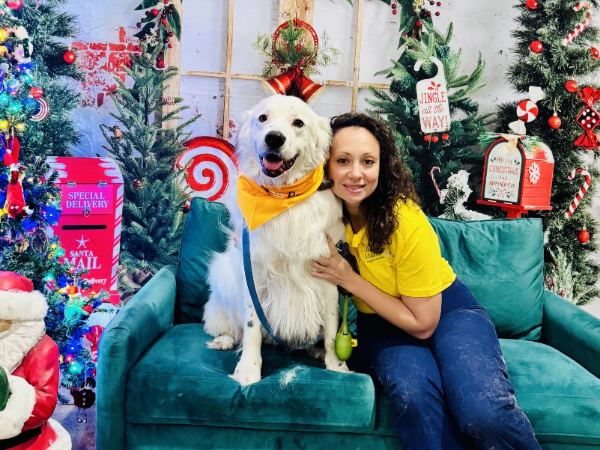
For Lily A. Gutnik, M.D., MPH, associate vice chair of global surgery in the Division of Breast and Endocrine Surgery, healing is a daily part of her work. One of her most compassionate partners also has have a white coat, but he also has four paws, a wet snout, and a gentle way of greeting strangers with a soft nudge. His name is Max.
Recently, Gutnik celebrated a milestone outside the operating room when Max, her beloved Great Pyrenees mix rescue, officially earned certification as a therapy animal through the nonprofit organization Hand in Paw. The certification allows the pair to volunteer at hospitals, nursing homes, schools, and community events across Alabama, bringing moments of comfort and connection to the people they meet. But Max’s journey to becoming a therapy dog started long before his certification. It started with a rescue.
A rescue dog finds his Birmingham home
Max came into Gutnik’s life shortly after she moved to Birmingham. Through a mutual connection, Emily Spangler, M.D., MS, associate professor in the Division of Vascular Surgery and Endovascular Therapy, Gutnik was introduced to a rescue organization that had a dog who might be a good fit for her. About seven months after settling in the city, she met Max. With the help of Catherine Parker, M.D., section chief of the Division of Breast and Endocrine Surgery, who joined her to pick him up and bring him home to Birmingham, Max quickly became part of her life. As his story highlights, many UAB surgeons have played a role in his journey. Now approaching his ninth birthday this September, Max quickly proved to be the kind of dog people instantly fall in love with. He’s big, white, and fluffy, the kind of dog that turns heads wherever he goes. More importantly, he’s calm, patient, and endlessly gentle.
“He’s always had a very loving personality,” Gutnik said. “He just enjoys being around people.”
Max spends most days living the relaxed life of a well-loved dog. His routine includes plenty of naps, midday walks with his dog walker, Paulette, and occasional adventures around Birmingham with Gutnik. One of his favorite activities is riding in the car to downtown Birmingham restaurants that welcome dogs. Because Max has a chicken allergy, some restaurants have even learned to offer him special treats that are safe for him to enjoy. As Max grew older, Gutnik noticed something about the way he interacted with people. His calm demeanor seemed to have a comforting effect, and that observation sparked an idea.
The idea for therapy work
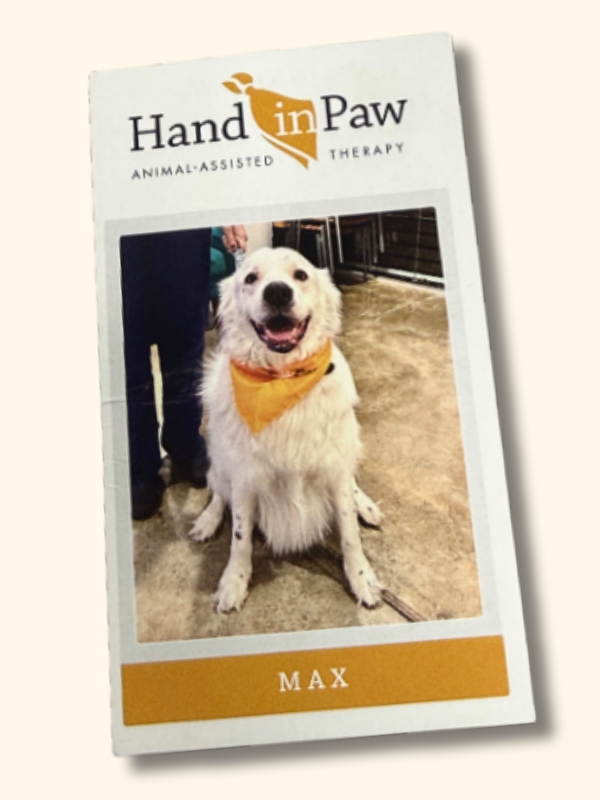 Max's official Hand in Paw business cardMax’s natural temperament made him stand out. He was patient, easygoing, and seemed genuinely happy meeting new people. Those qualities made Gutnik wonder if Max might enjoy becoming a therapy dog.
“He’s always been very calm and very friendly,” she said. “It made me think he might be a good fit for therapy work.”
That curiosity eventually led the pair to Hand in Paw, a nonprofit organization dedicated to improving human health and well-being through animal-assisted therapy. Through the program, trained volunteer teams visit hospitals, schools, and community organizations, offering companionship, encouragement, and emotional support, but joining the program requires more than simply having a friendly dog. Certification is rigorous.
A year of training
The path to certification took more than a year. Therapy dogs must demonstrate advanced obedience, pass behavioral screenings, and successfully complete practical evaluations designed to simulate real-life therapy visits. For Max, the training process involved mastering obedience skills, adapting to new environments, and becoming comfortable interacting with strangers in unpredictable settings. There were also small challenges along the way, helping Max become comfortable with people touching his paws, something that frequently happens during therapy visits with patients. With time and practice, Max worked through the challenge and continued progressing through the program.
By the end of training, Gutnik said he was considered one of the best-trained dogs in his group. After completing the formal coursework, Max and Gutnik also participated in supervised shadow visits before becoming fully certified. Only after those visits could the pair begin volunteering on their own.
Max’s first therapy visits
Now certified, Max has already begun visiting members of the Birmingham community. Together, Gutnik and Max have spent time at nursing homes, memory care facilities, and wellness events on the University of Alabama at Birmingham undergraduate campus. Therapy visits are structured and carefully managed, with sessions typically lasting between one and two hours. Therapy teams are required to volunteer at least twice each month to maintain certification, a substantial commitment, but Gutnik says Max seems to approach each visit with simple excitement.
“I think he just knows we’re going somewhere fun,” she said. “He loves car rides.”
When he arrives, Max does what he does best. He greets people quietly and gently, often with a soft nudge that invites a scratch behind the ears. One of Gutnik’s favorite moments is watching people react when Max enters a room.
“Seeing people light up when they see a big white fluffy dog walk in is my favorite part,” she said.
A therapy dog’s favorite job
Through the Hand in Paw program, volunteer teams visit more than 80 partner organizations across Alabama, providing moments of calm and comfort for patients, healthcare workers, students, and families.
For Gutnik, the experience has been rewarding not just for the people they visit, but also for the bond she shares with Max.
“Animals have a remarkable ability to bring comfort and connection,” she said. “I’m excited for the opportunity to participate in programs that support patients and communities through animal-assisted therapy.”
Max may not know the full impact of his work, but whether he’s sitting quietly beside someone who needs a moment of comfort or greeting a stranger with a gentle nudge, one thing is clear. This fluffy rescue dog has indeed found a very special job, and he’s very good at it. If Max could describe it himself, Gutnik says it might sound something like this:
“I don’t know what a therapy dog is,” Max might say. “But if it means more car rides, more pets, and making people smile, I’m all in.”