Taylor Wallen, M.D., an assistant professor in the UAB Division of Trauma and Acute Care Surgery, and Krystal Rivera, a Ph.D. candidate, published “Plasma Regulates Homeostatic Pulmonary Endothelial Signaling to Mitigate Vascular Leak Following Polytrauma and Hemorrhagic Shock” as co-first authors in the journal Shock last month.
Endothelial glycocalyx research
Wallen and Rivera worked with Associate Professor Jillian Richter, Ph.D., whose lab researches the role of the endothelial glycocalyx in outcomes for trauma patients.
The endothelial glycocalyx is a sensitive, gel-like layer that lines the inner surface of all blood vessels. It has an important role in vascular health by sensing blood flow chances, preventing excessive blood clotting, and regulating homeostasis.
Traumatic injury can cause the glycocalyx to shed, throwing off the delicate balance it helps maintain, leading to inflammation, severe bleeding, worsening shock, and organ failure.
The lab’s goal is to identify therapeutic strategies to prevent glycocalyx damage and to restore loss of glycocalyx function caused by trauma and hemorrhage.
Findings from the study
This study in particular evaluated endothelial-specific responses to fresh frozen plasma (FFP) resuscitation in order to identify therapies that promote vascular repair after traumatic injury. FFP is the liquid part of donated blood that is frozen within eight hours of collection and is a common type of blood product used in resuscitation.
The FFP was compared to Lactated Ringer’s solution, a type of IV fluid that is also used in resuscitation. The researchers found that resuscitation with FFP after polytrauma (multiple major traumatic injuries at once) or hemorrhagic shock does reduce systemic inflammation and vascular leak and preserves pulmonary vascular barrier function and homeostasis. They think this is because FFP promotes mitochondrial signaling, metabolic recovery, and endothelial stress regulation.
“Our findings provide insight into the benefit of fresh frozen plasma resuscitation for trauma patients,” Wallen said. “This type of resuscitation can uphold the integrity of the endothelial glycocalyx, preventing multiorgan failure and ultimately saving lives.”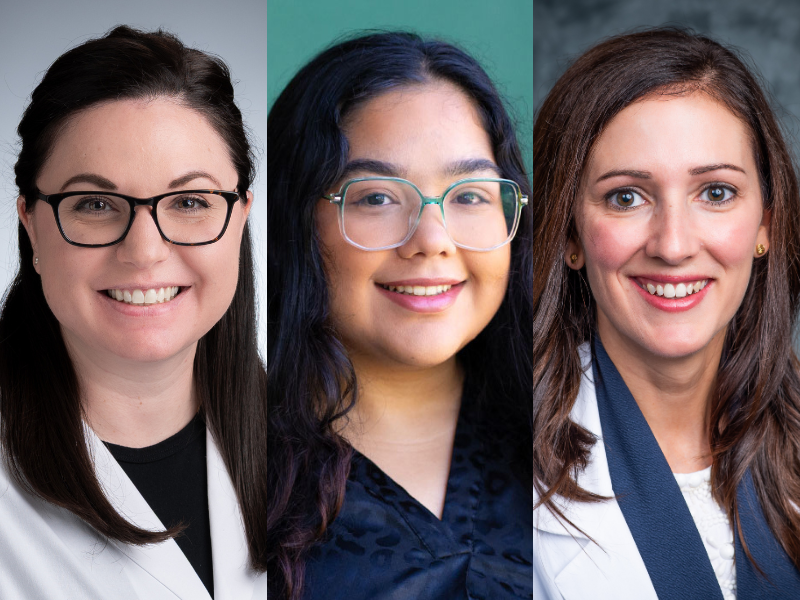 Left to right: Dr. Taylor Wallen, Krystal Rivera, and Dr. Jillian Richter.
The team noted two particularly interesting findings: one, the early protective endothelial response to plasma administration persists 24 hours after injury, and two, that plasma had measurable effects on endothelial cells even in the absence of injury.
“We often think of plasma primarily as a means of replacing volume and coagulation factors during resuscitation, but these findings support the idea that plasma is biologically active and can directly influence the vascular endothelium,” Richter said.
The researchers say their findings are one more persuasive argument for the need for prehospital blood – a treatment mechanism that has recently been advocated for by doctors and EMS agencies nationwide.
“The growing movement to place blood products on ambulances and other prehospital platforms is particularly relevant because it allows blood-based resuscitation to begin much closer to the time of injury,” Richter said.
Though research has shown that the early administration of blood products saves lives by replacing lost volume and helping with coagulation, this new study shows direct benefits to the vascular endothelium.
“Our hope is that as data such as the work we published continues to show improvement in survival, that access to prehospital products will become standard of care,” Wallen said.
The authors on the paper include Taylor Wallen, Krystal Rivera-Figueroa, James Odum, Giacynta Vollmer, Lei Zheng, Melad Dababneh, Delores Stacks, Camilla Margaroli, Robert Richter and Jillian Richter.
Read the full paper here.