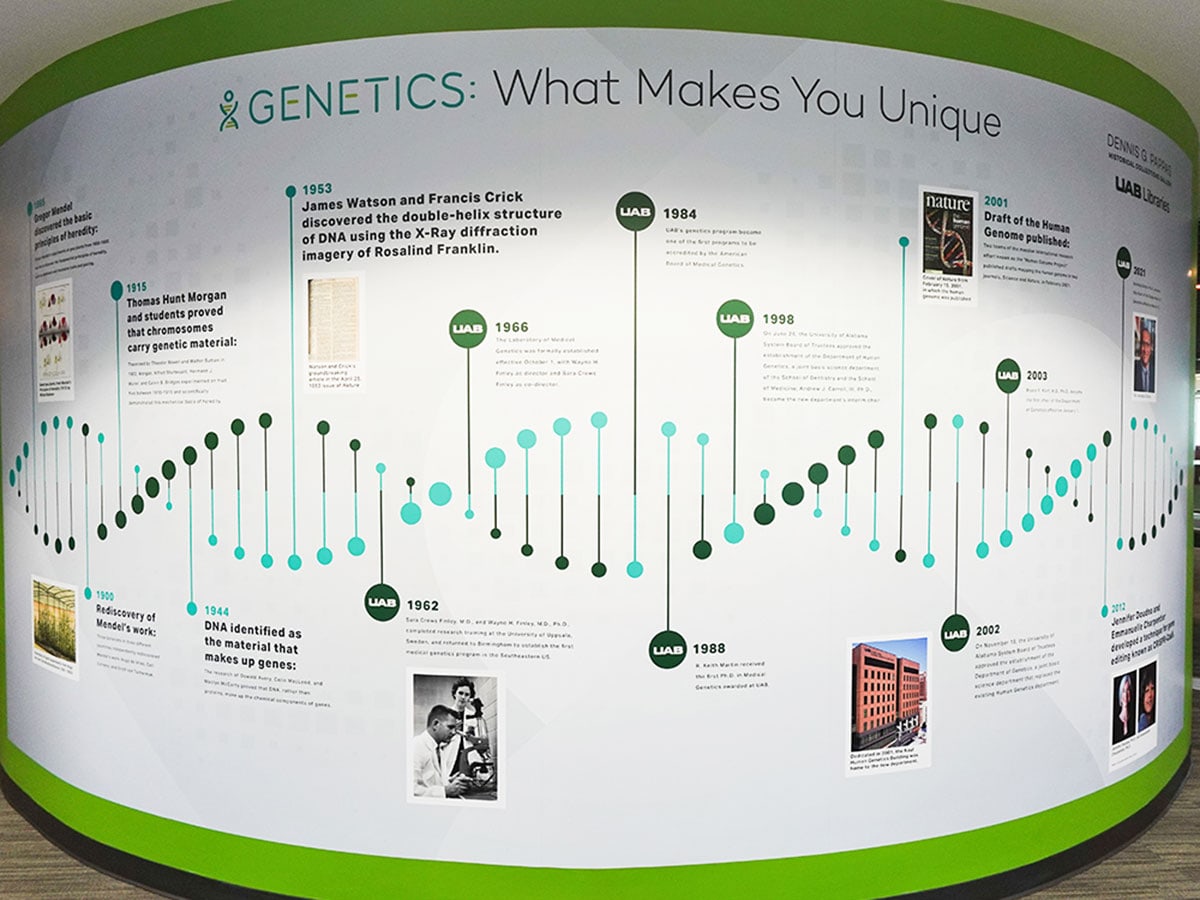
 Visitors can learn about the history of genetics in the new exhibit, “Genetics: What Makes You Unique,” which chronicles research from Gregor Mendel’s famous pea experiments in the 19th century to the present.Explore two exhibitions on display now at the University of Alabama at Birmingham’s Lister Hill Library of the Health Sciences.
Visitors can learn about the history of genetics in a new exhibit, “Genetics: What Makes You Unique,” which chronicles genetics research from Gregor Mendel’s famous pea experiments in the 19th century to the present. Along the way are highlights from UAB’s role in the study of genetics, from the founding of the Laboratory of Medical Genetics by Wayne Finley, M.D., Ph.D., and Sarah Finley, M.D., in the 1960s through current opportunities for study and careers. The exhibit showcases items from UAB Historical Collections, which is dedicated to the preservation of medical history at UAB and the regional, national and global communities.
“The study of genetics gives fascinating insights into the human condition,” said Jason Byrd, associate dean for Historical Collections. “This exhibition shows how human curiosity about the nature of heredity and advanced techniques in science combined to provide us with extraordinary insight into what makes us all unique.”
Find the exhibit on the second floor of Lister Hill Library near the Dennis G. Pappas Historical Collections Gallery and visit during library open hours.
See the traveling exhibition curated by the National Library of Medicine, “This Lead is Killing Us: A History of Citizens Fighting Lead Poisoning in Their Communities,” through May 16 on the first floor of Lister Hill Library. Specially curated items from UAB Historical Collections and UAB Libraries’ circulating collections also will be on display.
The exhibit explores how citizens have advocated for themselves to lead industries, housing authorities and elected officials to protect their health against lead poisoning in their communities. When people ingest lead, by breathing contaminated air, drinking contaminated water, or accidentally eating leaded paint chips or fragments, they can become very sick. Lead poisoning causes neurological problems and sometimes even death. Today, researchers believe that no amount of exposure to lead is safe for children.
“Birmingham grew as a city of heavy industry, a heritage we are still dealing with today,” said James Gilbreath, UAB reference librarian and liaison to the School of Nursing. “We are excited to host this exhibit that tells a story so familiar to our communities and our own fights about pollution from coke and steel production, and we’re glad to showcase other interesting and relevant resources from our collections as well.”
UAB Libraries provide access to an array of rich and diverse scholarly resources that inform intellectual, cultural, social and economic transformation of its community. It also provides the essential expertise to support excellence in education, research, patient care and community outreach that collectively advance the success and impact of the university. Its collections include more than 1.4 million volumes and more than 40,000 journals and serials, in addition to extensive electronic resources, rare books, microforms and audiovisual materials. UAB Libraries host nearly 1 million patrons each year and support students and faculty in advancing their learning, research and teaching.