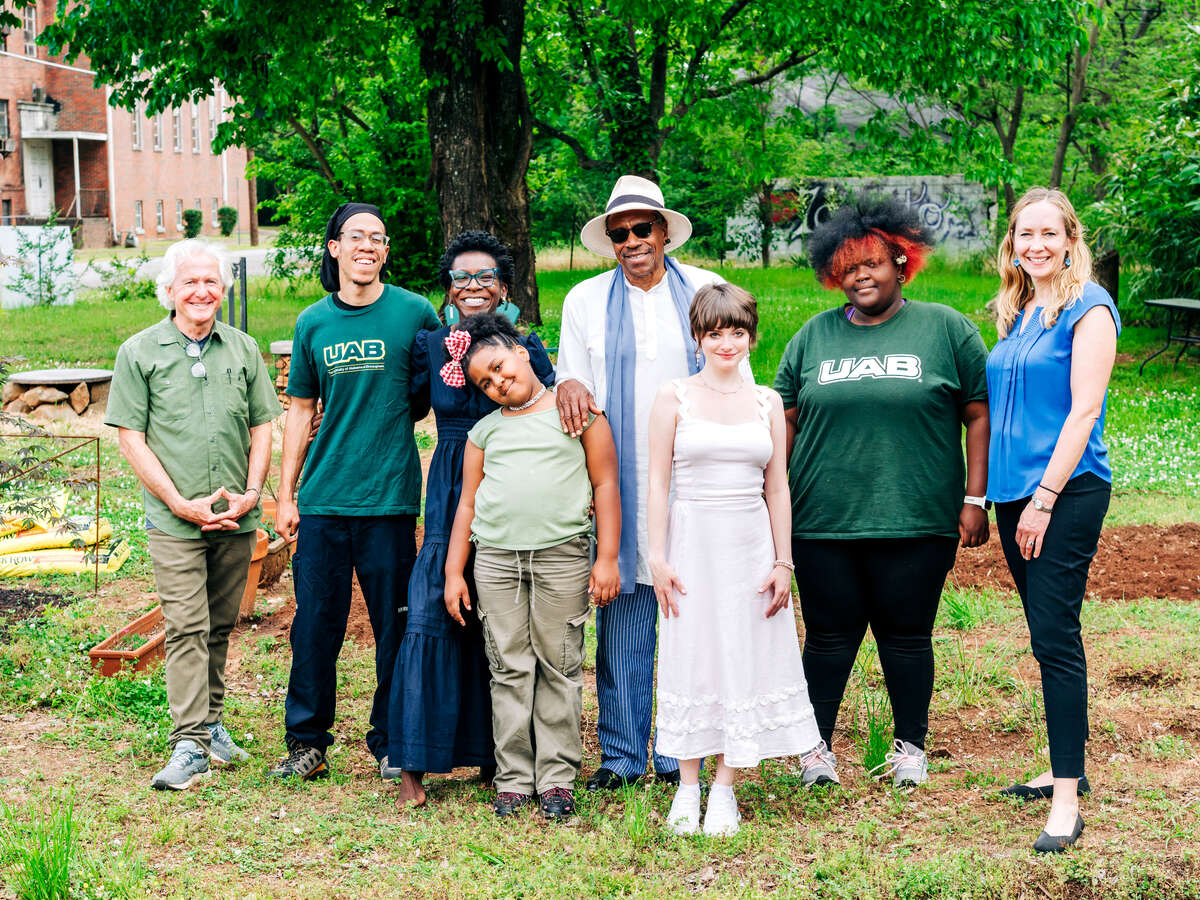
 Garden owner Mustafah Abdullah (center, with hat) stands with IHR Director Tina Kempin‑Reuter, Ph.D., (far right) and members of the class and community.Students studying human rights at the University of Alabama at Birmingham are serving the community by offering their skills to Sacred Space Garden.
The community‑focused garden, in Birmingham’s West End/Titusville neighborhood, was founded six years ago by property owner Mustafa Abdullah. The historic neighborhood of Titusville, just west of UAB’s campus, lacks access to fresh food with no full-service grocery stores within the city limits. The garden often provides free produce during the growing season. A gathering place for neighbors, the garden offers volunteer planting days, educational activities, blacksmithing demonstrations, flower‑arranging workshops and celebrations of local elders.
Students in the Introduction to Human Rights course were tasked with developing projects that would strengthen the garden’s visibility, accessibility and long‑term sustainability. Since opening in 2016, the Institute for Human Rights in the UAB College of Arts and Sciences has grown
to provide an academic framework for Birmingham’s human and civil rights activities and to connect the city’s historical significance in the struggle for civil rights to national and international collaborative initiatives for human rights. Led by Director Tina Kempin‑Reuter, Ph.D., the students’ work included creating a website, a marketing and social media plan, an updated neighborhood asset map, and community‑based research on food and green space access. The students presented their semester‑long projects Thursday, April 23, in Heritage Hall to students, faculty and community members.
Building a digital presence
One student group created the first official website for Sacred Space Garden, featuring a homepage, an “About” section, a gallery of garden photos, a calendar of events, and contact information for Mustafa and garden volunteer coordinator Kizzi Frisby, a graduate teaching assistant in IHR who is pursuing a Master of Arts degree in anthropology of peace and human rights. Frisby was instrumental in making connections between IHR and Abdullah and is passionate about urban agriculture and empowering residents through education, sustainability and collaboration.
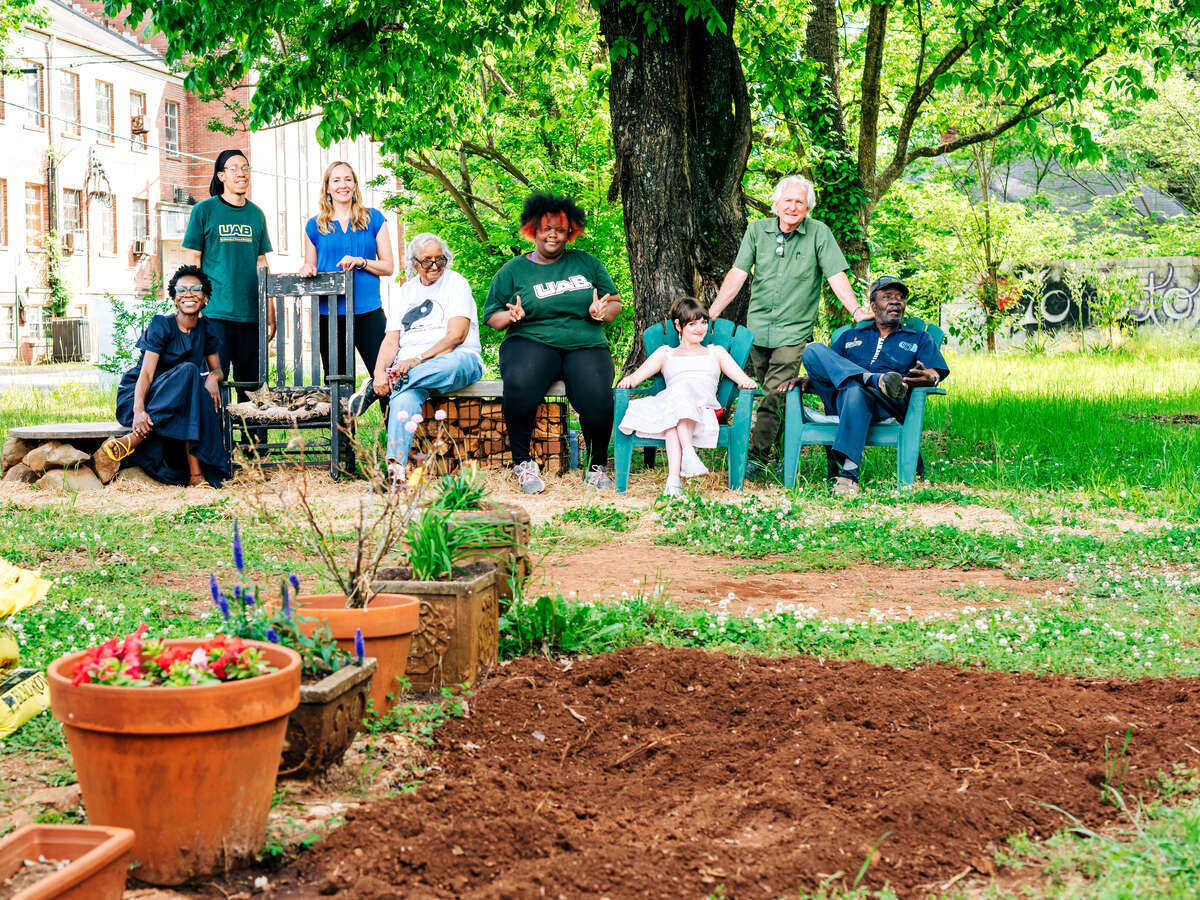 Garden volunteer coordinator Kizzi Frisby (far left) and Tina Kempin‑Reuter, Ph.D., (third from left) relax with students and community members outside at Sacred Space Garden.When it launches, the new website will include a Spanish‑language section to better serve Titusville’s large Spanish‑speaking population.
“If y’all had not done this, I would probably never have a website — it has been six years,” Abdullah told the students after their presentation.
Branding and social media outreach
Another group developed a comprehensive brand and style guide to help the garden create and maintain a consistent public identity. The students designed logos, color palettes and social media templates suitable for all ages. They also created informational posts on topics like composting, gardening basics and volunteer opportunities, using hashtags such as #sacredspacecommunity and #birminghamfooddesert to increase visibility. The students focused on ways to engage younger residents, with TikTok content and “Fun Friday” ideas aimed at encouraging teens to volunteer.
Mapping community resources
A third group produced an updated asset map of the West End/Titusville area, documenting transportation routes, bus stops, churches, parks and schools. Students walked the neighborhood to verify locations and safety conditions, noting that several schools listed on older maps had been demolished or repurposed.
Their research highlighted a key challenge: Titusville has no full‑service grocery stores within city limits, forcing residents to travel outside the neighborhood for fresh food. Not everyone who lives there has transportation, a severely limiting factor for accessing food, especially fresh fruit and vegetables, for themselves.
Listening to residents
Students conducted a community survey to better understand how neighbors use the garden and what barriers they face in accessing fresh produce. Students created and distributed flyers with QR codes to local businesses, interviewed four residents, and compiled their findings.
 Students harvested herbs including oregano (pictured) and rosemary from Sacred Space Gardens.Photos of garden events and the garden’s bounty were put into a small photo album presented to Abdullah. The physical album, students say, helps preserve the stories and impact of the garden in a tangible way.
Neighbor Joann Butler says the garden is needed in her community, and she is appreciative of the help the class is offering. Butler has enjoyed sweet potatoes from the garden and likes to harvest fresh mint leaves for her tea sometimes. She longs for fruit from the garden.
“It is very beneficial to the neighborhood, for the simple reason that you have people in the neighborhood who cannot go to the store — they do not have money to buy fruit and vegetables, and a lot of people do not have transportation,” Butler said. “Mustafa works very hard; he is out here early in the morning, late at night, and he needs help, because he provides everything here by himself.”
A continuing partnership
The projects will be passed on to future HRT classes, allowing students to continue building on the work completed this semester. Kempin‑Reuter emphasized that the institute’s mission is to foster collaboration, scholarly exchange and community engagement around human rights issues. Sacred Space Garden, she notes, embodies that mission by offering free produce, educational opportunities, and a peaceful environment rooted in dignity and connection. “It is important for students to learn about not only human rights, but also how they can contribute to human rights implementation themselves. I am also a big supporter of developing applied skills alongside academic learning, and this was just a great opportunity to combine the two,” Reuter said.
Abdullah says one of his hopes in creating the garden was to challenge restrictive ideas about masculinity and community.
“They want to play, they want to smile,” he told the class, describing the importance of creating welcoming spaces for all neighbors.
As the semester concluded, students reflected on the challenges of scheduling, delegation and outreach, but say the experience deepened their understanding of food insecurity and community‑driven solutions. With new digital tools, expanded outreach and ongoing student involvement, Sacred Space Garden is positioned to continue growing its impact in the West End/Titusville community.