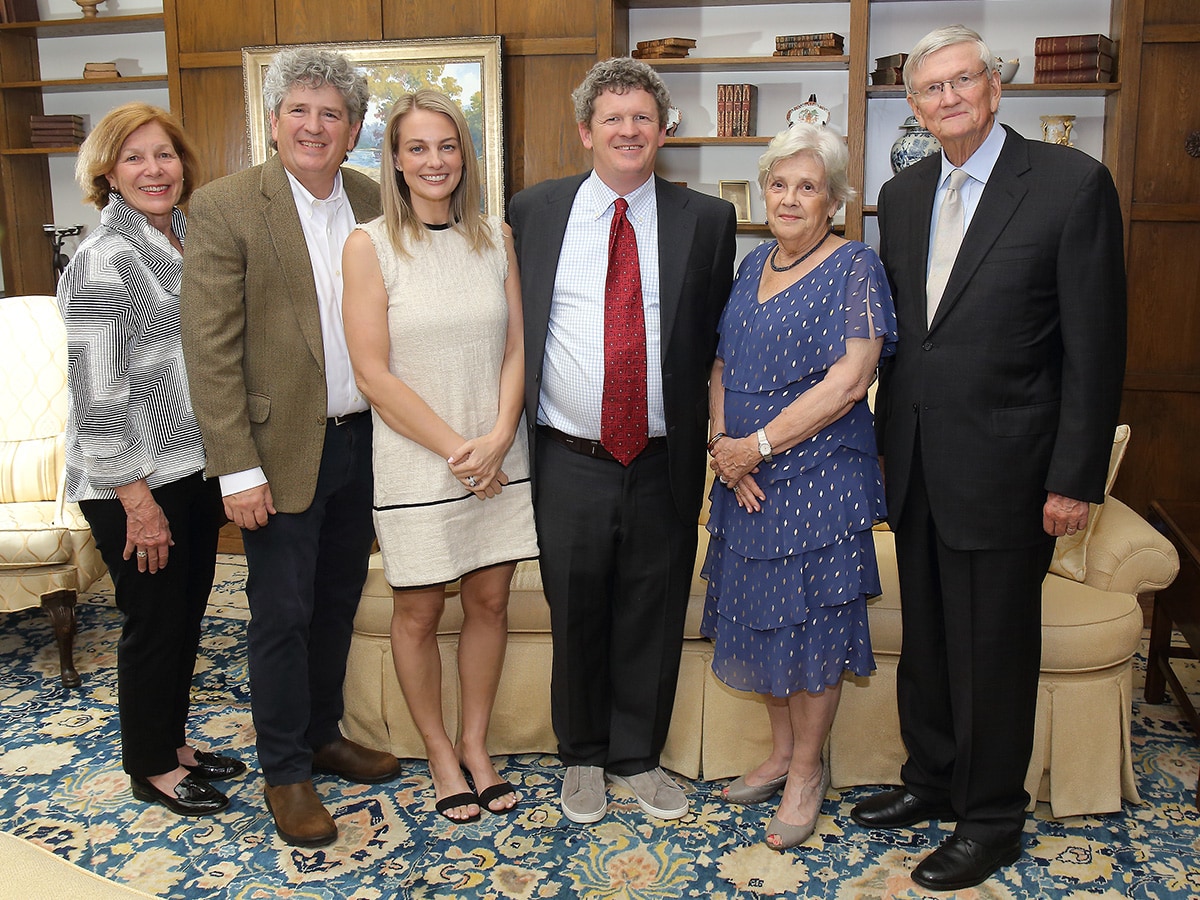
 The Goodrich familyIn parts of rural Alabama, healthcare is measured in distance and time. A routine appointment could require an hour’s drive. And preventive care? When it comes at all, it often arrives late.
A transformative $10 million gift from Mike and Gillian Goodrich to the University of Alabama at Birmingham Marnix E. Heersink School of Medicine lays the foundation for a system to train primary care physicians in rural communities — and give them the resources to remain.
The gift, which will establish Goodrich Rural Innovation in Training for Alabama, or GRIT, will underwrite educational scholarships, provide programmatic support to new rural residency training programs and strengthen rural clinic capacity where training will occur. Pending approval from the University of Alabama System Board of Trustees, the gift will also establish the Goodrich Endowed Chair in Rural Health and Primary Care.
Organized around four primary areas — leadership in rural health and primary care, expanded residency programming, scholarship support, and investment in the clinics and training sites where care is delivered — the program is calculated to benefit the places where care has grown most challenging to find.
Witnessing rural Alabama lose ground for the better part of a generation motivated the Goodriches to collaborate on potential solutions with Anupam Agarwal, M.D., senior vice president for Medicine and dean of the UAB Heersink School of Medicine.
“For a number of years, Gillian and I have been concerned about access to quality healthcare in rural Alabama,” said Mike Goodrich. “Small-town hospitals are closing or reducing services to local citizens. We have worked with Dr. Agarwal and his team to develop a comprehensive program that will attract and retain primary care residents and physicians in rural communities.”
Agarwal emphasizes the importance of the partnership between the Goodrich family and UAB in the ongoing effort to improve rural health outcomes: “From the start, the Goodrich family shared our concern about growing gaps in access to care across rural Alabama. Through their vision and partnership — and under the leadership of Irfan Asif, M.D., chair of the Department of Family and Community Medicine and associate dean of Primary Care and Rural Health at UAB — we have built GRIT into a comprehensive pathway that supports learners from early exposure through training and into practice.
“UAB is uniquely positioned to lead this effort due to the reach of our health system, a strong training infrastructure and a deep commitment to serving every corner of the state. This is what’s possible when philanthropy and academic medicine align around a shared purpose: to create lasting impact for Alabama.”
Where Physicians Train
While GRIT could be seen as an abstract network that will ultimately bolster rural medicine in Alabama, the need behind the program is all too real. Alabama ranks among the lowest states in the nation for access to primary care — a shortage that shapes everything from routine screenings to long-term health outcomes.
GRIT will not be able to resolve a crisis singlehandedly, but the program has something that sets it up for success: sustainability. One of the central goals of GRIT is to cultivate and support doctors who settle into communities and stay.
“The biggest thing is that we have a significant shortage of primary care physicians within Alabama,” Asif said. “We are in the bottom five for the number of primary care providers that we need within our state.”
For Asif, the solution starts with a simple and well-documented reality: Where physicians train often determines where they end up practicing. “Usually, 50 percent or more of people stay within 50 miles of where they graduated from their residency,” he said.
This fact informed the design of GRIT’s architecture, which extends outward from UAB into existing rural training tracks in locations such as Selma, already embedding residents in the communities that need them most while keeping UAB’s infrastructure as a central hub for academic and clinical resources.
“Small towns make up the fabric of Alabama,” Gillian Goodrich said. “We believe that this program is an exciting step to ensure rural Alabama will have the healthcare services that allow residents to continue to enjoy the benefits of rural life.”
Building the Pipeline
Although GRIT will establish a new pipeline for rural primary care physicians, it builds on a foundation that already engages communities across Alabama.
The pipeline begins long before medical school. For example, the Alabama Area Health Education Center Network, which is housed in the UAB Heersink School of Medicine and Department of Family and Community Medicine, supports pathway programs that introduce rural high school students to the possibility of careers in medicine and steer them toward training that will keep them in Alabama. From there, undergraduate and medical school programs work to carry that early interest forward into the field of primary care.
One of these programs enables supervised medical students to work with a panel of their own patients in the first year of their training.
“Students get to work with their patients over the course of four years,” Asif said. “We give them 10 patients, and they serve as health coaches, helping them with screenings, vaccines and any other health needs they may have, such as healthy eating or smoking cessation.”
By the time they graduate, these students have walked four years alongside the same patients. Clinical skills are a given for dedicated medical students; but what stays with them is more difficult to teach: an intimate, accumulated sense of a person’s health over time and the responsibility of having been entrusted with it.
Medical school is the most expensive piece of the pipeline and the one into which GRIT pours the greatest share of its resources, down to the scholarships intended to ease the financial math of choosing rural primary care.
“Our goal is to remove barriers that may prevent learners, especially those from rural areas, from pursuing primary care training and then returning to practice in high-need communities,” Asif said. “Alleviating some of the educational debt burden is one strategy to open up the pathway for students who may be drawn to primary care but feel they need to practice in a more lucrative specialty or in an urban area.”
Strengthening the System
A portion of the Goodriches’ gift answers immediate logistical needs. A rural practice cannot take on and train residents without first having the capacity to host them, and the physicians who agree to mentor these trainees require time and support that the system — as it currently operates — rarely affords them.
“If I am going to send people into different rural parts of the state, I need those practices to be able to accommodate the students,” Asif said.
In practice, this support can take the form of modest device upgrades — think handheld point-of-care ultrasound devices — or digital tools that allow a physician to track chronic disease across an entire panel of patients. It also means investing in practices that have stayed open against the odds, and in the people who have been doing this work largely unaided all along.
A program spread across so much territory and with so many moving parts requires an institution capable of holding it together over a state of remarkable geographic and socioeconomic variation. On this point Asif is unequivocal: UAB is uniquely built for the task.
“We have several resources that are unique to Alabama that you can leverage for a program like this,” Asif said. “We have a pretty impressive network at UAB, and I think that’s why a program like GRIT is so exciting — because you can think about building something that truly has statewide reach and has great potential to affect health outcomes here.”
Defining Success
GRIT enters a healthcare landscape that remains under considerable strain. Hospitals have closed, preventive care is distributed unevenly, and in a number of communities, patients continue to drive long distances for care that was once available nearby.
Asif, for his part, has little interest in measuring success by head count. What he watches for instead is whether people actually grow healthier. “I’d like to see our health outcomes improve in Alabama,” he said. “My hope is that, as Alabamians lead healthier lives, chronic disease rates will go down and things like our mortality rate will improve.”
It is early. The residency tracks are still taking shape, the partnerships are still being formed, and the outcomes Asif describes will not become measurable for years. Yet the premise underneath the entire enterprise is a durable one: that doctors, by and large, put down roots where they train and go on to influence their communities’ health outcomes positively.
If GRIT can embed enough physicians in rural Alabama with UAB as a homebase, the truest measure of the Goodriches’ gift will have very little to do with its size. It will be found, instead, in the towns that manage to keep their physicians, and in the people who no longer have to travel long distances to experience the kind of quality healthcare for which UAB is known.