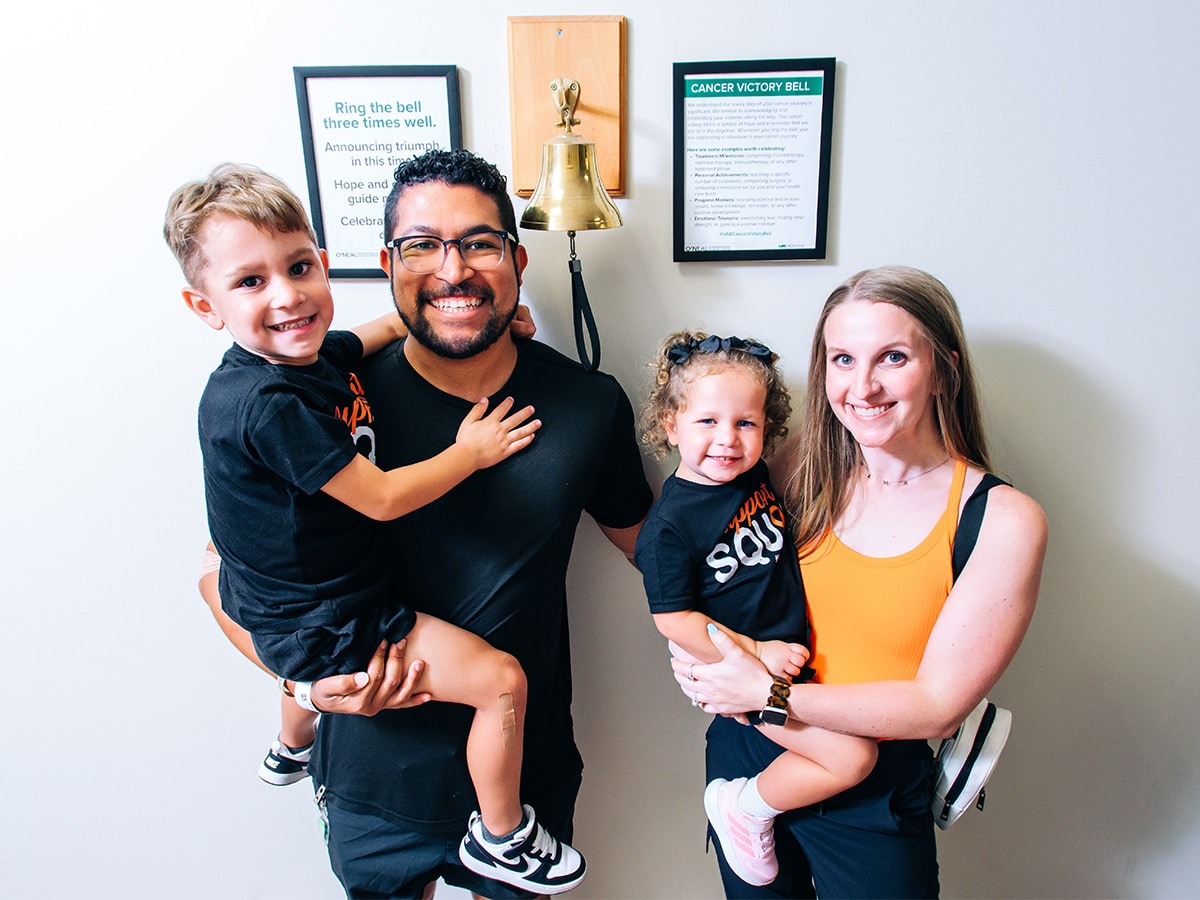
 Logan Hames celebrates ringing the bell alongside his wife, Katy, and their two children, Ace and Avy at UAB's Kirklin Clinic.Logan Hames, a 30-year-old University of Alabama at Birmingham alumnus and videographer within the Office of Marketing and Communications, is a storyteller at heart with a passion for spreading positivity through his work.
As a young father of two, husband and Christian man, life was nothing but ideal for Hames until April 2024, when he received his T-lymphoblastic lymphoma and leukemia diagnosis at UAB.
Following ringing the bell at The Kirklin Clinic on Aug. 20, 2026, Hames wants to share his story as he navigates being a young cancer patient and how it has changed his life, in hopes of raising cancer awareness and inspiration among the community.
A life-changing diagnosis at a young age
Around February 2024, Hames was taking a walk on the Campus Green at UAB when suddenly his heart rate spiked and his chest began to hurt immensely. Hames says he went to the doctor shortly after, as these symptoms were unlike anything he had felt before and worsened as time progressed.
Initially, doctors took into consideration that Hames’ symptoms could have resulted from his active lifestyle. Given his vitality and age, they assumed he could have been experiencing a muscle pull from physical activity or acid reflux.
After experiencing additional symptoms, including difficulty swallowing and neck pain, Hames underwent a computed tomography scan, then was later transferred to UAB. The imaging revealed that his symptoms were caused by a softball‑sized tumor pressing against his heart.
“I’ve never been sick like this before, so it really shocked me at the beginning,” Hames said. “But after the initial shock, I breathed in and said ‘we got this.’ I try not to let the negative thoughts take over. Protecting and focusing on your mental well-being is half the battle.”
Shortly after Hames’ CT scan, he received a call from the hospital confirming his diagnosis as T-LBL and that he would start the process of undergoing chemotherapy for the next month at UAB’s Women & Infants Center.
Hames admits that receiving his diagnosis was shocking and was difficult for both himself and his loved ones. Hames says that, regardless of the diagnosis, he remained confident that he could overcome this challenge and stay positive, reflecting his naturally optimistic outlook on life.
“The cure rate of this kind of cancer is about 90 percent in children. Compared to adults, it’s about 50 percent. That’s a big difference,” said Hames’ primary oncologist, Sravanti Rangaraju, M.D. “But with using these kinds of pediatric-inspired regimens over the last few years, we have seen those cure rates go from 40 percent to 50 percent closer to 80 percent to 90 percent in adults.”
“I try not to look at the negatives in life and focus on the positive outcomes,” Hames said. “I think it shocked my family more than me because I know that we will get through this, even though I didn’t know what the outcome would be.”
Pediatric-inspired regimen
T-LBL is described as a fast and aggressive type of cancer, beginning with an individual’s immature T-cells called lymphoblasts. These developing cells multiply at a higher rate in comparison to mature T-cells, crowding an individual’s immune system and weakening the body’s ability to fight infections.
In Hames’ case, T‑LBL presented as a tumor in his chest. Although T‑acute lymphoblastic leukemia usually refers to cases with significant bone marrow and blood involvement, T‑LBL can also display traits of leukemia when immature T‑cells enter the bloodstream. T‑LBL and T‑ALL are considered two presentations of the same disease, distinguished mainly by the extent to which blood and bone marrow are involved.
T-LBL and T-ALL are typically more common among children, in comparison to those who are considered adolescent and young adult patients like Hames within the 16 to 39 age group. Young adult patients are unique in that they are young and healthy enough to tolerate aggressive treatment similar to what is given to children, which are referred to as “pediatric-inspired regimens.”
The significance of lifestyle consistency and routine
Hames and cancer patients alike go through various treatments, follow-up appointments and recovery stages in order to manage what their daily life will look like post-diagnosis.
During the initial stages of treatment, specifically induction chemotherapy and consolidation, patients are undergoing treatments more frequently around one to two times a week for two months, accompanied with a longer recovery period. As patients continue through the phases of treatment, the frequency of visits decreases; however, daily routines need to be adjusted to accommodate medications and their side effects.
Alongside his appointments, Hames is taking three chemotherapy pills every night and 16 every Friday night. Rangaraju says the importance of being consistently attentive to the process of one’s treatment and following through is a major aspect of how the body will respond, which can be demanding for young adult patients.
“Following through with what your physician recommends is really important because, if you leave halfway through, then all that effort you’ve put in in the beginning is no good,” Rangaraju said. “I think being honest with your physician and just trying to show up the best that you can and then also communicating are key.”
Finding a support system and a passion
Finding a support system to lean on while battling any kind of illness plays a crucial role in how a patient copes both emotionally and mentally.
Hames says that navigating parenting his two energetic toddlers and wanting to be present for them was heavy while managing his fatigue. He says his wife, Katy, and his parents stepped up during his treatments to lessen the realistic burden that comes with this disease.
“My wife, Katy, was working full time and back in school, while also staying in the hospital with me. If I was in the hospital, she’d stay every night and go from the hospital to work,” Hames said. “I know it took a toll on her, but she pushed through. Everyone around me helped pitch in, and it took a toll on all of us.”
Alongside the support from his family, Hames found a support system through posting his journey on social media. Hames originally began making video content of his journey to give his loved ones general updates on how he was doing and to fulfill a fun, creative outlet while in the hospital. He was shocked to see that his videos soon reached users from all over the world who had questions, needed advice or just simply wanted to share words of encouragement.
“Now I’ll message people online too. I say, ‘Hey, I went through this too and I am praying for you,’ Just to let them know, you can do this. Even if it’s not the same thing I went through, just trying to keep them positive because it matters — it really does,” Hames said. “You genuinely never know if someone really needed that in that moment.”
UAB’s O’Neal Cancer Center is the only NCI-designated cancer center in the state of Alabama, offering patients access to cutting-edge treatments and clinical trials, as well as various in-person or virtual support groups for patients, survivors and loved ones to attend. Hames says he was one of the first patients who joined Rangaraju’s newly launched support group for patients with blood-associated cancers called Blood Buds.
“Sometimes just talking to someone who is not directly a part of your journey with you is helpful. Lean on your support team,” Rangaraju said. “You can’t do it alone so reach out to whoever those people are that can help you through it. Both your mental and physical health is very important.”
Ringing in the beginning of remission
Hames rang the bell on Aug. 20, 2026, surrounded by his friends and loved ones, signifying the beginning of his remission and perseverance through the challenge he believed he would overcome almost two years ago.
“I had all of my family and friends there. I’m glad they all got to see it because they’ve all been there to help me through it by taking me to chemo appointments or had some impact on my journey,” Hames said. “I will never forget it. It was such a happy day.”
Reflecting on this milestone, Hames says the care and people of UAB have been great, treating patients like family during their times of need. Hames says that, although the course of his treatment is not entirely over, achieving this success has opened his eyes to what is truly possible.
“It opened my eyes to not taking anything for granted and keeping up with your health. I look at people differently now — I never know what someone’s going through,” Hames said. “It opened my eyes to the realism of everybody’s going through something and how we can help one another.”