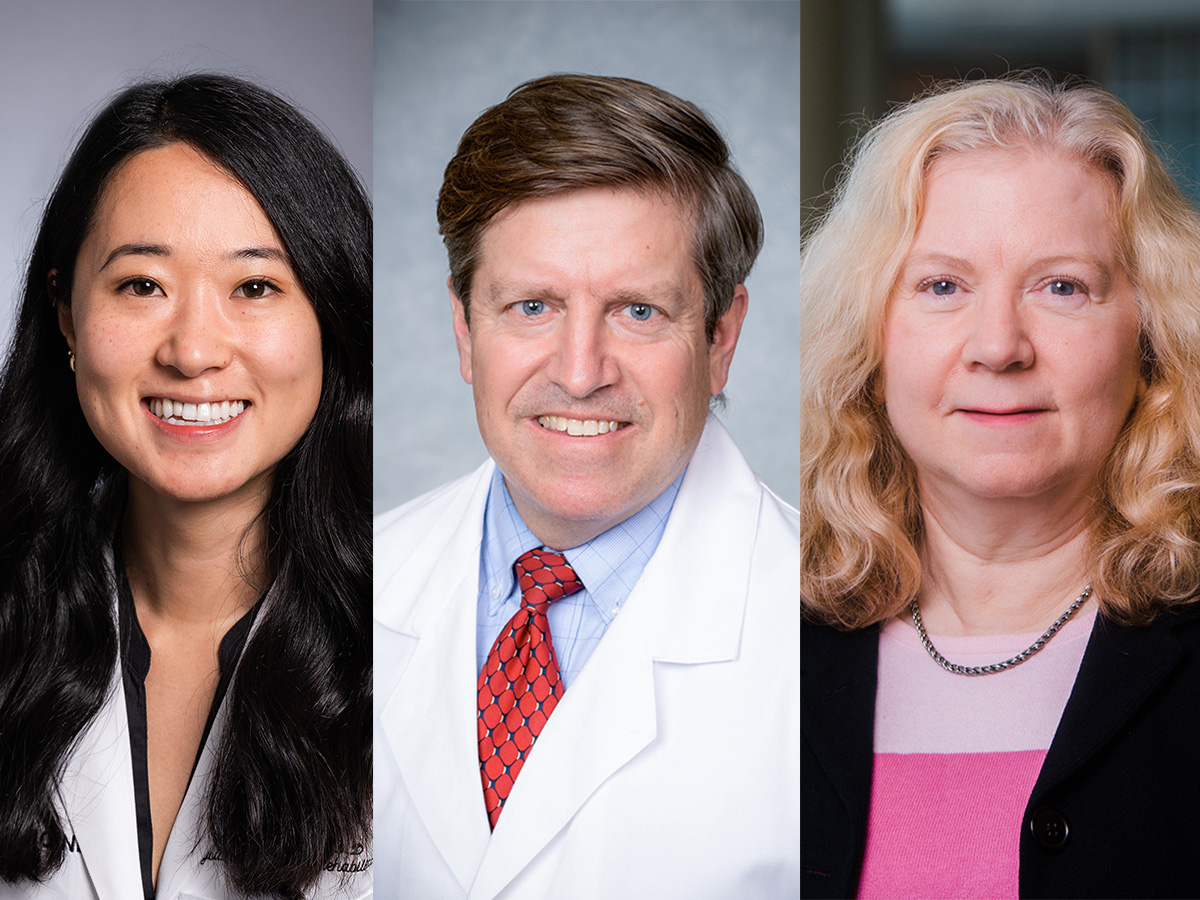
 From left to right: Rachel Teranishi, M.D., Robert Brunner, M.D., Jennifer Marwitz Traumatic brain injuries can be life-changing, impacting motor and cognitive functions and altering daily tasks and routines. Recovery can vary depending on the person, severity of the injury and precision of medical intervention. A TBI may cause difficulties with spatial awareness, executive functioning, processing speed, attention and self-awareness, which can impact a person’s ability to drive safely.
Researchers and clinicians at the University of Alabama at Birmingham recognize that driving can be a challenging yet important goal for patients in supporting mobility, community participation and engagement in familiar routines. That is why UAB is dedicating efforts to improve driving outcomes.
Rachel Teranishi, M.D., assistant professor in the Department of Physical Medicine and Rehabilitation at the UAB Marnix E. Heersink School of Medicine, says driving after TBI is possible, though rates vary depending on the study.
“Approximately 40 percent to 70 percent can return to driving after a moderate to severe TBI,” Teranishi said. “Successful return-to-driving has been associated with injury severity, race and family income.”
TBIs can vary in severity and symptoms. Due to an inability to measure or determine how they impact the body from one case to another, research cannot explicitly set definitive parameters and metrics for how these injuries reflect in recovery across motor skills, specifically when it comes to returning to driving.
Jennifer Marwitz, director of Traumatic Brain Injury Research in the UAB Department of Physical Medicine and Rehabilitation, says, although there are no standard numbers for recovery times for learning to operate a vehicle again, research shows that, of the 40 percent to 70 percent, most can return to driving within two years after a moderate to severe injury.
“Often the decision to return to driving is subjective,” Marwitz said. “There are no one-size-fits-all scenarios for recovery, so efforts are reserved to a patient’s discretion, progress and family members as opposed to a formal evaluation or threshold.”
UAB’s Traumatic Brain Injury Model System research on the use of a driving simulator aims to determine whether there are better ways to predict when people with TBI might return to driving.
Established in 1987, the TBIMS program was founded to establish a national network to provide resources on TBI-related research, information and quality-of-life improvement tools to better support individuals with TBI, families, researchers and clinicians.
Robert Brunner, M.D., medical director of Spain Rehabilitation and Distinguished Professor in the Department of Physical Medicine and Rehabilitation, says, for many individuals recovering from traumatic brain injury, returning to driving represents far more than transportation.
“It is a gateway to independence, employment, social engagement and full participation in community life,” Brunner said. “Through the UAB Traumatic Brain Injury Model System driving study, we are working to identify objective, evidence-based measures that help clinicians, patients and families make informed decisions about when it is safe and appropriate to return to driving.”
The research conducted under the program can be distinguished into four key categories. The first is a long-term national database of more than 21,000 people who received inpatient rehabilitation for traumatic brain injury at a TBIMS center, including 1,630 UAB participants tracked for up to 25 years after injury. The second is collaborative TBIMS module projects that examine a wide range of TBI-related topics, including health literacy, weight management and caregiver resilience. The third is maintaining a site-specific study, which is currently examining return-to-driving outcomes after injury. Lastly, the Model System translates and shares its research findings with patients, care partners, researchers and clinicians through multiple channels including the Model System Knowledge Translation Center, UAB-TBIMS website and social media channels.
“Over the span of UAB’s 28 years of competitive funding, researchers have conducted site-specific studies focused on describing outcomes, therapy interventions, pharmaceutical interventions, scale development and program development,” Marwitz said.
UAB’s current site-specific study is comparing participants’ performance on a desktop driving simulator with neuropsychological testing at three months post-injury. At six months post-injury, participants complete an on-the-road evaluation in addition to repeating the driving simulator and neuropsychological testing.
“Most states, including Alabama, require a six-month wait after a significant neurological event, such as a seizure, stroke or TBI,” Marwitz said. “The six-month timepoint is based only on evidence related to epilepsy, and UAB researchers have found that, of those with TBI who do return to driving, about half do so before the six-month time frame.”
This study hopes to establish a more consistent framework for clinicians in making decisions regarding a return to driving.
“The study aims to validate the driving simulator assessment using data from the on-road driving evaluation and neuropsychological testing and ideally predict driving outcomes at one year post-injury based on the earlier assessments,” Marwitz said.
If the driving simulator research supports consistent predictive results, the next step would be building interventional training and ultimately identifying qualitative methods to establish support for those with TBI to get back on the road.
The UAB TBIMS program is competitively funded by the National Institute on Disability, Independent Living and Rehabilitation Research through 2027.