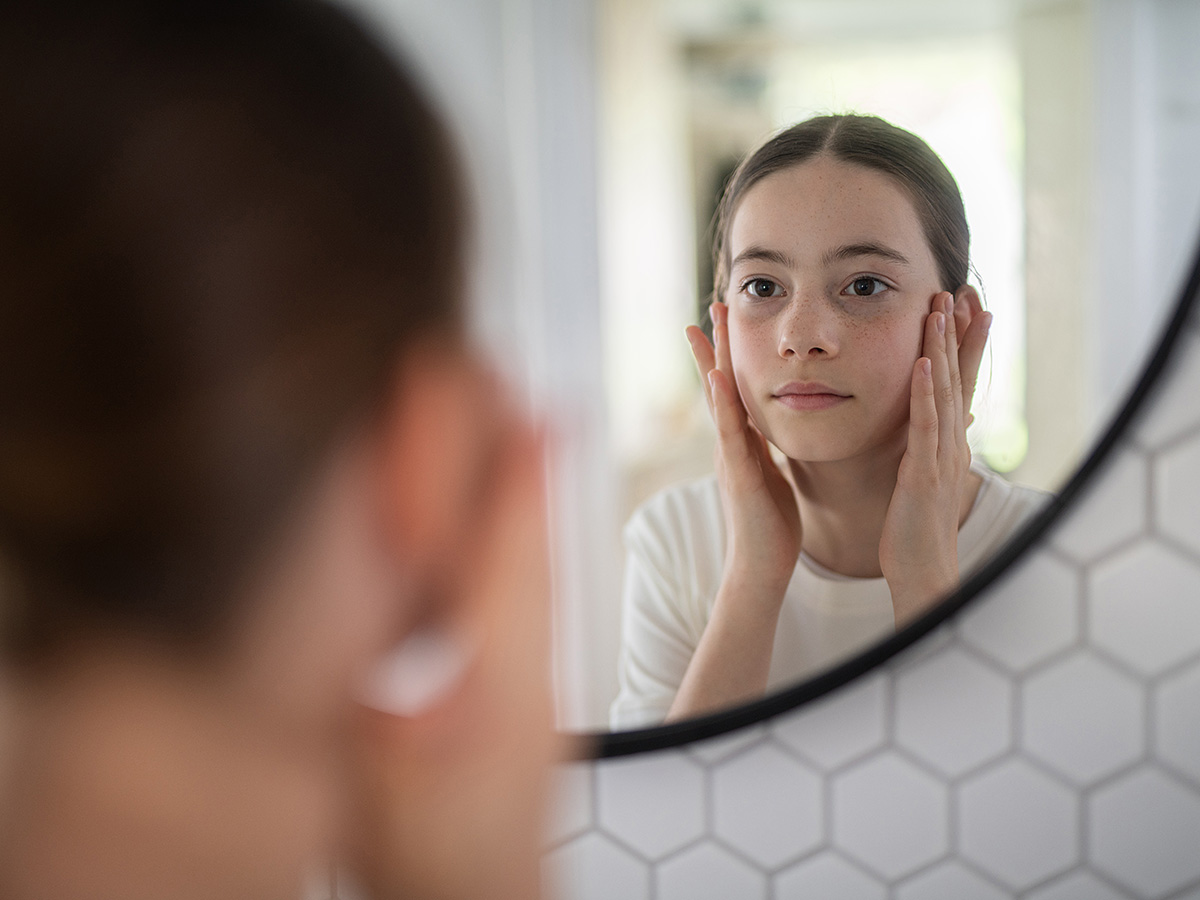
 Social media trends largely impact the younger generation. One way these trends shape society today is through the beauty industry. Skincare products are part of a booming industry shaped by young people. However, University of Alabama at Birmingham dermatologists are offering need-to-know information for parents and families considering buying skincare gifts for their youth this holiday season.
Cleansers
Clean and healthy skin should always be the priority no matter one’s age. Therefore, utilizing a cleanser is an acceptable skincare product for children and teens.
“Cleansers are relatively harmless no matter one’s age,” said Ravi Hiremagalore, M.D., assistant professor of pediatric dermatology. “However, it is the active ingredients in the cleanser that should be taken into consideration based on skin conditions.”
For teenagers who specifically suffer with acne, Hiremagalore says a cleanser that contains benzoyl peroxide should be used.
For those in the mid-childhood range, or between the ages of 6 and 12, Hiremagalore says it is most important to ensure they follow a fragrance-free regimen if they are prone to drier skin or eczema.
“Fragrances can further irritate and dry out the skin,” he said. “This can cause damage to the epidermis in those who may have eczema.”
Moisturizers
Moisturizers are another simple and relatively harmless skincare product for children. This is a mandatory form of skin care at all ages. Showers and baths naturally deplete the moisture levels in the skin.
Unless a child or teen is prone to rougher or abnormal skin, an over-the-counter or in-store moisturizer is an acceptable skincare product for young people and should be mandatory.
Hiremagalore suggests avoiding fragranced moisturizers on the face for kids and teens with eczema or those who struggle with more dry skin.
Oils
Skincare oils can take many forms. Some skincare oils contain vitamins to enrich the skin, while others feature active ingredients to remove dark spots and prevent aging. These items are not appropriate or beneficial on youth skin.
“Whether they are in a mid-childhood range, or a true teen, oils are not needed for youth skin care and should be avoided,” Hiremagalore said. “Most features do not have a necessary effect on skin that is naturally maturing.”
Skincare products that advertise acne and dark spot removals, anti-aging, or fine line correction are not appropriate for youth because the skin is still developing and does not need products that work against a natural growth.
Once a child’s body enters puberty, the skin begins to increase oil production. Acne is the skin’s common natural response to this increase. Clogged pores from excess oil and dead skin cells produce bumps, sores and whiteheads on the skin’s surface. Adding more oil to skin that is already saturated in natural oils can have adverse effects on the skin.
However, even in children who have not reached puberty, drier skin should be combated via moisturizers and not oils.
Masks
Skincare masks serve a variety of purposes, but it is not essential in the healthy maintenance of youth skin. These masks work by applying embedded ingredients to the surface of the skin. These should also be avoided in terms of daily use.
“If this were for a fun special occasion like a wedding, it is OK,” Hiremagalore said. “However, skincare masks are not for daily use for young people and should be approached with caution when applying to the skin.”
Sunscreen
Sunscreen is an essential layer of protection for people of all ages. While many may be lax on the application of sunscreen in the winter and colder months, sunscreen is a needed product year-round.
To read more about the importance of sunscreen application in the winter, click here.
Do’s and don’ts
Hiremagalore says experimenting with different products can be detrimental to the skin.
“Do not keep trying different products,” Hiremagalore said. “Children and teens are still growing, and because of this it is important to not use too many different versions of the same thing.”
Once a product is integrated into a routine, it is safest to continue use of that specific product for a period before utilizing a new brand of the same item or introducing something else.
“The skin is sensitive and must be handled with care,” Hiremagalore said. “Youth should not be overwhelming their skin with different products, as the result could damage the already developing organ.”
Hiremagalore also says parents should consult with a dermatologist if they are uncertain about a specific product for their child.
Simplicity in products is also important to note for parents purchasing products for their kids. Unless a child has a preexisting or notable skin condition, a fragrance-free cleanser and moisturizer with minimal additives should be fine for moderate use on youth skin.