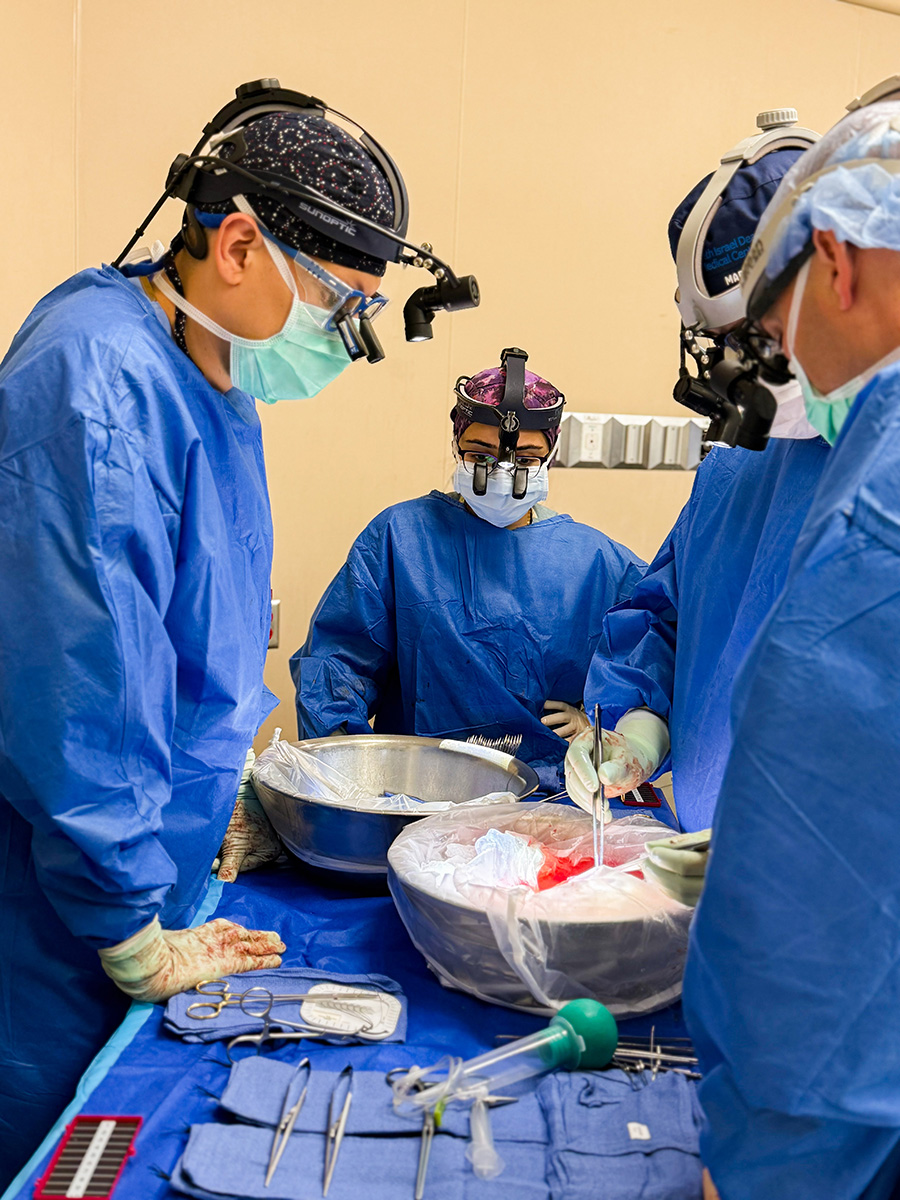
 Saluat Sheikh, M.D. (purple scrub cap) performed UAB and Alabama's first adult living donor liver transplant.For the first time in Alabama, surgeons at the University of Alabama at Birmingham have successfully completed the first living-donor liver transplant — an advancement that expands lifesaving options for patients facing long wait times on transplant lists.
UAB has continued expanding access to liver transplantation, yet demand remains high, and many patients with lower model for end-stage liver disease, or MELD, scores face long wait times that can lead to worsening health and increased surgical risk. To address this, multidisciplinary UAB transplant teams have spent years preparing to introduce living donor liver transplantation as an additional option for patients.
The first procedure took place in early March 2026 and was led by Saulat S. Sheikh, M.D., assistant professor and surgical director of UAB’s Living-Donor Liver Transplant Program in the Division of Transplantation. She says, until now, many patients seeking living-donor liver transplantation had to travel outside Alabama for care. With the launch of this program, patients and families can remain close to home while receiving advanced transplant treatment.
“We are thrilled to have completed our first living-donor liver transplant at UAB — an achievement years in the making,” Sheikh said. “This milestone reflects our team’s unwavering commitment to offering the full spectrum of transplant options to the patients we serve in Alabama and neighboring states.”
In living donor liver transplantation, surgeons remove a portion of a healthy donor’s liver and transplant it into a recipient with liver failure. Both livers regenerate over time. Living donors undergo extensive medical and psychological screening, and donor safety remains the guiding principle throughout the process.
With significant advancements in surgical expertise, perioperative care, and strong institutional and multidisciplinary readiness, Jacqueline Garonzik Wang, M.D., Ph.D., division director of Transplantation and co-director of the UAB Comprehensive Transplant Institute, says the timing is now right to offer this lifesaving alternative.
“Living donation can shorten or eliminate wait time, reduce waitlist mortality, and allow transplantation at an earlier, more controlled time — often when the recipient is in better medical condition,” Garonzik Wang said. “This can translate to better outcomes, shorter post-transplant recovery and less time living with the uncertainty of waiting for a deceased donor.”
• More than 9,400 people are on the waiting list for a liver transplant in the United States
• More than 150 patients are currently on the UAB waitlist
• Living donor transplantation can significantly shorten wait times
Brendan McGuire, M.D., medical director of Liver Transplant, says liver transplantation can be a life‑changing and highly successful option for people living with cirrhosis.
“Right now, more than 150 of our patients are waiting and hoping for a liver transplant,” McGuire said. “There are still not enough deceased donor organs to meet the needs of every patient who is waiting. By offering patients with cirrhosis the opportunity for a living-donor liver transplant, we can give them additional pathways to receive a transplant sooner, restore their health and return to a fuller, more vibrant quality of life.”
Sheikh says Alabama carries a high burden of liver disease, yet access to advanced transplant modalities has historically been limited. As indications for transplant grow and organ availability remains constrained, expanding to living-donor transplantation is a critical step in reducing waitlist mortality and improving access for patients.
To safely launch a program of this nature, Garonzik Wang says a team of experienced hepatologists, transplant surgeons, anesthesiologists, interventional radiologists, intensivists and living-donor coordinators are needed to achieve success.
“Success also requires an established infrastructure for complex liver surgery, robust evaluation pathways, advanced ICU and floor-level care, and strong support services such as social work, donor advocacy and post-care coordination,” Garonzik Wang said. “UAB has a track record for providing outstanding expertise and care in all of these domains, which allowed us to safely and successfully launch the program.”