Key Insights
Olga Khaybullina’s research offers a new way to trace nanoplastics in the body, laying the groundwork for future studies of their potential effects on maternal and fetal health.
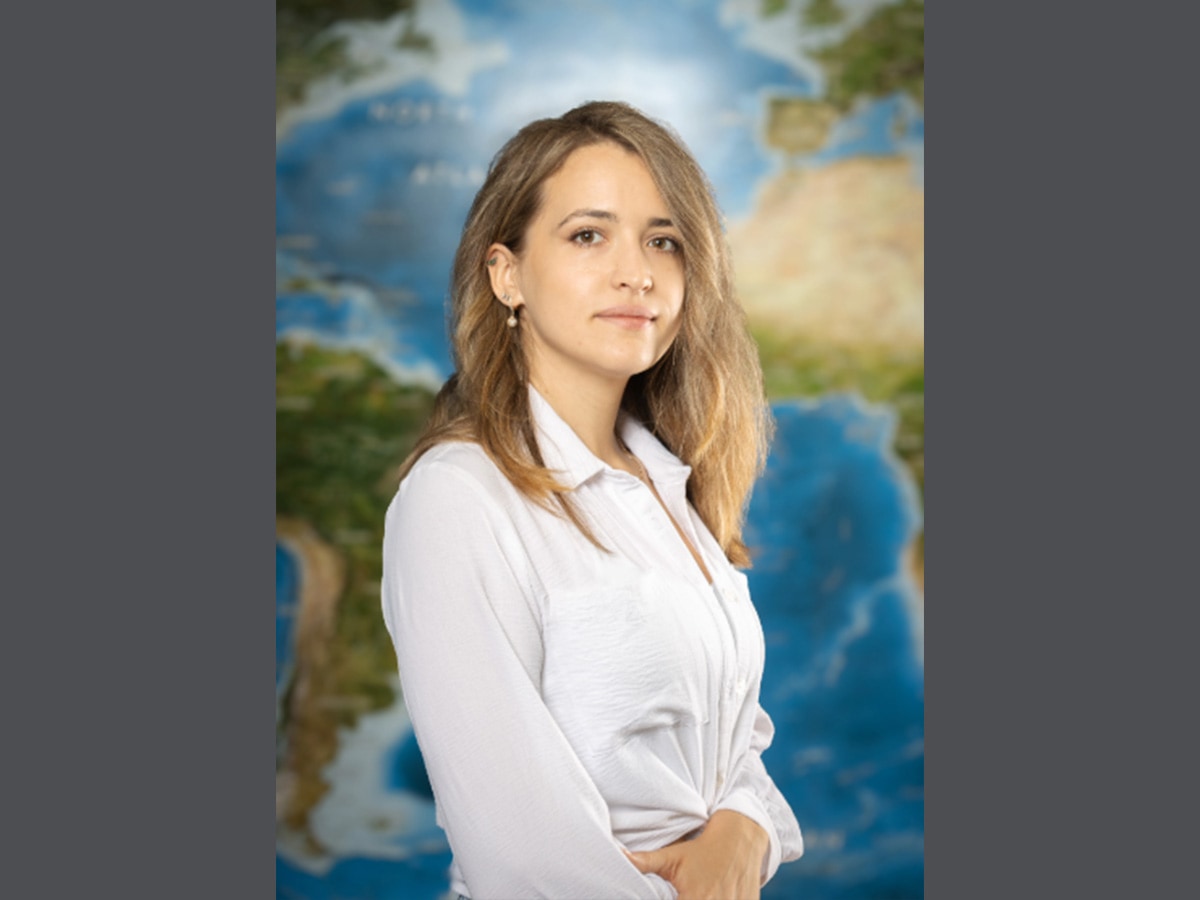 Olga Khaybullina’s research offers a new way to trace nanoplastics in the body, laying the groundwork for future studies of their potential effects on maternal and fetal health.Olga Khaybullina, a doctoral candidate in chemistry at the University of Alabama at Birmingham, has received the C. Ellen Gonter Environmental Chemistry Award for research developing a method to track how nanoplastics move through the body during pregnancy.
The award is the highest student honor presented by the American Chemical Society’s Division of Environmental Chemistry and recognizes graduate students for outstanding research in environmental chemistry.
Nanoplastics can form as plastic breaks down into increasingly small particles and may enter the body through air, food or water. Their extremely small size makes detecting and tracking them inside the body difficult.
Khaybullina and her collaborators developed polystyrene nanoplastics containing carbon-14, creating a built-in signal that allows researchers to detect and measure where the particles travel. Using the method in pregnant animal models, the team investigated how particle size influenced distribution and whether nanoplastics could reach the placenta and developing embryos.
“Understanding where these particles go is one of the first questions we need to answer,” Khaybullina said. “Ultimately, this method can help move the field from understanding where nanoplastics travel to understanding what they may do once they arrive.”
The study did not examine whether nanoplastics cause adverse health effects. Instead, the tracking method provides a foundation for future research into how repeated or long-term exposure could affect maternal health, placental function and fetal development.
Outi Keinänen, Ph.D., Khaybullina’s mentor and an assistant professor in the UAB Department of Chemistry, says incorporating the carbon-14 signal into the nanoplastics allows researchers to quantify their distribution without altering the particles’ inherent physical and chemical properties.
The research was published in Advanced Science, where it was selected for the journal’s inside back cover.
Khaybullina came to UAB in 2021 after earning her bachelor’s degree in chemistry from South Ural State University in Chelyabinsk, Russia, and participating in an academic exchange at Zhejiang Ocean University in China. Her interest in environmental chemistry developed during her doctoral studies after joining Keinänen’s research on micro- and nanoplastics.
Alongside her research, Khaybullina has taught introductory chemistry laboratories, has mentored undergraduate students and serves as founding president of the Chemistry Graduate Advisory Board.
“Receiving this award gave me a moment to step back and appreciate how far the project had come,” Khaybullina said. “It was especially meaningful to have the work recognized by the environmental chemistry community because this is an area I discovered during my Ph.D.”.