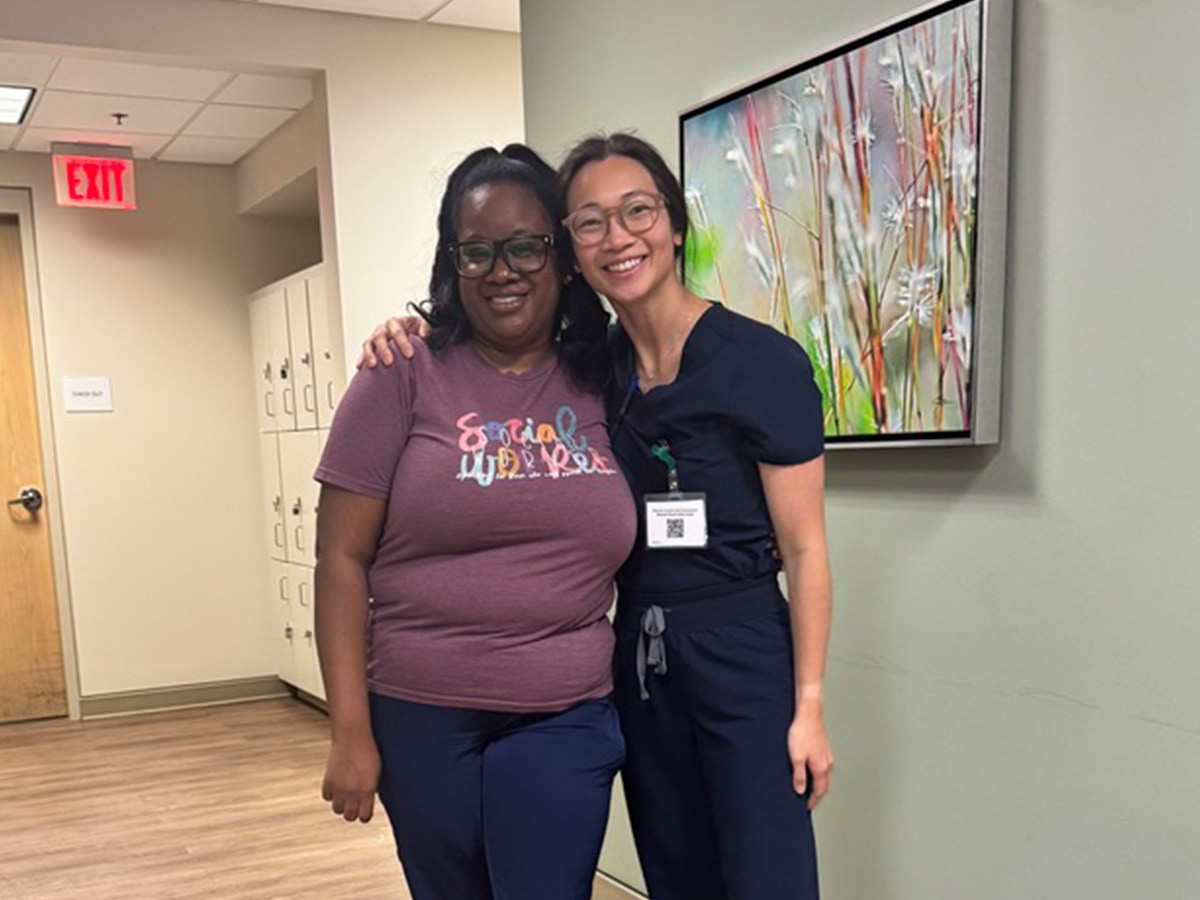
 UAB’s new Granulomatous Mastitis Steroid Injection Service reshapes the course of treatment and research with its first patient, Laterica Williams. Laterica Williams has always been a caregiver. She is the person who is always ready to help friends and family. Even her chosen profession as a hospice social worker reflects her character as a caregiver and guide. Her daughter, Kinley, was born in 2022. She gave Williams her newest and favorite caregiver role of all: mom. Williams is the type of mom who does not miss a single dance class, trading small-talk and encouragement with the other caregivers outside the studio and always pulling her daughter into a warm hug after each class.
In April 2025, her signature warm hug felt painful. That was when Williams discovered a tender lump in her right breast. Within weeks, the lump would become multiple painful lumps, eventually erupting into wounds on her skin draining thick fluid. It was as if someone had taken a knife and cut multiple holes in her breast. It became hard to hold her daughter close, and the excruciating pain made it hard to do even her daily activities. Despite multiple antibiotics and pain medications, Williams was unable to find any relief from her worsening condition.
Seeking answers, Williams went to the University of Alabama at Birmingham where Lily Gutnik, M.D., and Nurse Practitioner Jenna Chambers at the Breast Health Clinic requested a mammogram and ultrasound. The breast radiologists who performed her evaluation were immediately concerned by the imaging of her breast and performed a biopsy to obtain a diagnosis. Shortly after, the pathology results revealed Williams’ diagnosis to be idiopathic granulomatous mastitis, a non-cancerous but debilitating autoimmune disease. She was quickly placed on several oral medications and eventually referred to rheumatology for stronger medication and monitoring.
Idiopathic granulomatous mastitis: A particularly cruel disease
IGM is a rare inflammatory breast condition that primarily affects young women, often following pregnancy or lactation. In that way, it is a particularly cruel disease. Few pull young ones close to the breast as much as a young mother who often has no time to spare for herself. Williams had to take a month off from work and relied on the support of her family and friends to care for her and Kinley.
Although benign, the disease can take a serious toll on quality of life, causing persistent pain, skin changes, recurrent abscesses and, in some cases, open, draining wounds on the skin. IGM can be both physically and emotionally distressing. Due to the rare nature of the disease, patients can find themselves facing a very isolating path ahead. Williams describes facing IGM as one of the hardest things she has had to do in her life, but she found strength in her faith and in Kinley.
 Williams and her daughter Kinley. “I couldn’t leave her. I couldn’t give up because I wanted to be here to raise her,” Williams said. “She kept me motivated and kept me going, and that was my reason for not giving up.”
When Williams’ healing seemed to stall, Gutnik and Chambers referred her back to the breast imaging division in the UAB Department of Radiology. They were seeking the first patient for their new outpatient IGM steroid injection service—a low-cost, effective treatment of IGM—led by clinical assistant professor Cathy Chen, M.D.
A gentle hug between patient and doctor
On the day of her first injection, Williams was led to a procedure room in the breast imaging clinic. When Chen walked in to discuss the procedure with Williams and perform the injection, they were both stunned to recognize the other from sitting outside their daughters’ dance class. They hugged gently.
From the people at the front desk to her healthcare team at UAB, Williams felt seen and cared for throughout her journey. She admires how kind and personable everyone has been toward her, supporting her every step of the way.
As of May 2026, Williams is living comfortably with reduced flare-ups, thanks to the dedication of her healthcare team at UAB. She is back to her favorite roles as caregiver and guide. She and Chen have even discussed starting an IGM support group to help others like her.
Chen describes seeing Williams in clinic as profoundly humbling.
“So many women in our communities are quietly living with painful and isolating diseases like IGM while balancing work and caregiving responsibilities. You truly never know what someone sitting right next to you every week may be going through,” Chen said. “It is our privilege as physicians to provide care to these women are used to being the caregivers themselves.”
With the addition of the steroid injections, Williams saw continued, significant relief and has had multiple injections for intermittent flare-ups of pain since that first day. Over time, Williams and Chen have formed a new friendship too, not just as their daughter’s moms, but as Laterica and Cathy. This spring, when their daughters embraced and posed for photos before their annual dance recital at The Alabama Theater, the moms also shared a hug and the knowledge of a mother’s strength.
Through her experience, Williams gained a new perspective in life, filling her with joy and gratitude and the appreciation of the simple, everyday moments that bring her happiness.
“We take so many things for granted. The ability to be able to care for myself and take care of my daughter now brings me so much joy because at one point I couldn’t do that,” Williams said.
For those experiencing IGM or something similar, Williams emphasizes having a strong support system and a medical team willing to do whatever it takes to help their patients get better. These factors provide emotional encouragement and strength.
“You have to advocate for yourself,” Williams said. “I encourage everybody to advocate for yourself and tell your doctors what you are feeling.”
A promising new option: Intralesional steroid injections
IGM has long posed challenges for both patients and providers. Symptoms can persist for months or even years. Treatment approaches vary widely and range from systemic medications, like oral steroids or immunosuppressive drugs, to surgical intervention. Each option comes with trade-offs, including side effects, risk of recurrence or complications related to wound healing.
Because there is no universal standard of care, providers must often tailor treatment strategies to each individual patient, something UAB is especially equipped to do.
One of the most exciting advances of the UAB Granulomatous Mastitis Steroid Injection Service is the use of ultrasound-guided steroid injections directly into the breast. This targeted therapy allows physicians to deliver medication directly into the affected breast tissue, reducing inflammation at its source.
“We’re really excited to be offering intralesional steroid injections for our patients,” Chen said. “So far, we have had incredible results.”
Unlike systemic therapies, which affect the entire body and can lead to unwanted side effects, this localized approach is both effective and well-tolerated. The procedure is quick, minimally invasive and cost-efficient, an appealing combination for patients who may already be navigating a long and difficult clinical journey.
Early outcomes have been particularly encouraging. Some patients have experienced rapid symptomatic relief, and in certain cases, the treatment has been described as life-changing.
Multidisciplinary care makes the difference
Beyond a single treatment modality, what truly sets the UAB Granulomatous Mastitis Steroid Injection Service apart is its role in the multidisciplinary approach taken at UAB. According to Chen, this approach is much more effective for treating this complex chronic disease.
Treating IGM effectively often requires collaboration across specialties, including breast imaging, surgery and medical management, to address both the physical and long-term aspects of the disease.
Patients may receive intralesional steroid injections as a standalone therapy or in combination with systemic medications or surgical planning, depending on their needs. This flexibility allows providers to optimize outcomes while minimizing complications.
As awareness of IGM grows, so does the need for innovative and compassionate care models. UAB is advancing treatment options alongside redefining the patient experience, offering faster relief, fewer side effects and a clearer path toward remission.
“We’re highly motivated to expand this service and help other women achieve faster symptomatic relief and ultimately durable remission,” Chen said. “Williams’ story and strength have been a major motivator for us in breast imaging to expand awareness of and access to this service.”