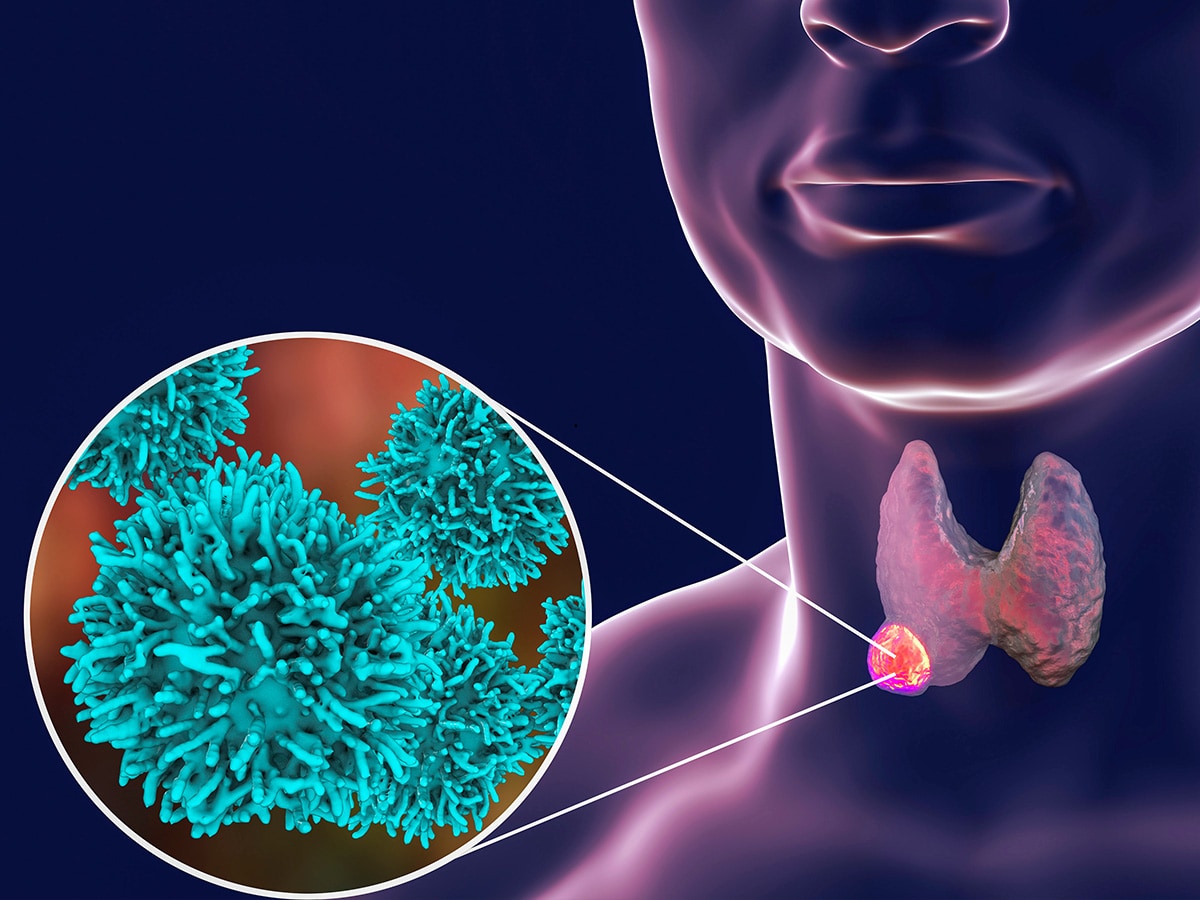
 Metastatic thyroid cancer is an aggressive form of cancer that has limited treatment options.The University of Alabama at Birmingham is taking strides toward a possible new aggressive cancer treatment.
UAB professor Sadanandan Velu, Ph.D., is leading the potential discovery of a new therapeutic strategy that could address a critical need for patients fighting a rare and aggressive form of thyroid cancer.
Velu is a professor in the Department of Chemistry, co-director of the Undergraduate Program in Cancer Biology and a researcher for the O'Neal Cancer Center. He works alongside Renata Jaskula-Sztul, Ph.D., an associate professor in the Division of Breast and Endocrine Surgery, and doctoral student Piyasuda Pukkanasut to learn more about this discovery.
The new therapeutic strategy focuses on blocking a specific voltage-gated sodium channel known as Nav1.7.
This strategy could help treat patients with an aggressive form of cancer that currently has limited treatment options, metastatic medullary thyroid cancer.
MTC is particularly difficult to treat once it spreads beyond the thyroid. Patients whose cancer spreads beyond the thyroid are faced with a poor prognosis — a 10-year survival rate of 10 percent, largely due to the development of hepatic or liver metastasis. Unlike other thyroid cancers, MTC does not respond to standard treatments, leaving patients with few effective options.
 Sadanandan Velu, Ph.D., professor of Chemistry and Co-Director of the Undergraduate Program in Cancer Biology.“Our recent studies using medullary thyroid cancer cell lines and patient specimens confirmed that VGSC subtype Nav1.7 is uniquely expressed in aggressive MTC,” Velu said. “It is not expressed in normal thyroid cells and tissues, which makes it an attractive therapeutic target.”
Nav1.7 blockers work by inhibiting the transport of sodium ions in and out of cancer cells, reducing their ability to migrate and invade surrounding tissue. Inhibition of Nav1.7 by small molecules is a novel strategy for the development of therapeutic drugs for metastatic MTC.
Currently, the primary treatment option for advanced MTC involves tyrosine kinase inhibitors. While four FDA-approved TKIs are available, they often come with severe side effects and can lose effectiveness over time as tumors develop drug resistance.
“There are no current treatments for metastatic MTC other than TKIs,” Velu said. “Although these are promising drugs to treat advanced MTC, resistance arising from mutations in tyrosine kinase domains is a significant problem, and patients often experience multiple side effects. Since Nav1.7 blockers specifically inhibit cell invasion and migration, they are likely to have fewer side effects associated with the cytotoxin agents.”
The research remains in the basic science stage; but Velu believes that, when fully developed, Nav1.7 blockers have the potential to provide the first treatments for metastatic MTC.
For Velu, the motivation behind the work is deeply tied to patient outcomes.
“The major cause of MTC deaths is hepatic metastases,” he said. “We would like to improve the survival rate for patients facing this disease, and that is what excites us most about the potential of this work.”