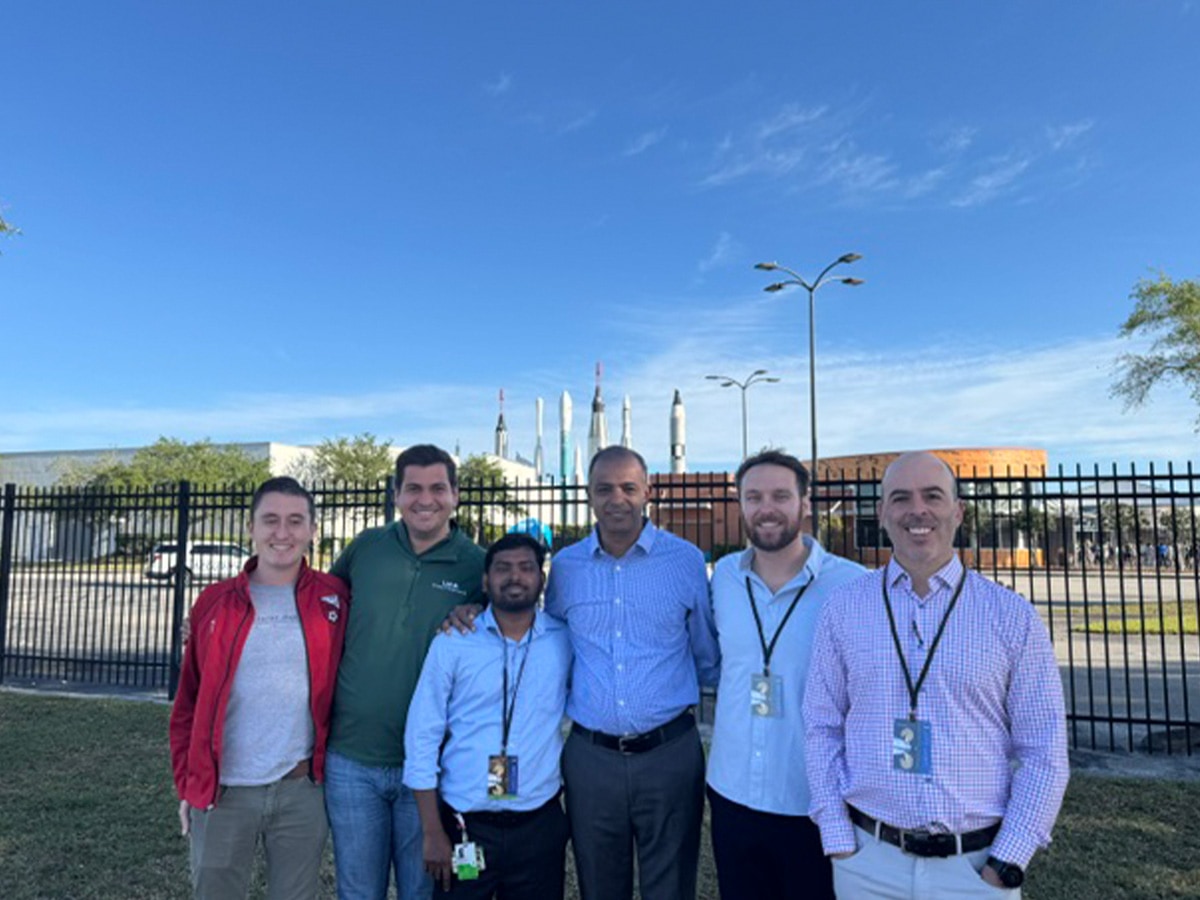
 From L-R Kenny Long (UAB), Ian Berg (UAB), Vipin Chembilikandy (UAB), Palaniappan Sethu (UAB), Grant Vellinger (Redwire Space), Carlos Orihuela (UAB)Researchers from the University of Alabama at Birmingham are launching a new space‑based biomedical investigation to better understand how pneumonia can lead to serious and often fatal heart complications.
The study, designated MVP CELL-09, was recently concluded aboard the International Space Station using spaceflight research hardware and integration services provided by Redwire and will examine the effects of Streptococcus pneumoniae (SPN) infection on cardiac tissue in microgravity. The investigation aims to identify molecular and biological mechanisms that contribute to heart damage following community acquired pneumonia (CAP), a condition responsible for millions of deaths worldwide each year. More than 25 percent of adults hospitalized with CAP go on to develop cardiovascular complications.
By leveraging the unique environment of space, where muscle tissue including the heart undergoes accelerated atrophy and bacterial infections can become more severe, UAB researchers hope to create an enhanced model for studying how pneumonia damages the heart.
This approach is designed to accelerate disease processes that unfold more slowly on Earth, allowing scientists to more clearly detect critical biological changes.
“Prior studies have shown that bacterial infections are more severe in Space than on Earth,” said Palaniappan Sethu, Ph.D., Professor in the UAB Department of Medicine and Biomedical Engineering. “Human muscle tissue including the heart experience loss of muscle mass in space. By studying SPN infections in space using tissues that are easier to infect, we are looking to identify factors that lead to severe infection and heart damage, especially factors that may not be obvious when heart tissue is infected on Earth.”
In this investigation, the microgravity conditions aboard the ISS will be used to intensify infection of cardiac tissue, enabling researchers to amplify and analyze changes in gene expression, soluble signaling factors, and tissue damage associated with severe disease. The investigation will leverage Redwire's Multi-use Variable-g Platform (MVP) onboard the ISS. MVP features dual centrifuges to simulate varying gravities and has successfully supported a wide variety of investigations, including those focused on cell growth, plant root growth, bone health, and protein crystals for applications on Earth and in deep space.
“We have a unique opportunity to leverage the space environment, which promotes cardiac tissue atrophy, enhances bacterial virulence and decreases the susceptibility of bacteria to antimicrobial treatment to create an accelerated and more severe model of SPN infection of cardiac tissue,” Sethu said. “By exacerbating the infection process, we will amplify the molecular changes (gene expression, soluble factor production) involved in critical events that promote microlesion formation and enhance SPN virulence to understand molecular mechanisms and identify therapeutic targets for early intervention to prevent adverse cardiac events.”
The experiment launched to the ISS aboard Northrop Grumman’s NG24 Commercial Resupply Mission and was completed on the 23rd of April. Samples are expected back in the lab sometime in June.
This work was conducted by a collaborative research team, including Sethu, Carlos J. Orihuela, Professor in the Department of Microbiology; and postdoctoral fellows Ian C. Berg and Vipin Chembilikandy. The study was supported by funding from the National Science Foundation and the Center for the Advancement of Science in Space.