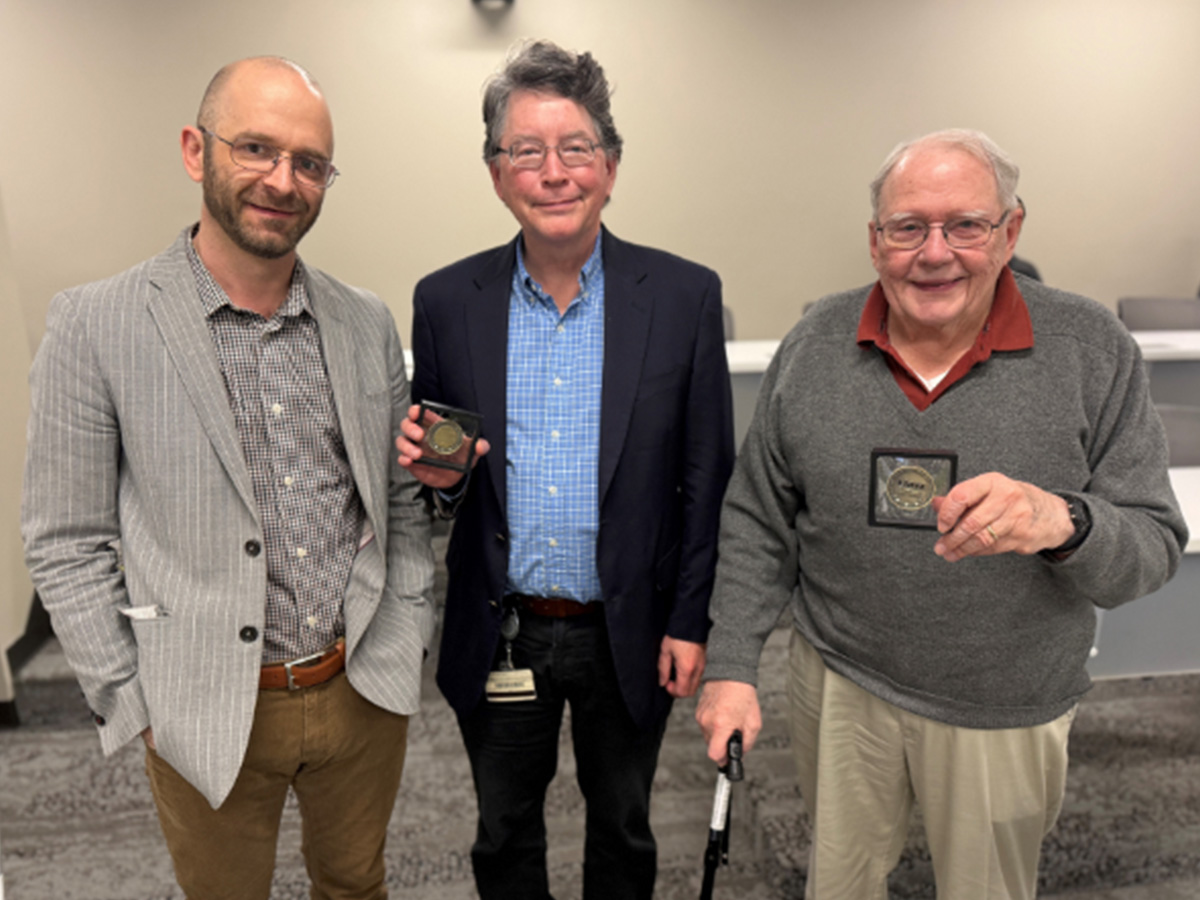
 Wink Crittenden, Ph.D. (left), licensing associate at the Bill L. Harbert Institute for Innovation and Entrepreneurship, presents a Patent Coin to Tim Gawne, Ph.D. (center), professor in the UAB School of Optometry, and Thomas Norton, Ph.D. (right), professor emeritus, recognizing their newly patented lens design aimed at slowing myopia progression in children.Professors in the University of Alabama at Birmingham School of Optometry have received a patent for a lens design that may help slow or stop the progression of myopia, marking a milestone in the effort to translate decades of basic vision science research into clinical application.
Tim Gawne, Ph.D., professor, and Thomas Norton, Ph.D., professor emeritus in the School of Optometry, were supported by the Bill L. Harbert Institute for Innovation and Entrepreneurship.
Wink Crittenden, Ph.D., licensing associate at the Bill L. Harbert Institute for Innovation and Entrepreneurship, presented Gawne and Norton with a Patent Coin, a ceremonial metal coin stamped with the inventor’s name and patent number, as a tangible recognition of their achievement.
“Dr. Norton and Dr. Gawne are two of our most prolific inventors,” Crittenden said. “They continuously advance our understanding of myopia and are strengthening the care available to patients. We’re grateful for their work and proud to support the innovations that grow from it.”
This new patented technology modifies the chromatic structure of light in a way that could influence how the eye grows during childhood. Gawne says patent protection is essential for moving innovations like this out of the laboratory and into real-world use.
“A patent creates the opportunity to move an idea into application,” Gawne said. “With patent protection in place, companies are more willing to invest the resources needed to further develop the technology and conduct clinical trials. Without that protection, it would be difficult to attract the support needed to move forward.”
The lens design stems from long-term research on how the eye determines whether images are in or out of focus. During childhood and young adulthood, the eye uses visual cues to regulate its growth in a process known as emmetropization. When that process fails, the eye may elongate excessively, leading to myopia. The condition, Gawne says, is inconvenient and a major risk factor for sight-threatening diseases later in life.
Gawne’s research aims to pinpoint the specific visual signals the eye relies on to judge focus. By understanding those cues, researchers hope to create visual therapies that can slow or prevent the progression of myopia. The new lens design represents one approach to modifying those cues.
This patent is Gawne’s first. He has two additional patents in progress, each exploring optical strategies for myopia control.
Norton is widely regarded as one of the foremost experts in the field. Norton has spent nearly 50 years studying the mechanisms underlying myopia development, and Norton and Gawne have worked closely for more than a decade.
“It’s exciting when basic research develops enough that you can begin to move it toward clinical practice,” Gawne said. “Dr. Norton’s expertise has been essential throughout this work.”
HIIE leads UAB’s efforts in patenting and licensing university-developed technologies by evaluating new discoveries, securing intellectual property protection and connecting inventors with industry partners to bring innovations to market.