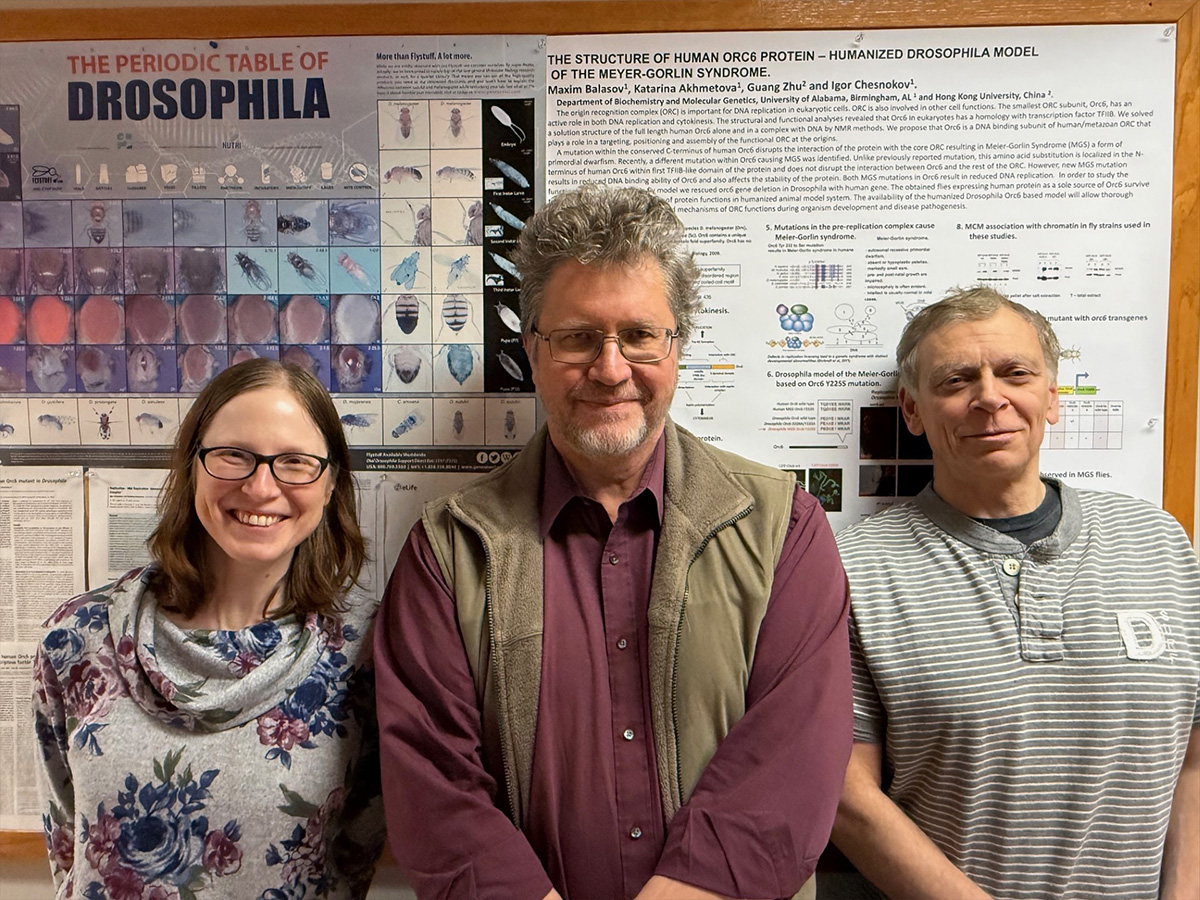
 Left to right, Katarina Akhmetova, Igor Chesnokov and Maxim Balasov.A study conducted in fruit flies by investigators at the University of Alabama at Birmingham has linked a patient variant of a rare genetic disorder called Meier-Gorlin syndrome, or MGS, with low levels of ORC6, a protein involved in copying DNA. Featured in Genetics, the work could lead to therapeutics that increase the amount of this protein.
Fewer than 100 cases of MGS have been reported. Patients with this genetic disorder have a form of dwarfism — they are short in stature and have underdeveloped ears and kneecaps, as well as other conditions such as a small head, hearing loss and difficulty eating. There is no cure, and treatment currently involves managing individual symptoms. Mutations in several genes that are involved in copying or replicating DNA, such as ORC6, are associated with MGS, and researchers are beginning to figure out how these mutations cause developmental abnormalities.
“The molecular mechanism we discovered explains how one clinical variant with mutations in ORC6 results in MGS phenotypes, and this finding may open up new avenues for therapeutics,” said the study’s senior author Igor Chesnokov, Ph.D., professor and vice chair of Research in the UAB Department of Biochemistry and Molecular Genetics.
ORC6 mutations in patients
As we grow, cells divide to create more cells. To prepare for division, cells make an extra copy of their genomes in a process called DNA replication. The ORC6 protein is a part of the origin recognition complex, or ORC, that binds to certain genome sequences to indicate where replication should begin. If DNA is not copied correctly, embryonic development will be affected.
Chesnokov’s team did not initially set out to study MGS. They were investigating ORC and focused on ORC6 to understand how this protein functions during cell division. But when medical geneticists started finding ORC6 mutations in the genomes of MGS patients, it caught Chesnokov’s attention. It turns out that the region his team was analyzing at that time was involved in the condition.
In their experiments, the UAB team found that an MGS mutation in the C-terminal end of ORC6 impeded the interaction of the ORC6 protein with the core ORC. In later work, they found that a different MGS mutation that was in the N-terminal region of the protein directly affected its binding to DNA.
“However, despite these different molecular mechanisms, the phenotype was the same — the patients all had MGS,” Chesnokov said.
In the current study, Chesnokov focused on a third type of genetic variation found in about one-third of MGS patients with ORC6 mutations. These patients have two different mutations on separate copies, or alleles, of the ORC6 gene.
Humans inherit one allele of each gene from their mother and one from their father. MGS is a recessive disorder, so if one allele of a gene associated with MGS has a mutation, the other one can still compensate. MGS develops if both alleles have either the same mutation or different mutations that cause problems, such as producing nonfunctional proteins or no protein at all.
Humanized fly model
To study these mutations, Chesnokov’s team used a fruit fly model they had developed previously. Deleting the ORC6 gene in flies is lethal, but the team had found that a hybrid transgene encoding for the human N-terminus and the fly C-terminus of ORC6 could fully substitute for the deleted ORC6 gene and produce living flies without defects. Using this “humanized” model, the team could then make mutations in the human part of the gene, where the patient mutations were, and see how that affected the flies.
In the clinical variant, the mutation on one allele disrupts the three-nucleotide start sequence, called the start codon, which is where protein production is supposed to begin on the mRNA. The mutation on the other allele changes how the mRNA encoding the protein is processed, or spliced, once it is made. Both were predicted to produce smaller-than-normal ORC6 proteins.
“The common consensus was that one of those truncated proteins might still have some residual activity,” Chesnokov said. “We were skeptical because we were working with this protein and thought these truncations would result in non-functional proteins.”
In fact, the team’s experiments showed that DNA transgenes that produced the predicted smaller proteins or that had the MGS mutations could not substitute for the ORC6 deletion in flies. But patients with these exact mutations were alive and had relatively mild symptoms, so Chesnokov’s team knew something else had to be going on.
It turned out that the human ORC6 mRNA has a strong translation initiation sequence, called a Kozak sequence, just before the start codon. This sequence is a strong signal to the protein production machinery to start here.
“We inserted a human Kozak sequence just upstream of the start site mutation in the humanized flies, and we got the same phenotype as with other MGS mutations, which is living flies with mild developmental defects,” Chesnokov said. “We concluded that this mutation in the context of a strong Kozak sequence can create a functional protein that is the normal length, but the expression level is significantly lower.” Boosting expression of this protein with common genetic tools used in laboratory experiments with fruit flies completely substituted for the ORC6 deletion in the flies.
Toward new therapies
The findings steer the field in a whole new direction, since this ORC6 MGS variant had a different mechanism from the ones studied previously. In this case, DNA binding or protein assembly is not the issue — it is just that not enough protein is being made. With little ORC6 protein available, the correct number of ORCs cannot form, and less replication occurs.
Some compounds are already known to facilitate protein production from these unusual sequences in yeast. With further research, molecules that work the same way in humans could be developed.
“Hopefully, someday a similar drug can be administered during early embryonic development before a child with an MGS variant is born,” he said.
He also notes that researchers could use the humanized fly model to screen for other small molecules with the same or an improved effect.
The Featured Genetics study, “Unexpected molecular mechanism of Orc6-based Meier–Gorlin syndrome: insights from a humanized Drosophila model,” was led by corresponding author Chesnokov.
Co-authors are Maxim Balasov and Katarina Akhmetova, UAB Department of Biochemistry and Molecular Genetics.