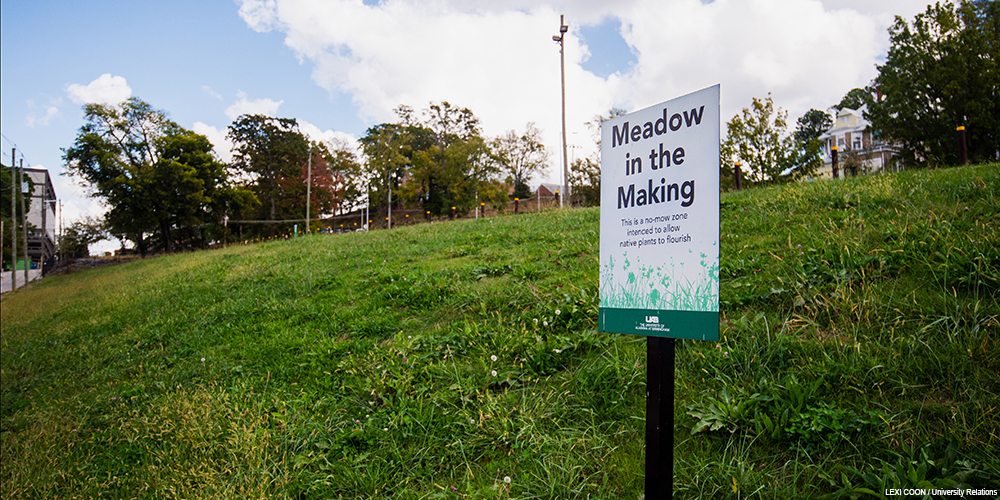
 A new butterfly habitat on the corner of 11th Avenue South and 17th Street is the first section of a larger insect meadow coming to campus.
UAB’s campus is home to world-class scholars, award-winning authors, game-changing researchers — even a dragon. Next fall, a new species will flutter in: monarch butterflies, drawn to a new habitat on the corner of 11th Avenue South and 17th Street. The butterfly habitat is the first section of a larger insect meadow coming to campus; a bee habitat is planned for spring.
Some of the habitat’s milkweed plants are provided by Monarch Watch, a nonprofit education, conservation and research program based at the University of Kansas that focuses on monarch butterfly habitats and migrations. More milkweed and other nectar plants, such as black-eyed Susans, are provided by UAB Sustainability. The plants were installed earlier this fall by Lindsey Best, UAB Facilities groundskeeper, and UAB Sustainability interns Emily Colpack, Rachel Ellis, Megan Julian, Jason Needham, Ed Pung and Banks Stamp.
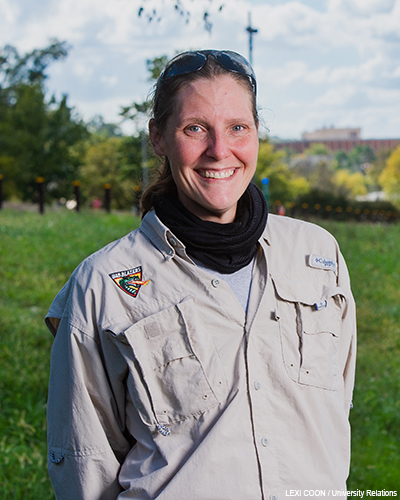 Lindsey Best, UAB Facilities groundskeeper“It doesn’t look like much now, but next year, we’re going to have a flood of happy monarch butterflies on site,” said Bambi Ingram, manager of UAB Sustainability. “This shows once again just how committed UAB is to transforming campus into an environmentally friendly and positive space for species of all kinds.”
UAB now is certified as a Monarch Waystation, a designated, intentionally planted space to provide food and shelter for monarch butterflies as they migrate yearly from Mexico to Canada. UAB is on a national registry of waystations and, along with Forest Park's Altamont School, is one of only two certified monarch butterfly habitats in Birmingham.
Learning the history
Monarch butterflies are an important part of our ecosystem, says Best, who helped install the milkweed and nectar plants in the habitat. Their history in central Alabama is a long one, she said.
At the fringes of the Appalachian Mountains, where Birmingham now sits, once stood thousands of acres of longleaf pine and native grasslands, the remnants of which still make Alabama the most biodiverse state in America, Best explains. As Americans began to settle in what is now Birmingham, longleaf forests were decimated — approximately 3% of those original forests remain, and most of the grasslands became farmland. During these changes, Alabama’s native animals and insects were left without their natural habitats — including the monarch butterfly.
“With that dramatic change to the ecosystems the native flora and fauna suffered,” Best said. “This sad story continues today.”
According to a survey by the World Wildlife Foundation Mexico, the monarch butterfly population wintering in the Latin American country was down 53% during the 2019-20 season; in 2018-19, butterflies occupied 15 acres of forest during the winter months. This past season, they occupied just seven. The area occupied by monarch butterflies in the forests of Mexico is used as an indicator of the number of butterflies that migrate each year from the United States and Canada to Mexico.
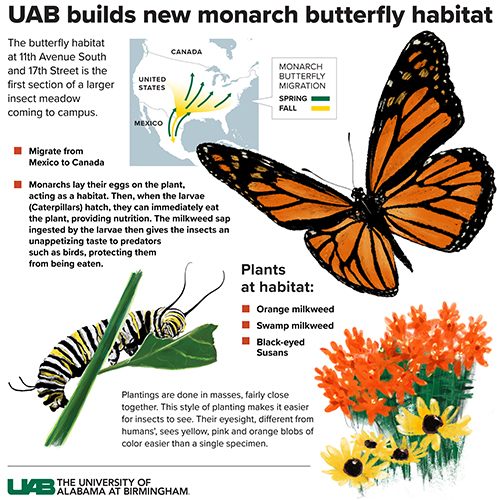 UAB builds new monarch butterly habitat. See full text-only version of this infographic below.The marvelous milkweed
Residential and commercial gardeners often reach for the traditional butterfly bush when working to recreate monarch butterfly habitats, Best says, but the better option is Alabama’s native milkweed plant. UAB’s new habitat is home to both orange and swamp milkweed plants, which also can be found in UAB’s pollinator garden and at the Solar House. Butterfly bushes do provide food for monarchs, but not much else, Best explains, because they aren’t native to the state and haven’t coevolved with native insect species. Native plants, she explains, have evolved alongside insects such as the monarch butterfly and therefore can better meet their needs for nutrition, protection and habitat.
“Butterfly bushes provide nothing else besides food for the butterflies’ life cycle,” Best explains. “The butterfly bush is like a can of Pringles. Sure, it tastes good and technically is food. But it isn’t nutrition — it’s just a snack.”
The milkweed plant, alternatively, is like a well-balanced meal for a butterfly. Monarchs lay their eggs on the plant, which acts as a habitat. Then, when the larvae hatch, they can immediately eat the plant, providing nutrition. The milkweed sap ingested by the larvae then renders the insects poisonous to predators such as birds, protecting them from being eaten.
“So already, the milkweed bush has run circles around the butterfly bush — and the milkweed isn’t finished,” Best continues. “As monarchs are migrating, they also feed on milkweed blossoms as adults, creating a functioning, healthy, thriving ecosystem.”
Planting mindfully
When gardeners plant non-native flora, it changes the natural ecosystem, leaving native insects and animals to look for food and shelter, Best explains, and unfortunately, they are unable to adapt to non-native species. Planting milkweed plants on campus provides an educational opportunity for Blazers who visit the garden or seek out information after seeing an increase in monarch butterflies on campus.
“This is our chance to mindfully give back to the ecosystem a small piece of what we took away,” Best said. “We know better now, so it becomes our duty to do better.”
Click through the slideshow below to see more of the new butterfly habitat.
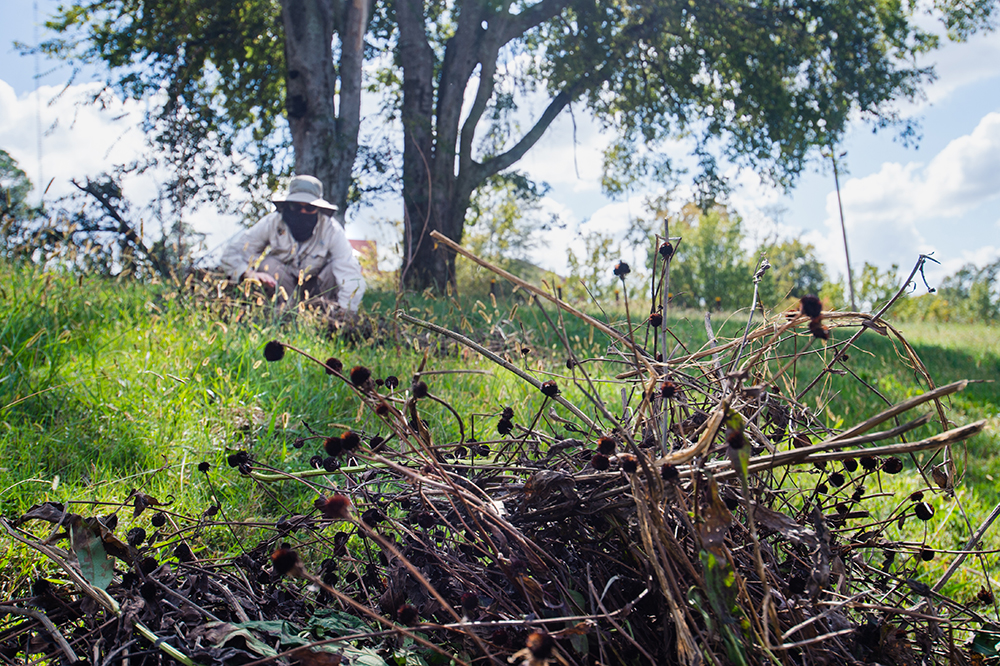
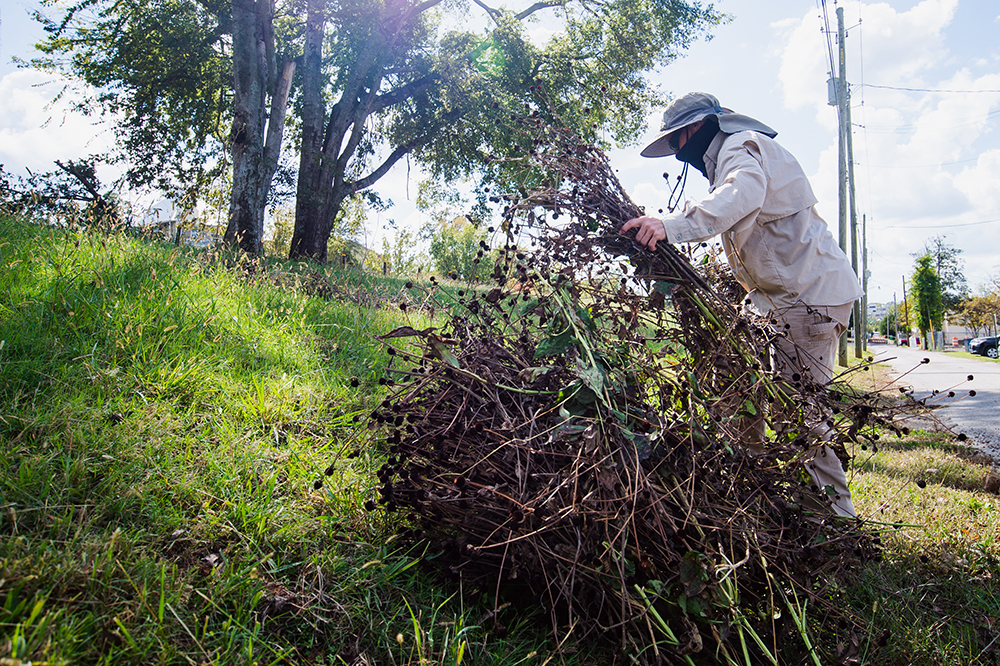
- Milkweek plants at the new habitat are seen in the foreground, with a member of the UAB Facilities grounds staff working in the background
- A UAB Facilities worker wearing long sleeves and a mask picks up milkweed plants
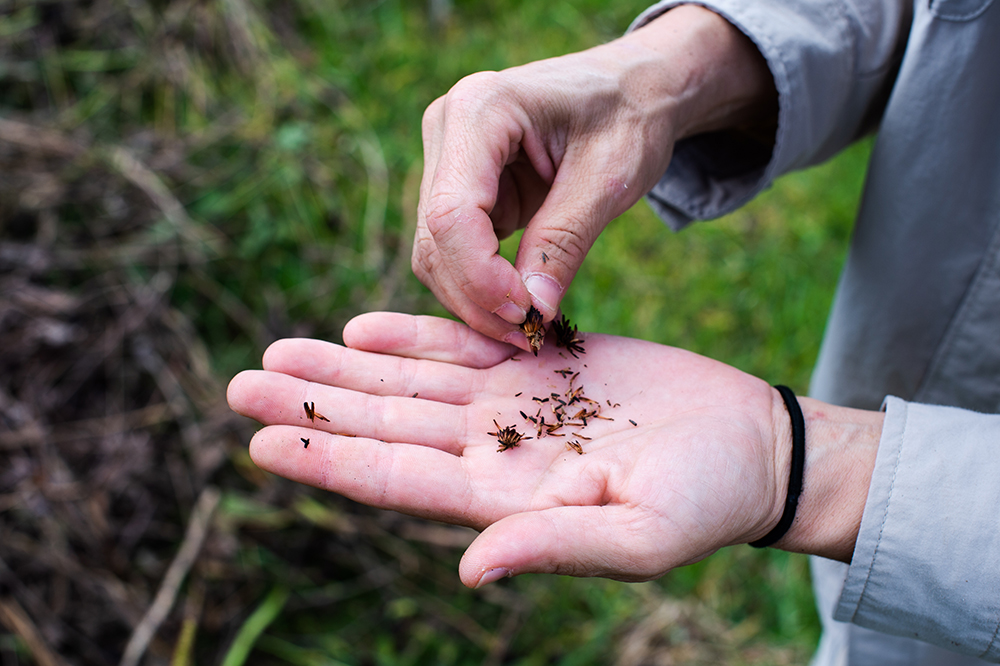
- A UAB Facilities staff member holds out a palm to the camera, showing the parts of a milkweed plant
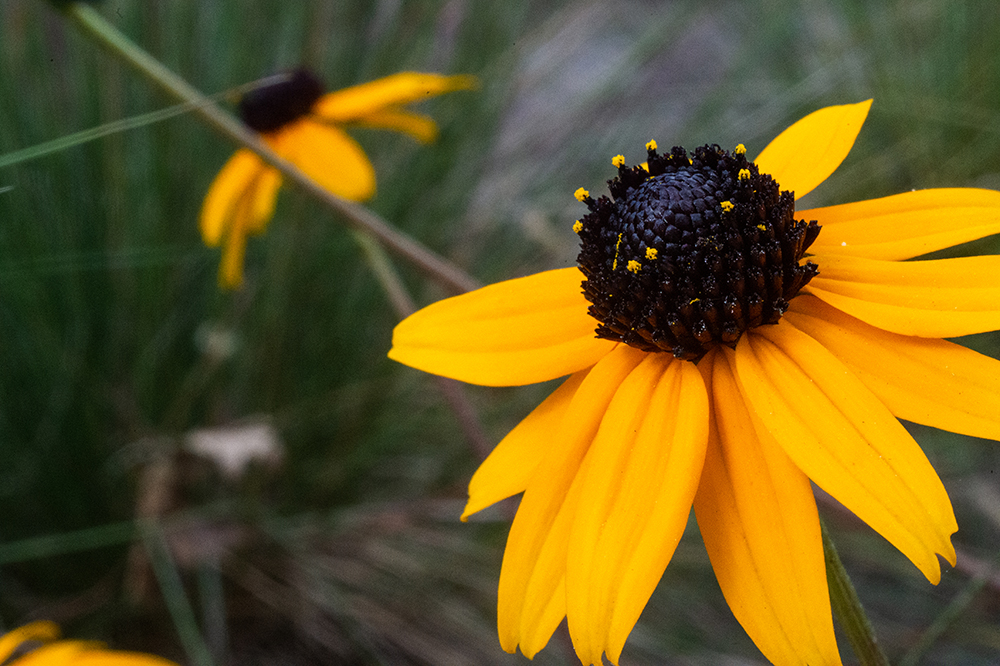
- Black-eyed susans at the UAB Butterfly Habitat
-
Some of the habitat’s milkweed plants are provided by Monarch Watch, a nonprofit education, conservation and research program. LEXI COON / University Relations
-
UAB now is certified as a Monarch Waystation, a designated, intentionally planted space to provide food and shelter for monarch butterflies as they migrate yearly from Mexico to Canada. LEXI COON / University Relations
-
The milkweed plant is like a well-balanced meal for a butterfly. LEXI COON / University Relations
-
Other nectar plants, such as black-eyed Susans, were provided by UAB Sustainability. LEXI COON / University Relations
UAB Builds New Monarch Butterfly Habitat
The butterfly habitat at 11th Avenue South and 17th Street is the first section of a larger insect meadow coming to campus.
Migration
Monarch butterflies migrate from Mexico to Canada. They travel northward in the spring and return south in the fall.
How Monarchs Use Milkweed
Monarchs lay their eggs on milkweed plants, acting as a habitat. Then, when the larvae (caterpillars) hatch, they can immediately eat the plant, providing nutrition. The milkweed sap ingested by the larvae then gives the insects an unappetizing taste to predators such as birds, protecting them from being eaten.
Plants at the Habitat
- Orange milkweed
- Swamp milkweed
- Black-eyed Susans
Planting Design
Plantings are done in masses, fairly close together. This style of planting makes it easier for insects to see. Their eyesight, different from humans', sees yellow, pink and orange blobs of color easier than a single specimen.
The University of Alabama at Birmingham (UAB)