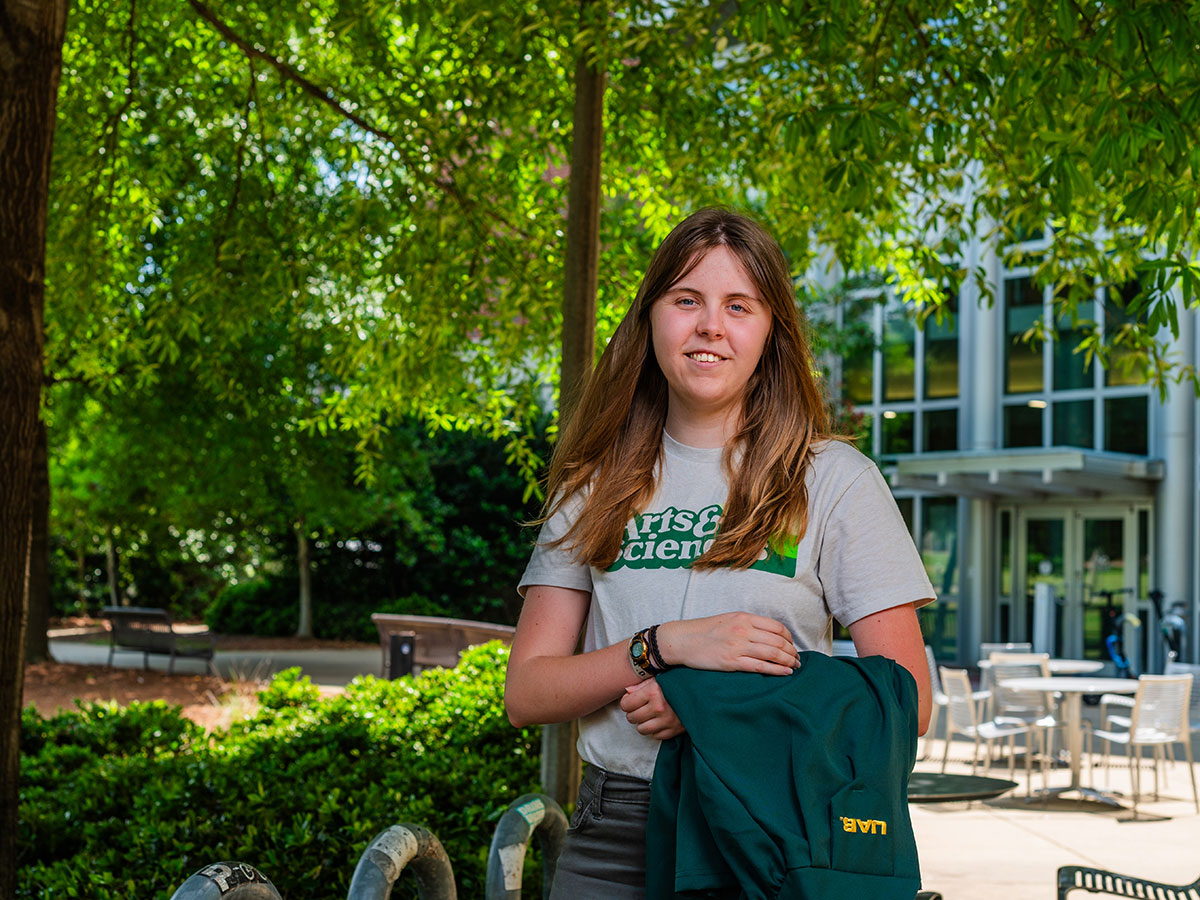
 Amelia Hawkins graduated from UAB in spring 2026 with an individually designed major in natural resources interpretation.Even as a “painfully shy 8-year-old,” Amelia Hawkins was filled with a passion for sharing nature with others.
“When someone new moved in, I would gather up my courage, knock on their door and ask if I could show them the creek in our neighborhood,” said Hawkins, who graduated from UAB in May with an individually designed major in natural resources interpretation through the College of Arts and Sciences. “It was important to me that they get to experience it.” Today, after years of experience speaking to groups, she is no longer shy. “I have found my voice,” Hawkins said. But she has the same intensity. “That is still what I want to do — inspire engagement with the world around us,” she said.
Alabama, as Hawkins is quick to mention, is the fifth most biodiverse state in the country, and the most biodiverse east of the Mississippi River. “For our size, we have an amazing number of species and habitats, which has to do with our rivers — a sixth of our surface area is rivers and streams,” she said. But because the extent of Alabama’s riches “is not well known, a lot of these habitats are under threat.”
At the center of Alabama's natural splendor
The Birmingham area, where Hawkins grew up, is at the center of all that Alabama has to offer, she says — and it is home to a large number of nonprofits and parks dedicated to solving these problems. Hawkins has worked or volunteered at many of them, including the Alabama Wildlife Center at Oak Mountain State Park, the Cahaba River Coalition, the Birmingham Zoo, and Jefferson County Greenways, a private-public partnership that manages Ruffner Mountain, Red Mountain State Park and Turkey Creek Preserve. “In Birmingham, there is always something to do, and everything you do can make a difference,” Hawkins said.
“I realized that with the IDM [individually designed major] program I could craft my degree and learn through service.”
Turning a love for the outdoors into a career is not easy, though. Landing a coveted spot as a full-time staffer with a park service or nonprofit requires a combination of skills, hands-on experience and training. “The interpretation field values experience over degrees,” Hawkins said. But she was able to get both at UAB thanks to the individually designed major, or IDM, program and the UAB Honors College Personalized Pathway, which allowed her even more flexibility to create a personalized curriculum that emphasized hands-on learning. Hawkins blended courses in biology, education and more with a specific focus on service learning.
“That let me stay in Birmingham and continue the work I was doing with local nonprofits,” she said. “I realized that with the IDM program I could craft my degree and learn through service.”
Exploring service opportunities across Alabama
The service opportunities Hawkins found at UAB extended around the state.
As part of a course in invertebrate zoology with Biology Assistant Professor Cynthia Tant, Ph.D., Hawkins spent time at Dauphin Island Sea Lab on Alabama’s Gulf Coast, where Tant and University Professor Jim McClintock, Ph.D., helped the students see how many different ecosystems share space on the coast. “The Gulf, the precarious dune habitats and the constantly moving palmetto forests all next to each other gave me a sense of how dynamic nature can be,” Hawkins said.
Another memorable experience came during her astronomy course with Physics Assistant Professor Michelle Wooten, Ph.D., a passionate advocate of protecting the night sky from artificial light. (It was one of the first City as Classroom courses in UAB’s new Blazer Core Curriculum.) Hawkins and her classmates spent three days in the remote Wehle Land Conservation Center in Midway, Alabama, documenting all sources of artificial light to help the center meet its commitment to safeguarding its dark skies. They then presented on the project at UAB’s undergraduate research Expo and won first place in their category.
Hawkins also built an independent study course around Alabama’s Certified Master Naturalist program, which combined online coursework with field experiences and 30 hours of volunteer work. “I couldn’t have added that on top of my course load and existing volunteering, but it became part of my course load,” Hawkins said.
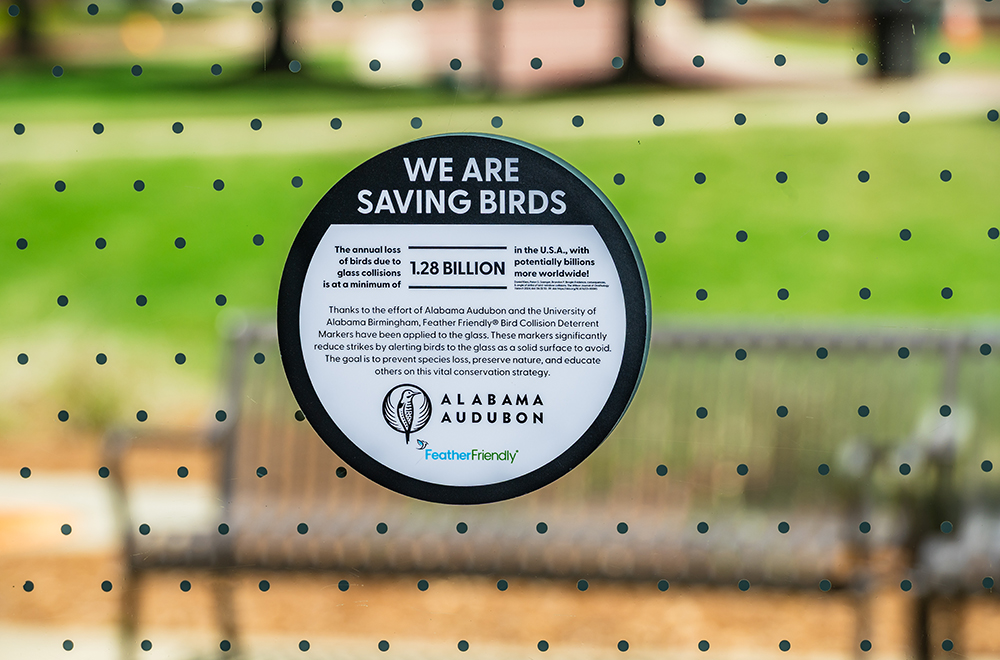 Closeup of the special bird collision-deterrent stickers applied to an entrance door to Heritage Hall, leading onto the Campus Green.
Stickers save birds
Hawkins found other ways to combine her time at UAB with her passion for protecting the outdoors, including becoming a Sustainability Ambassador with UAB’s sustainability division. Through Wooten’s class, she also got connected with Alabama Audubon’s Project Safe Flight, which has the goal of reducing bird collisions with windows. Soon Hawkins was getting up early to collect data on bird strikes around campus. She saw the effort pay off: There are now special stickers on a section of Heritage Hall windows that were seeing a large number of collisions from cedar waxwings, and fatalities there have dropped to near zero. UAB is also now the first Audubon-certified campus in the Southeast because of the built-in bird-safe glass in its new Altec/Styslinger Genomic Medicine and Data Sciences Building and the Biomedical Research and Psychology Building, currently under construction.
Convincing leaders to make this investment would not have been possible “without that data,” Hawkins said. “Being able to contribute to that research really made an impact.” During her junior year, Hawkins received an honorable mention for the highly competitive national Udall Undergraduate Scholarship, which identifies early leaders in environmental fields.
Help "every step of the way"
After graduation, where she earned High Distinguished Honors from the Honors College, Hawkins headed to Costa Rica to study rainforest ecology in a study abroad course with Assistant Professor Megan Gibbons, Ph.D. The goal was to pick up ideas from “Costa Rica's incredible ecotourism industry that I can bring back to my work in Alabama,” she said. “I also got to see the strangler fig trees, which have been a passion of mine for years.” For the rest of the summer, Hawkins will continue as a STEM educator at the McWane Science Center, “getting kids excited about astronomy, physics and problem-solving,” she said. Then in the fall, she will move on to a position as an environmental educator at Alabama’s Camp McDowell, close to the Sipsey Wilderness, “one of the largest old-growth forests in the Southeast,” Hawkins pointed out. Her seasonal position “is typical in this field,” she said. “You get an undergrad degree and then work in seasonal positions for a few years until you find a full-time job, which is also a good way to build experience.”
Eventually, Hawkins sees herself back in the Birmingham area, perhaps working as a naturalist for a local nonprofit. “During my time here at UAB, I have fallen even more in love with what Birmingham has to offer,” she said. “We are living in one of the most incredible environments, with so much biodiversity and people who are solving the conservation issues that they see. Becoming an interpretive park ranger has always been a dream for me. But I have also learned to value the work of Alabama’s nonprofits highly and would love to be a part of the work here.”
Hawkins recommends the IDM program to students who have a vision for what they want to accomplish. “If you have a specific or unique goal in mind for your career, it’s a great way to start accomplishing that as an undergrad,” she said. “UAB will really cheer you along and help you every step of the way.”
Art + education
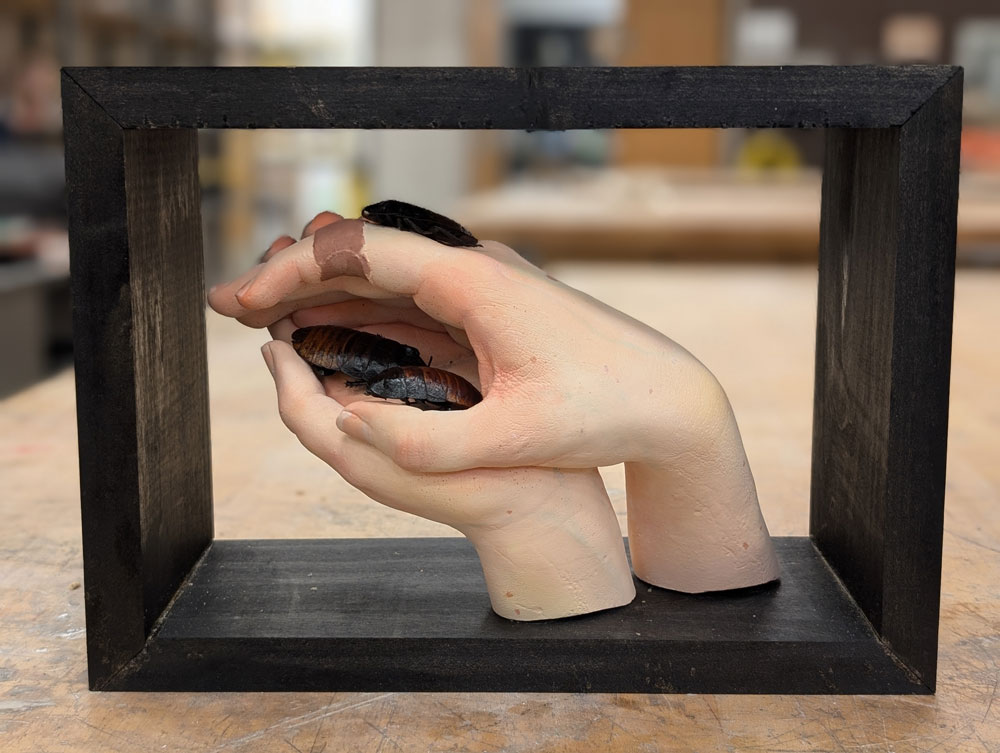 "Inordinate Fondness for Beetles," featuring Madagascar hissing cockroaches, is one of Hawkins' latest sculptures. Image courtesy Amelia Hawkins
Amelia Hawkins’ minor in art studio, with a focus on sculpture, is also part of her passion for nature. “I’ve always been an artist, and I think it is important to help people create art out of the experience they have outdoors,” she said. She set herself “a personal goal that every sculpture I made would have a bug or weird creature.” That way, “my sculptures are also educational pieces,” she said. One of her latest, shown above, is titled “Inordinate Fondness for Beetles” and features Madagascar hissing cockroaches, modeled on the ones at the McWane Science Center. (“They’re all named ‘Twinkie’ for convenience,” she said.) The piece represents “my passion about protecting even parts of the environment that aren’t easy to love,” Hawkins said. “My classmates will look at them and ask, and that gives me a chance to explain why I appreciate these hissing cockroaches, even though they are scary.”