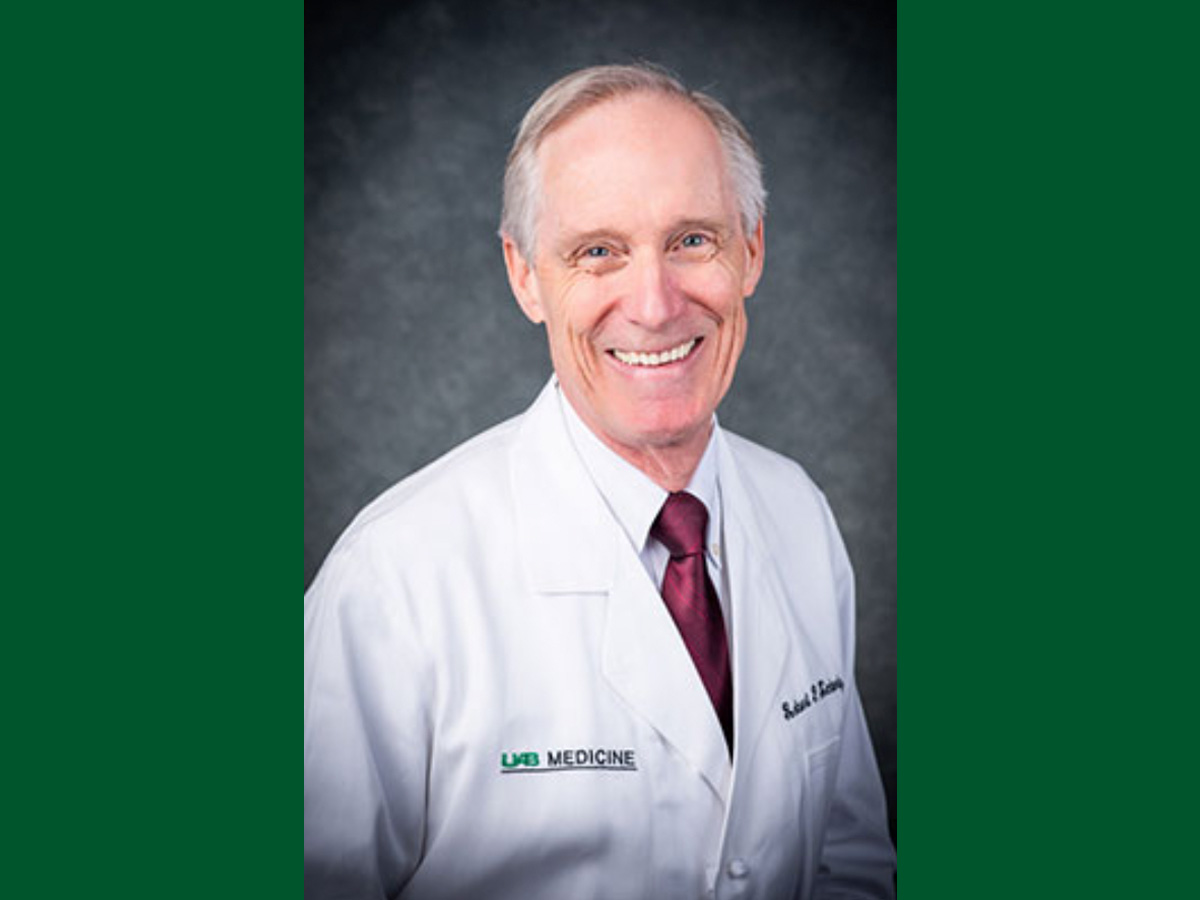
 Robert Kimberly, M.D., Howard L. Holley Professor and senior associate dean for Strategic Initiatives in the UAB Heersink School of Medicine, is the recipient of the 2026 Sam Brown Bridge Builder Award from the UAB Office of the Provost.
The award honors UAB faculty members who demonstrate a deep and abiding commitment to collaborating across campus and enhancing the research and teaching activities of the university.
Kimberly, who joined UAB in 1996, is internationally recognized for his translational research on autoimmune diseases, including lupus and rheumatoid arthritis. He has written more than 300 peer-reviewed articles and more than 50 books and book chapters. As co-founder and architect of the international lupus genetics consortium, SLEGEN, and the lupus nephritis-end stage renal disease consortium, LN-ESRD, Kimberly facilitated more than 100 publications at the forefront of lupus genetics research. He has received in excess of $156 million in NIH research funding over his career, including serving as investigator on three current NIH grants. Kimberly holds 19 patents and is a fellow of the National Academy of Inventors.
Beyond these individual accomplishments, however, nominators emphasized Kimberly’s service as director of UAB’s NIH-funded Center for Clinical and Translational Science (CCTS) from 2012 to 2024. In that role, he has had a lasting impact on UAB’s research enterprise and established ongoing partnerships with institutions and communities across multiple states.
Breaking down barriers
Under Kimberly’s leadership, the CCTS “became a hub for interdisciplinary collaboration, connecting faculty from medicine, public health, nursing, engineering and the basic sciences, while also strengthening relationships with partner institutions across the Deep South,” said Anupam Agarwal, M.D., senior vice president and dean of the Heersink School of Medicine.
“Dr. Kimberly has been instrumental in breaking down traditional barriers that often separate disciplines and administrative units,” Agarwal said. “Through the development of shared resources and integrated research cores — including programs in informatics, biostatistics, genomics, clinical trials and community engagement — he has enabled investigators to work together more effectively and efficiently. These efforts have helped catalyze advances in areas ranging from precision medicine and data science to health disparities and implementation research, all while fostering a culture in which collaboration is both expected and supported.”
Mission over personal recognition
“In every setting, he brings people together in a way that is both intentional and genuine,” said Joan Hicks, chief information officer for the UAB Health System. “He has a remarkable ability to unite individuals from different schools, disciplines and perspectives around a shared goal — always with a focus on advancing the mission of UAB rather than personal recognition.”
“One of the clearest examples of his bridge-building impact has been the development of UAB’s clinical and translational research ecosystem around electronic health record-based research and learning health system initiatives,” said James Cimino, M.D., UAB Distinguished Professor and chair of the Department of Biomedical Informatics and Data Science.
“Dr. Kimberly recognized early the importance of integrating informatics, clinical care, population science and translational investigation,” Cimino said. “Many of the interdisciplinary programs that are now considered central to UAB’s research enterprise were facilitated, accelerated or sustained through the collaborative structures he helped create.”
Cimino also noted that the CCTS’ training and mentored career development programs “have helped create a generation of investigators who view collaboration across disciplines as the path to solving complex biomedical problems.”
Kimberly also “has played a prominent role on the national stage in advancing collaborative science,” Agarwal noted. “Through his service and leadership in the Association for Clinical and Translational Science and other national organizations, he has contributed to shaping models for team-based research that are now widely adopted.”
A big-picture thinker
“Bob is a consummate and creative big-picture thinker and has received wide recognition as a visionary leader,” said Kenneth Saag, M.D., Anna Lois Waters Professor and director of the Division of Clinical Immunology and Rheumatology in the Department of Medicine. “His national leadership includes service to the Arthritis Foundation, the Alliance for Lupus Research, the American College of Rheumatology, the Clinical Immunology Society, the Association of American Medical Colleges and numerous scientific advisory boards.”
Most notably, Saag continued, Kimberly “was the architect of the highly touted CCTS Partner Network that now includes 11 academic health centers, research institutes, and universities across Alabama, Mississippi and Louisiana.”
Kimberly’s efforts to expand collaborative research opportunities at UAB spread far beyond the life sciences, colleagues shared. “I found Bob to always be looking for ways to bring more voices to the table in discussions, research and action,” said Jeffery Walker, Ph.D., J. Frank Barefield, Jr. Endowed Chair of Communities and Crime in UAB’s J. Frank Barefield, Jr. Department of Criminal Justice. “He fully supported pilot funding for investigators across all schools on campus and welcomed their projects as ways of fulfilling the promise of advancing science and health.”