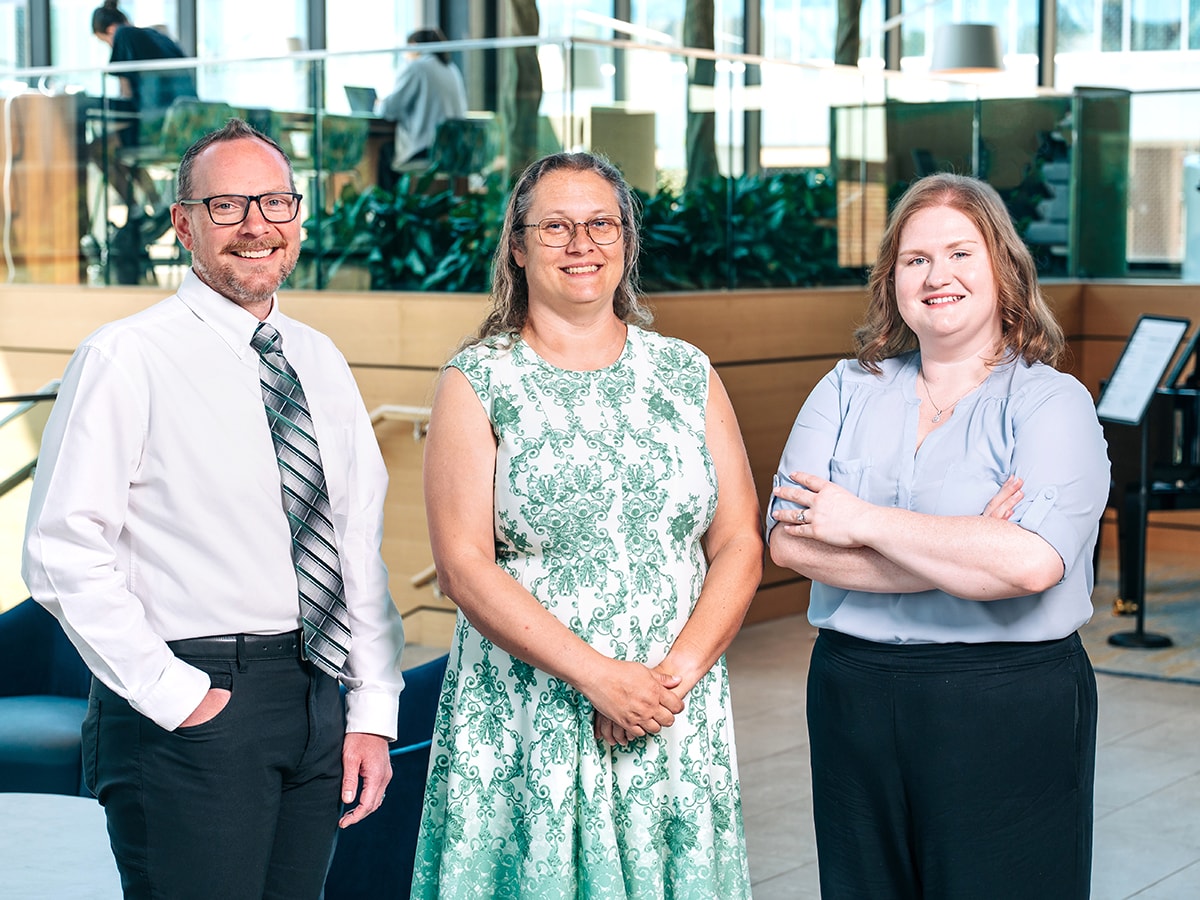
 UAB faculty and staff Will Brooks, Ph.D., Heather Patterson, Ph.D., and Nikki Sarabat are members of the inaugural cohort of the Learning Design and Learning Sciences master's program.Evidence suggests that UAB’s master’s program in Learning Design and Learning Sciences attracts people with problems — who are determined to find solutions.
The program, which launched in fall 2025, is the first in Alabama and one of only a few worldwide to focus on the learning sciences. This relatively new, interdisciplinary field aims to create more effective and engaging educational experiences by merging the latest research from education, cognitive science, computer science, neuroscience and other specialties that typically do not interact.
In fall 2026, UAB will introduce a certificate program in Learning Design and Learning Sciences. At 15 credit hours, it is “basically the first half of the master’s,” said Jonan Donaldson, Ph.D., assistant professor in the Department of Curriculum and Instruction in the UAB School of Education and Human Sciences. Donaldson is the director of both the master’s and certificate programs; he is hosting information sessions on the new certificate at noon and 6 p.m. Monday, April 27.
As Donaldson prepares to introduce the certificate program, the Reporter took the opportunity to speak with members of the first cohort of the master’s program to find out what drew them to this emerging area of study.
Combining theory with practical insights
Heather Patterson, Ph.D., director of Online Learning and Educational Technology in the Department of Biology, says she is always looking for opportunities to improve what she does in the classroom. In particular, she is focused on how to maximize student engagement and time-management skills in the online environment. “I’m always thinking about where students are struggling and why,” she said.
When Patterson heard about the new Learning Design and Learning Sciences master’s program, it sounded like a perfect fit. “Learning sciences takes the theories that are out there and combines them with the practical insights from research in the classroom in a way that lets you figure out what to fix,” she said. “In traditional science — in biology, for example — you would try to fix one little thing so you can isolate it and then test the results. But what do you do in this big, interconnected world in which we actually live?”
Project-based learning
The Learning Design and Learning Sciences program is largely project-based. Patterson’s projects often involve tweaks to the biology courses she teaches. In one, she has added an assessment that asks students to reflect on how class experiments and other activities could relate to their intended careers. “Anything that encourages students to engage more fully is helpful,” she said. “I have had good feedback so far, although I don’t yet know how it is working. But as a learning scientist, I could get approval to study these changes I am implementing and publish results, so that I can help find ways to improve not just my classes but everyone’s classes.”
Use your Educational Assistance benefit to grow
Find answers to common questions about this important benefit for UAB employees.
Will Brooks, Ph.D., professor in the Department of Medical Education in the Heersink School of Medicine, has been teaching anatomy to medical students, residents and undergraduates for nearly two decades. But like many scientists who ended up as teachers, he had no formal training in pedagogy. “We learn as we go and pick up techniques from the people who taught us,” Brooks said. “I’ve always been interested in understanding more about learning theory to supplement the self-education I have done along the way.” Because the Learning Design and Learning Sciences master’s program also includes a research component that aligned with his professional interests in educational research, enrolling was “a win-win,” he said.
Like Patterson, Brooks appreciates the project-based focus of the program. “We are encouraged to take what we do in real life and use it as projects for our coursework,” Brooks said. “What we take away from our classes is not something we will never use; we get a chance to directly apply what we are learning every day.”
This semester, in his course on design research, Brooks is working to build a research project around peer instruction, “which is a method I use with our medical students,” he said. “I am getting to dig into the literature and theoretical basis for why this works, but also to look at its ability to engage students in the classroom.”
Another classmate, Nikki Sarabat, who is assistant director of Career Education at the UAB Career Center, is working on a design-thinking project centered on career advising.
Sarabat is working to reimagine career readiness to better resonate with today’s students. “I want to have a greater impact,” Sarabat said. Talking with her supervisor, Cynthia Marie Washington, associate director of the Career Center, about opportunities to grow at UAB, Sarabat learned about the new master’s program. “Learning Design and Learning Sciences is so new and relevant,” Sarabat said. “I was attracted to the fact that it is a degree that can be applied directly to the real world of what we do as professionals.”
Sarabat trains the Career Center’s peer career advisors, undergraduates who help their fellow students with career exploration; resumes, LinkedIn profiles and personal branding; interviewing skills and professional etiquette; and job/internship searches. Teaching students the information they need, and how to share it with others, is straightforward. But building the students’ confidence in their own abilities, and visibility for their services, is not.
Tackling a "wicked problem"
As part of their current semester class on design thinking, LDLS students were charged with tackling a “wicked problem” — one with no easy, obvious solution. Sarabat suggested that the group take on this perennial challenge of peer advising: how to convey authority along with accessibility. Sarabat has her own ideas on how to move the needle, but the diversity of students in the Learning Design and Learning Sciences program has helped attack the problem from multiple angles. “We are able to tap into everyone’s individual strengths, to see what any one person would not be able to and avoid those blind spots we all have,” Sarabat said.
Maddi Zeanah studied business with a focus on human resources as an undergraduate and initially enrolled in the Learning Design and Learning Sciences program as a UAB employee. At the time, she was interested in further preparation for a career in corporate training. She has since left the university but stayed in the master’s program and shifted her focus to building informal learning environments. “I have always had an interest in researching how people learn,” Zeanah said. In line with that, her favorite class so far has been on research methods. As do her fellow students, she highlights the program’s project focus as a major plus. For a course in the fall 2025 semester, Zeanah created a collaborative learning environment among her peers to embrace creativity, including organizing a crafting day “designed to keep us motivated,” she said.
Zeanah recommends the Learning Design and Learning Sciences program for “anyone interested in creating learning spaces for people,” she said.
Donaldson encourages anyone interested in the program (certificate or master’s tracks) to attend the information sessions at noon and 6 p.m. Monday, April 27.