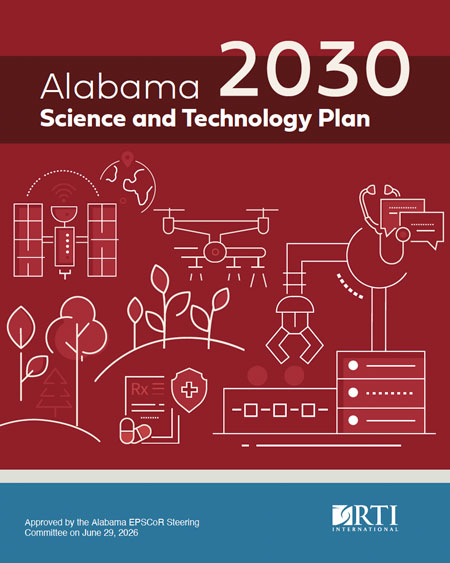
 A new science and technology plan for the state of Alabama identifies key areas of growth for research, workforce and commerce in the next five to seven years. Citing the plan is a requirement for submission of many types of federal grants. It also can provide inspiration for UAB researchers looking to explore new topics.
The Alabama Science and Technology Plan: Vision 2030 was developed through the Alabama EPSCoR (Established Program to Stimulate Competitive Research) office, which is housed at UAB. It provides guidance for continuing Alabama’s rapid growth in high-tech industries and jobs, says Christopher Lawson, Ph.D., executive director of Alabama EPSCoR and a professor of physics at UAB. Lawson notes that, in the past year alone, about $14.6 billion in capital investment came to Alabama in biotech, steel production and advanced manufacturing. “Building on that growth requires an educated workforce and scientists who can help with these high-tech industries,” he said. “This plan helps to coordinate those activities.”
Priority research areas and strategies
The plan identifies six high-priority research areas to secure Alabama’s position as a premier Southeastern hub for high-tech industry and innovation:
- AI and quantum computing;
- Biotechnology and biomedical sciences;
- Materials and manufacturing science;
- Robotics, autonomy and automation;
- Space and unmanned vehicles; and
- Agriculture, forestry, fisheries, water systems and coastal resilience.
Strategically, the plan identifies three main goals for Alabama to prioritize:
- Bridging the talent gap by increasing STEM graduates in high-demand fields and strengthening educational outreach and community engagement;
- Strengthening commercialization by increasing translation and innovation activity and supporting the growth of R&D-intensive companies; and
- Coordinating state, academic and private-sector resources to diversify and expand activity in high-priority research areas and to increase applied research activity.
What is Alabama EPSCoR?
The National Science Foundation’s Established Program to Stimulate Competitive Research, or EPSCoR, was designed to help better distribute federal research grants across the country. Alabama EPSCoR has the mission of advancing technology-based economic development in the state through collaborative scientific and engineering research. From 2015 to 2025, Alabama EPSCoR received 303 federal EPSCoR grants totaling more than $195 million, with research expenditures of $29 million in fiscal year 2025. Alabama EPSCoR also administers the state Graduate Research Scholars Program, which has funded more than 400 students working on EPSCoR research since 2006.
The plan updates the original Alabama Science & Technology Plan written by Lawson and others in 2015, and the second edition in 2021. It is based on interviews with the vice presidents of Research at all eight Ph.D.-granting institutions in Alabama (including UAB), the president of the Economic Development Partnership of Alabama and a representative from the Alabama Commission on Higher Education, along with input from Cynthia Crutchfield of Innovate Alabama, Secretary of the Alabama Department of Workforce Greg Reed and Secretary of the Alabama Department of Commerce Ellen McNair. It was developed with RTI International and published on June 30, 2026. Read the plan on the Alabama EPSCoR website here.
How UAB researchers can use the plan
Having an updated state science and technology plan in place is a requirement for many large proposals Alabama is submitting at the federal level, Lawson says. But the plan is also essential reading for researchers across UAB, he adds. “This document is required for submissions to many National Science Foundation EPSCoR grants, including E-RISE and E-CORE,” Lawson said. “But its use isn’t limited to EPSCoR grants. Many federal agencies, including the NIH, want to know that research they fund is a priority at the state level. UAB researchers can link their research proposal to an element of the S&T plan to prove to the funding agency that their proposed research is a big priority for Alabama, and that really strengthens the proposal.”
“If you are trying to understand what is going on across Alabama in terms of research, workforce development and economic development, you will find this report very interesting,” said Tiffany Vickers Davis, program coordinator for Alabama EPSCoR. “A lot of researchers are trying to figure out where they are headed next; this report can be inspirational for them as well.”
“It’s always nice to have a plan in place,” Lawson said. “Ten to 20 years ago, Alabama was very similar to surrounding states. But increasingly those states don’t have the new technologies and high-tech industries flooding in that Alabama does. A big reason is that our state government has put a very high priority on economic development over the past decade. Looking at economic data among EPSCoR states, Alabama tops category after category. There is a case to be made that we’re going to be on another level entirely in five to 10 years. This plan will help us get there.”