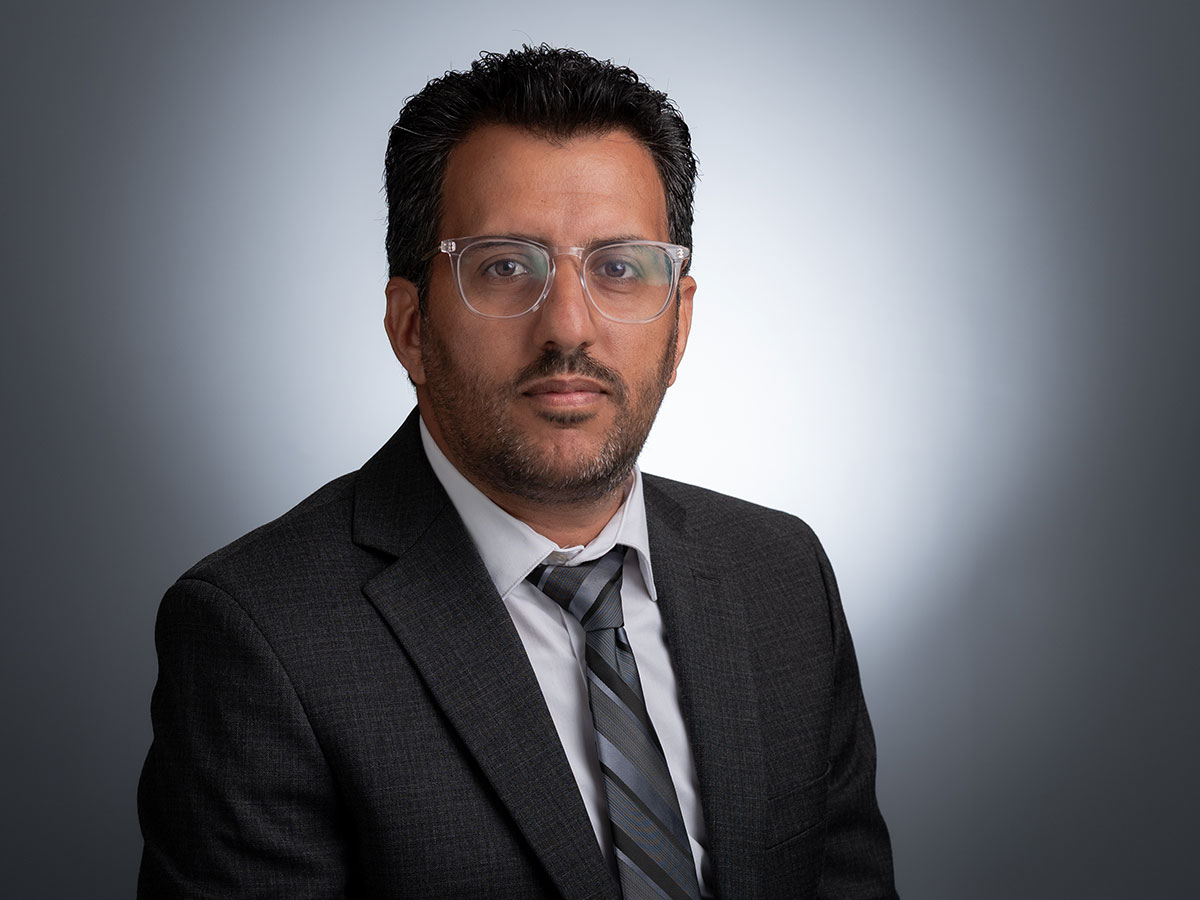
 Abdulaziz Ahmed, Ph.D.Nationwide, about one in eight emergency department visits involves a mental health or substance use diagnosis. At UAB, mental health-related visits rank fourth among diagnostic groups by volume, yet they have the highest 30-day return rate. In a preliminary cohort studied by Abdulaziz Ahmed, Ph.D., associate professor in the UAB Department of Health Services Administration, 27 percent of these visits were followed by a return to the ED within 30 days.
“Repeat visits can signal that important needs remain unmet, including follow-up care, medication access, housing, transportation and other clinical and nonclinical factors,” said Ahmed. “They also add pressure to already crowded emergency departments.”
In a new five-year, nearly $4 million project, funded by the National Institute of Mental Health, Ahmed and colleagues at UAB and Vanderbilt University Medical Center are developing a new way to tackle this problem. Ahmed serves as the contact principal investigator for the grant, in collaboration with Mohammed Ali Al-Garadi, Ph.D., of Vanderbilt University Medical Center, who serves as a multiple principal investigator.
Together, they will lead the development and evaluation of AI-MERRA, an explainable artificial intelligence-based ED return risk assessment clinical decision support system. The goal is to identify patients at high risk of returning to the ED and present the patient-specific factors driving that risk to clinicians in brief, actionable, data-grounded explanations.
From complex risk to actionable guidance
“An ED return is rarely driven by a single factor,” Ahmed said. “It may reflect the interaction of symptoms, medication adherence, prior utilization, follow-up care, housing, transportation and other factors. Our goal is to bring those signals together before discharge, explain why a patient may be at risk and help the care team connect that person with the right services.”
Although prediction models have been developed for general ED populations and groups such as older adults, few validated tools focus specifically on mental health-related returns, Ahmed says. Existing models also rely heavily on structured electronic health record data and can miss important risk factors documented only in clinical notes.
To address these gaps, the team brings together expertise in emergency medicine, psychiatry, nursing informatics, biomedical informatics, human-centered design and implementation science. The researchers will use large language models, or LLMs, to extract return-risk factors from clinical notes, combine them with structured electronic health record data in explainable machine-learning models, and predict return risk at multiple time points, ranging from 24 hours to 90 days. The resulting AI-MERRA tool will be designed with clinicians, integrated into ED workflows and evaluated through a quasi-experimental pilot study at UAB. The models will also undergo multisite validation at UAB and Vanderbilt, with the findings informing a future multisite randomized clinical trial.
Building an accurate prediction model is just one part of the challenge, Ahmed says. For AI-MERRA to support care, the system must also explain its predictions in a way clinicians can understand and use within the emergency department workflow.
“Accuracy is only the starting point,” Ahmed said. “Clinicians need to understand what is driving each prediction, see that the explanation is grounded in the patient’s record and be able to act on that information within their existing workflow. That combination of accuracy, explainability and usability is what we are building.”
Grant builds on work described in new paper
The R01 builds on preliminary work published in June 2026 in the journal JAMIA Open by Ahmed and colleagues at UAB, along with Al-Garadi at Vanderbilt University Medical Center.
Using 42,464 de-identified ED visits from 27,904 patients, the researchers developed machine-learning models to predict 30-day returns using demographics, chief complaints, vital signs, prior utilization and other structured information from the electronic health record.
They then created an explainability framework that combines SHAP, a method for estimating how each variable contributes to an individual prediction, with LLMs that translate those results into concise, patient-specific narratives.
“SHAP can show how much each factor pushes a patient’s predicted risk higher or lower, but the charts can still be difficult to interpret quickly in a busy clinical setting,” Ahmed said. “We use the LLM to translate the model output, patient characteristics and population patterns into a plain-language explanation that remains grounded in the underlying data. The goal is not just to produce a risk score, but to make the reason behind that score clear and useful.”
Because hallucination is a concern with LLMs, two independent raters evaluated a random sample of 100 explanations. Ninety-nine were fully aligned with the expert review; the remaining explanation contained a one-point numerical discrepancy, reporting 92 instead of 93.
For the NIH-funded project, Ahmed’s team will extend this work to risk factors extracted from clinical notes, conduct expert chart review, assess hallucination, bias and fairness, and test generalizability across UAB Health System and Vanderbilt University Medical Center.
Other explainable AI projects: ED overcrowding and liver cirrhosis scores
This is not Ahmed’s only project in explainable AI research. He has been studying ED overcrowding since he came to UAB in 2021 from the University of Minnesota Crookston, where he had built up a research program in machine learning for healthcare problems. With an initial $1 million grant from the Agency for Healthcare Research and Quality, he has created predictive models using historic UAB ED data that can accurately forecast overcrowding six, eight, 10 and 12 hours in advance.
Ahmed also is working on machine learning-based predictive models for liver cirrhosis, a complication of long-term liver inflammation. Once it progresses far enough, this scarring of the liver is irreversible and will be fatal without a liver transplant. “But if we catch the patient before the irreversible stage there are many interventions,” Ahmed said. The two main risk scores for liver cirrhosis, APRI and Fibrosis-4, only use a small number of variables, because computational capacity has historically been a bottleneck. “We got retrospective data for the past 10 years and trained a machine-learning model that outperforms the traditional scores across the board by about 10 percent accuracy,” Ahmed said. “And it is explainable, providing the reasoning for its predictions.”
Building trust
Ahmed’s background is in industrial and systems engineering; he earned his Ph.D. at SUNY Binghamton, which has a healthcare focus. “I started working on systems engineering and AI optimization in healthcare at Binghamton, then continued working with local hospitals after I joined the University of Minnesota Crookston,” Ahmed said. He came to UAB in part because researchers here have access to large amounts of deidentified patient data. “It was a golden opportunity, and ideas came flowing one after another,” he said.
Ahmed’s long experience working with clinicians means he understands that building an accurate, reliable, explainable system is just one step in a long process. “There will be a lot of testing stages for any of these tools,” he said. “We won’t just develop them, throw it in the electronic health record system and expect clinicians to use them. It will take time for clinicians to use these tools and trust them.”
“Explainable AI for mental health emergency returns: integrating large language models with predictive modeling” was published in JAMIA Open on June 19, 2026. In addition to Ahmed, authors are Mohammad Saleem, MSc, and Mohammed Alzeen, M.D., of the UAB Department of Health Services Administration; Badari Birur, M.D., Rachel E. Fargason, M.D., Bradley G. Burk, PharmD, and Ahmed Alhassan, M.D., of the UAB Department of Psychiatry and Behavioral Neurobiology; and Mohammed Ali Al-Garadi, Ph.D., of the Department of Biomedical Informatics at Vanderbilt University Medical Center.