From having parents who met at the Lakeshore Foundation, where the CEDHARS lab resides, to stumbling in as an undergraduate intern, to now leading her own pilot research project funded through CEDHARS, Ashley Wright’s journey to research has come full circle.
Her project, “Validation of a Cardiorespiratory Fitness Teleassessment for Young People with Mobility Disabilities: The 2-minute Punch Test,” will examine whether the adapted movement can provide an accessible measurement of exercise capacity in children and young adults with cerebral palsy.
“It’s really cool that I can say that I started somewhere and now have my first grant as a PI at the same place, and I have all this support around me consistently,” she said.
Wright was majoring in kinesiology and was on the path to pursuing a career in physical therapy when her instructor and the then Adaptive Human Performance Lab coordinator talked her into completing an internship for class credit. The opportunity opened her up to the world of disability health research, and she landed a job administering testing for the Movement to Music project.
Eventually, she connected with Dr. Byron Lai, CEDHARS core director and assistant professor in the UAB Department of Pediatrics, and became a project coordinator on his research, where she’s been for roughly three years.
“If I wouldn't have stumbled in here as a little undergrad intern, I would have never known that this existed, and now it's what I love to do every day,” she said.
Lai has served as a mentor to Wright and has seen first-hand her professional growth and increasing interest in disability health research.
“Her growth has been exponential, and she continues to absorb new responsibilities and challenges,” Lai said. “She is a natural at research. She gets it.”
Now, the mentor and mentee are colleagues as co-investigators on the pilot study.
The two-minute step test is an established, evidence-based assessment used to measure exercise capacity. But for some people with cerebral palsy or other mobility limitations, the step test isn’t an accessible or useful gauge of cardio ability.
Wright hopes the punch test, in which participants use their arms to repetitively punch between two cones, can be an adapted version of the same measurement.
“We want to look at an assessment that’s accessible for everybody, even those who use a wheelchair.”
The study will focus on children and young adults between the ages of 10-24 with cerebral palsy. The team will divide the participants into two functional groups: a higher-functioning group who are ambulatory and a lower-functioning group who may use an assistive device or a wheelchair. The study aims to have a total of 34 participants with at least 12 in each functional group.
Wright said they wanted to focus the pilot study on children and young adults with cerebral palsy because it’s a population the team has worked with a lot in Lai’s research. It also allows them to lean on established relationships for recruitment before trying to study the test on additional populations.
“Ashley is a natural with her participants,” said Alex Evancho, AHPL lab director. “She is so good with the kids and parents that she works with. She always puts everyone at ease, and I can tell she genuinely enjoys working with them.”
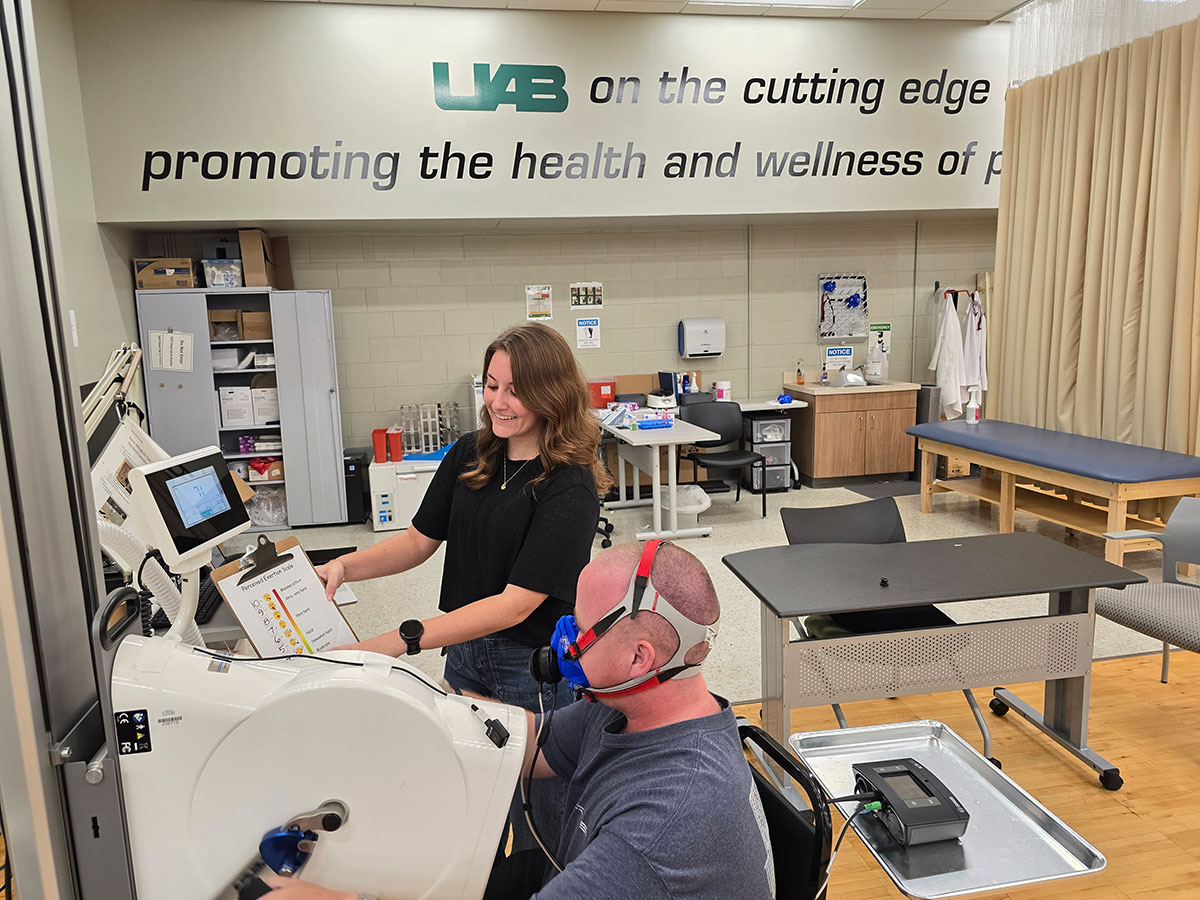
During the first visit, participants will complete a graded arm-bike exercise test, measure their VO2 peak and complete a simulated version of the punch-test assessment.

The arm-bike test provides a quality point of comparison because upper-body exercise is already used in other forms of adapted exercise testing.
The researchers will then examine how performance on the punch test relates to the arm-bike test and oxygen consumption and cardiorespiratory fitness.
The second session will be a virtual visit in which participants will perform the punch test from home through Zoom. The remote aspect is an important feature of the study because transportation is a disproportionate barrier for people with disabilities, especially youth, as families must balance research participation with other demands on the schedule for the entire family.
Wright said the technical aspects of research are important to ensure accessibility through study design, but equally important is the human impact to ensure accessibility in all its meanings.
“She brings true passion, focus and empathy when working with children and their families,” Lai said, referring to Wright’s work with his ongoing research. “In the moment, she is laser-focused on working with the family and their needs.”
Wright couldn’t originally apply for CEDHARS pilot funding because the eligibility was initially limited to faculty, but when the eligibility language was expanded to include staff with a Ph.D. as Co-I, Lai encouraged her to apply.
Although they are now co-investigators on the project she is leading, Wright said she still leans on Lai for guidance with aspects of the research process that are new to her, such as tweaking grant application language and navigating the IRB process.
Wright was particularly motivated to have the project focus on this population because regardless of which of Lai’s studies she has worked on, she “loves working with the kiddos.”
She’s found purpose and fulfillment through design and delivery of protocols in a manner that feels engaging rather than having participants feel like they’re going through physical therapy or testing.
“Ashley has grown immensely over the past few years. She continues to show up, apply herself and remains passionate about her work,” Evancho said. I have no doubt that Ashley will go places.”
For this reason, Wright has been drawn to participant interaction, study design and translating research projects into programs that are actually adopted but remains unsure if she will pursue a Ph.D. and traditional academic career.
“I kind of just want to stay here and help continue to grow our research projects into actual programs that are adopted,” she said.
Regardless of the path she chooses, Lai said he knows she will be successful because of her commitment to the field and drive to see things through.
“Ashley is mentally strong, flexible and persistent, which has allowed her to thrive in research, which is non-structured, constantly evolving, and requires numerous skills,” he said.
In some ways, Wright’s path to Lakeshore Foundation, where the CEDHARS lab resides, began many years before she ever knew research would become her career.
Her parents met at the facility, where her mother worked as an adaptive aquatics coach, and her father served as a maintenance engineer.
Today, Wright sees those influences in her own work.
“I took my dad’s fix-it and solve-the-problem mindset and my mom’s exercise-as-medicine mindset, and I’ve combined them together into my exercise research career,” she said.
From a childhood at the same facilities to an undergraduate internship and now her first grant as a principal investigator, Wright’s career has brought her back to the place where her parents’ paths first crossed – this time in her own work of disability research.