
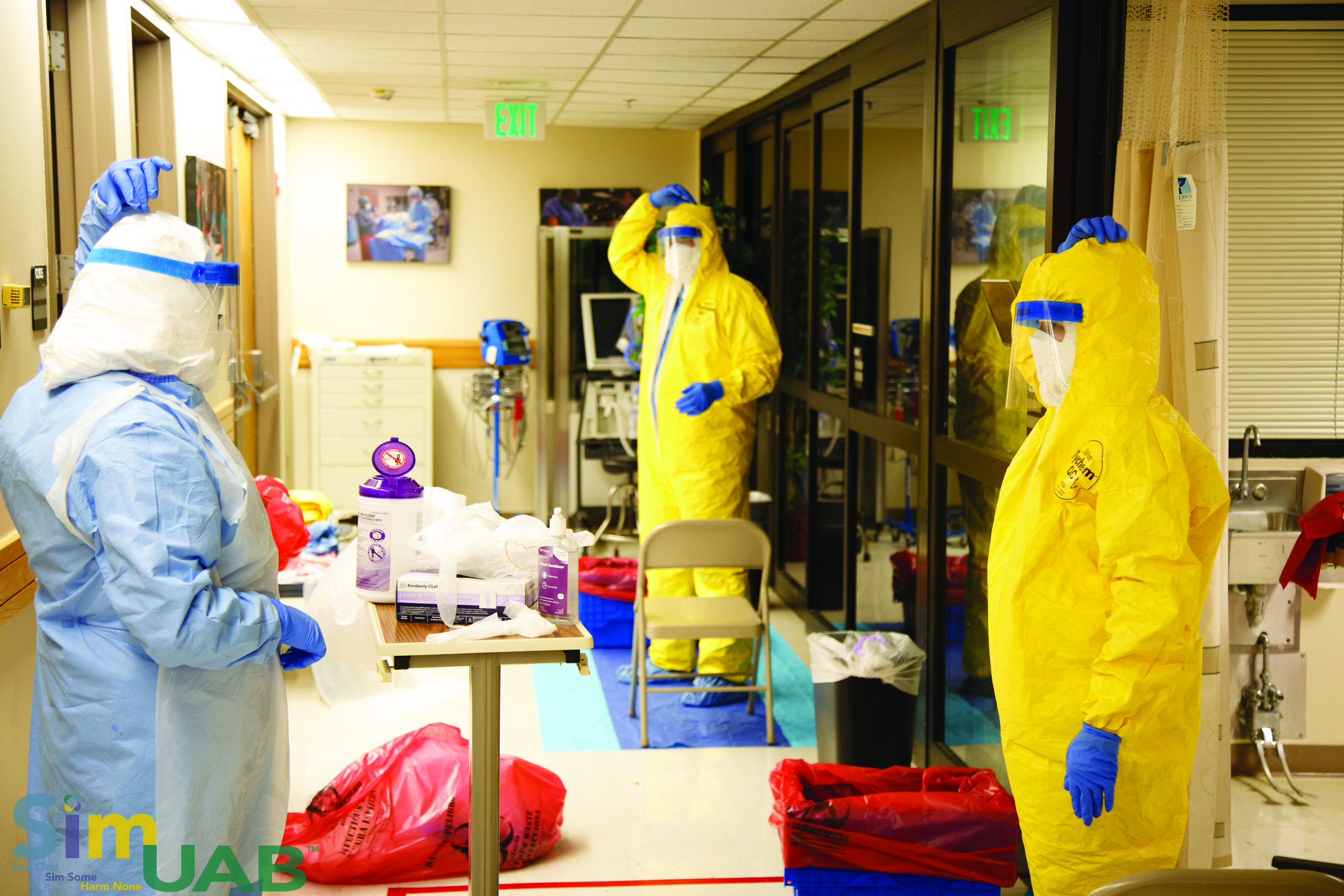
 Participants prepare for a simulation to deliver skills and knowledge to apply what they learn to daily functions and to advance communications. Photo by UAB Office of Interprofessional SimulationJohn Cole - Contributor
johncole@uab.edu
UAB recently received a grant to train local healthcare and public safety workers to respond to potential outbreaks of Ebola or other infectious disease following the 2014 Ebola outbreak.
The new program, led by Lisa McCormick, Ph.D., and Marjorie Lee White, M.D., concentrates on biosafety measures for healthcare and public safety workers in the Deep South, specifically Alabama, Mississippi and the Florida panhandle area.
The budget period for the grant will span three years from June 1, 2016 to May 31, 2019. UAB is the main grantee and subcontracts to two other partners, the Alabama Fire College and the University of Mississippi Medical Center. The primary focus of the two subcontractors will be concerning first responders and healthcare workers in Mississippi, respectively.
In March of 2014, West Africa experienced the largest Ebola outbreak in history, which resulted in multiple countries being affected, according to the CDC’s website. The United States experienced four confirmed laboratory cases, and one death as a result. The following year, Birmingham experienced what was thought to be its first local case, where eight individuals, six of them being first responders were exposed to a patient exhibiting Ebola type symptoms, according to UAB News.
“We want to increase the health care and public safety workforce’s understanding of how infectious diseases are spread in an occupational environment and what measures can be taken to shield workers from potential exposure,” McCormick said in an interview with UAB News. “What our program will do is really target those in healthcare that work in both direct and indirect patient care roles and teach them how to protect themselves from becoming infected if there is another infectious disease outbreak such as Ebola or something easily transmissible from person to person or via bodily fluids.”
The training, which was explained in a powerpoint during the Deep South Biosafety Advisory Board Meeting, will equip healthcare and public safety workers with the skills and knowledge needed to protect themselves from potential exposure to contaminated materials or infected individuals they may encounter. The program aims to deliver training in such a way that participants will be able to apply what they learn to their daily functions, as well as advance communications across healthcare and public safety disciplines and organizations that will lead to better coordination and planning. The goal is to create a team of peer trainers that can further disseminate both awareness, and operations-level knowledge and skills to the workforce.
“I remember being an undergraduate student at Emory University during the Ebola scare and a lot of the student body was concerned about getting Ebola because of how close the CDC and Emory hospitals were to the campus,” Rohan Prabhu, a former public health student at Emory University and current student at the UAB School of Medicine said. “Among the hysteria, it became apparent that many students did not have a good understanding of how the disease is actually transmitted. Having a better understanding of infectious disease and how these diseases can be spread is important for individuals both inside and outside of the healthcare setting and can help stop the spread of communicable diseases.”