
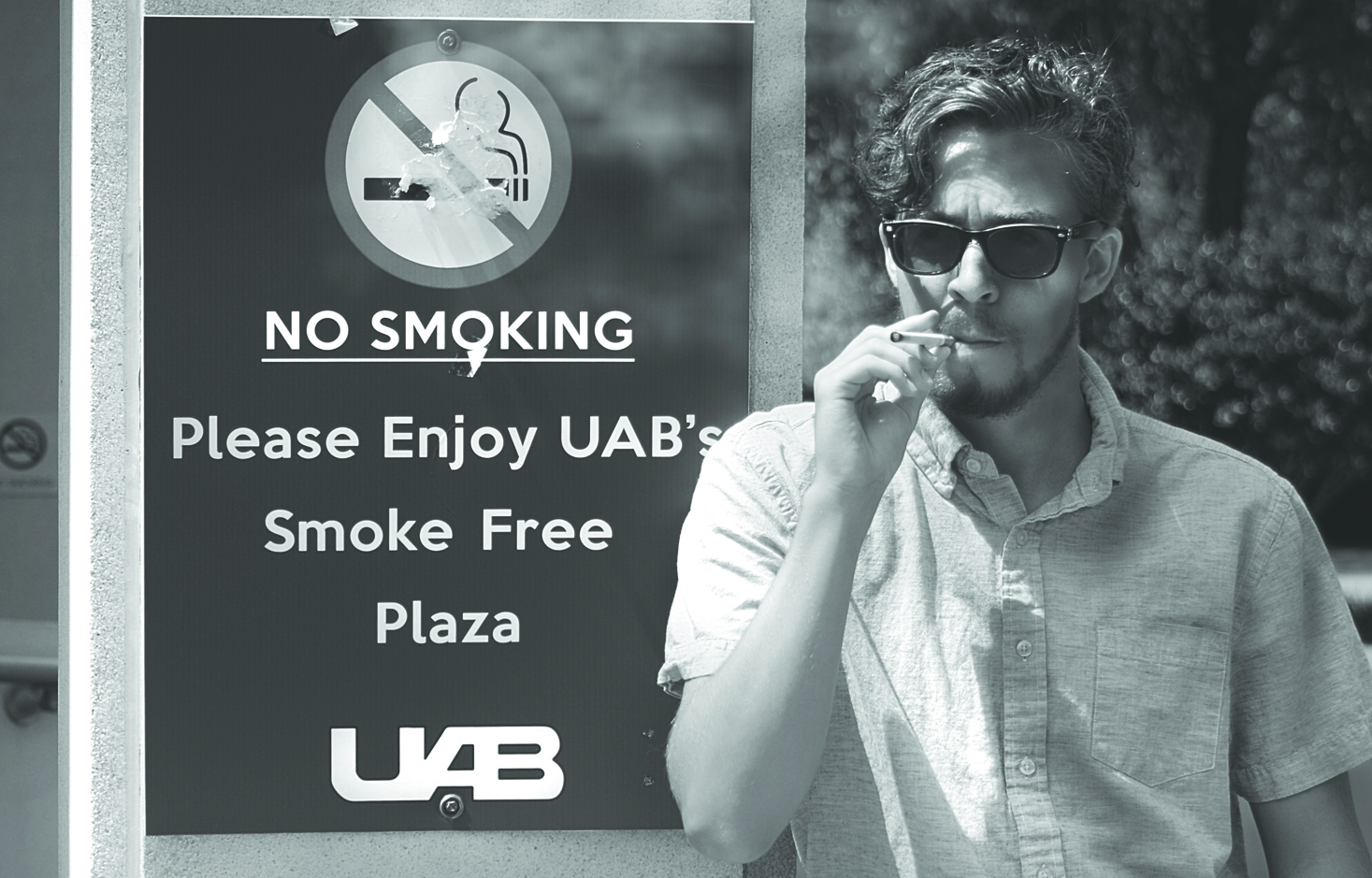
 Photo illustration by Ian Keel
Tessa Case - News Editor
news@insideuab.com
A new taskforce aims to offer support instead of punishment in order to uphold UAB’s non-smoking campus policy, which has been under fire recently due to its perceived failure to be enforced.
In 2015, UAB updated its non-smoking policy to prohibit use of tobacco and smoking-related products, including vaping, within all buildings, facilities, vehicles and spaces that are owned, rented, leased or otherwise controlled by the university, according to official UAB policy. The policy appointed the vice president for Financial Affairs and Administration, Allen Bolton, as the party responsible for procedures to implement this policy, including to visitors. Provost Linda Lucas, Ph.D., is responsible for the implementation of this policy as it relates to students, student organizations and student facilities.
However, Jake Baggott, assistant Vice President of Student Development, Health and Wellness, was appointed this past spring to a new taskforce to address this issue. Baggott said the final composition was still in development, but that the model will follow one of awareness, education and support that he has found to be successful across the 1,500 campuses nationally that are smoke-free.
“It doesn’t need to be confrontational, it needs to be supportive,” Baggott said.
The policy Baggott said that he hopes to create is one that will effectively communicate the policy throughout campus and provide the services necessary in order to eliminate the issue. According to Baggott, programs such as an employee tobacco cessation program will be available, as well as services in the Student Health and Wellness Center.
Though resources are available to help those who are addicted to nicotine, students pointed to the lack of administrative enforcement as the cause for the continuation of smoking on campus.
“I was not aware UAB was a smoke-free campus,” said Connor McDonald, a junior molecular biology student. “And I especially was not aware of any vaping restrictions anywhere on campus.”
McDonald cited the lack of appropriate signs and an apparent disregard for the policy as a source of his confusion.
Zack Carpenter, recent alumnus, and Carolyn Byrd, a current pre-nursing student, saw the courtyard outside of the library as being the least enforced area, despite it having multiple signs placed throughout the premises.
“One time I even asked a guy to stop and he got angry and said, ‘But I smoke here everyday,’” Byrd said.
Public health major Rachel Rice said that although she has seen at least one person smoking in front of a sign that demanded otherwise, she still feels like the policy is necessary to uphold.
“People with asthma and are sensitive to the smell are at a disadvantage otherwise,” Rice said.
Garrett Stephens, who was USGA president when the non-smoking policy was updated to address electronic cigarettes, said that the ban isn’t being enforced because UABPD doesn’t want to write a multitude of tickets.
“The academic departments don’t want the responsibility of enforcing academic punishments if caught, and it’s not the student body’s responsibility to communally enforce and shame people,” Stephens said. “That’s why it’s not enforced.”
Baggott said that students can get involved, though, by helping to create a culture that promotes a tobacco and smoke-free environment. He also said that while enforcement is important, smoking is not a criminal issue — and therefore, not for the police department — and it is an issue of awareness, education and providing services to create the type of environment everyone wants.
“I would definitely like to see some sort of helpful aid, in the form of a pamphlet with advice at the very least,” McDonald said. “The advice could range from information on apps to help you record your progress on quitting to safer alternatives such as nicotine gum. Also having a person that students could go to ask questions and get one on one advice would be helpful.”
Baggott also pointed out that the problem isn’t as rampant as many believe. According to a National College Health Assessment survey conducted by UAB in 2015, 76 percent of students reported never having used tobacco.
“The reality is that it’s closer to 11 percent who use tobacco,” Baggott said. “This is not as big of a problem as people think it is, and research shows that the majority of students prefer a non-smoking environment.”
In 2015, UAB updated its non-smoking policy to prohibit use of tobacco and smoking-related products, including vaping, within all buildings, facilities, vehicles and spaces that are owned, rented, leased or otherwise controlled by the university, according to official UAB policy. The policy appointed the vice president for Financial Affairs and Administration, Allen Bolton, as the party responsible for procedures to implement this policy, including to visitors. Provost Linda Lucas, Ph.D., is responsible for the implementation of this policy as it relates to students, student organizations and student facilities.
However, Jake Baggott, assistant Vice President of Student Development, Health and Wellness, was appointed this past spring to a new taskforce to address this issue. Baggott said the final composition was still in development, but that the model will follow one of awareness, education and support that he has found to be successful across the 1,500 campuses nationally that are smoke-free.
“It doesn’t need to be confrontational, it needs to be supportive,” Baggott said.
The policy Baggott said that he hopes to create is one that will effectively communicate the policy throughout campus and provide the services necessary in order to eliminate the issue. According to Baggott, programs such as an employee tobacco cessation program will be available, as well as services in the Student Health and Wellness Center.
Though resources are available to help those who are addicted to nicotine, students pointed to the lack of administrative enforcement as the cause for the continuation of smoking on campus.
“I was not aware UAB was a smoke-free campus,” said Connor McDonald, a junior molecular biology student. “And I especially was not aware of any vaping restrictions anywhere on campus.”
McDonald cited the lack of appropriate signs and an apparent disregard for the policy as a source of his confusion.
Zack Carpenter, recent alumnus, and Carolyn Byrd, a current pre-nursing student, saw the courtyard outside of the library as being the least enforced area, despite it having multiple signs placed throughout the premises.
“One time I even asked a guy to stop and he got angry and said, ‘But I smoke here everyday,’” Byrd said.
Public health major Rachel Rice said that although she has seen at least one person smoking in front of a sign that demanded otherwise, she still feels like the policy is necessary to uphold.
“People with asthma and are sensitive to the smell are at a disadvantage otherwise,” Rice said.
Garrett Stephens, who was USGA president when the non-smoking policy was updated to address electronic cigarettes, said that the ban isn’t being enforced because UABPD doesn’t want to write a multitude of tickets.
“The academic departments don’t want the responsibility of enforcing academic punishments if caught, and it’s not the student body’s responsibility to communally enforce and shame people,” Stephens said. “That’s why it’s not enforced.”
Baggott said that students can get involved, though, by helping to create a culture that promotes a tobacco and smoke-free environment. He also said that while enforcement is important, smoking is not a criminal issue — and therefore, not for the police department — and it is an issue of awareness, education and providing services to create the type of environment everyone wants.
“I would definitely like to see some sort of helpful aid, in the form of a pamphlet with advice at the very least,” McDonald said. “The advice could range from information on apps to help you record your progress on quitting to safer alternatives such as nicotine gum. Also having a person that students could go to ask questions and get one on one advice would be helpful.”
Baggott also pointed out that the problem isn’t as rampant as many believe. According to a National College Health Assessment survey conducted by UAB in 2015, 76 percent of students reported never having used tobacco.
“The reality is that it’s closer to 11 percent who use tobacco,” Baggott said. “This is not as big of a problem as people think it is, and research shows that the majority of students prefer a non-smoking environment.”